Annotating The New Union Club: A Case Study on Critical Praxis for Digital Art Histories
by Temi OdumosuTemi Odumosu is an art historian and curator at the University of Washington Information School. Her scholarship involves Afro-diasporic memory work, interrogating the visual politics and legacies of colonialism, and paying particular attention to how collections steward historical artifacts, physically and virtually online. Her publications include “The Crying Child: On Colonial Archives, Digitisation, and Ethics of Care in the Cultural Commons” (2020) and “Approaching Colonial Photographs with Care” (2024) for the project Digital Benin. Through cultural practice, Odumosu develops collaborative interventions with contemporary artists, designers, and curators that are focused on repair. Examples of this work include the sound installation What Lies Unspoken: Sounding the Colonial Archive (2017) at the Royal Danish Library and Statens Museum for Kunst in Copenhagen, Denmark; and the exhibitions Threshold(s) (2019) at the Center for Art on Migration Politics in Copenhagen, and The Dream Keeper: Cecilia Germain (2021) at Botkyrka Konstall in Stockholm, Sweden.
Email the author: todumosu[at]uw.edu
Citation: Temi Odumosu, with David Schwittek, “Annotating The New Union Club: A Case Study on Critical Praxis for Digital Art Histories,” Nineteenth-Century Art Worldwide 24, no. 2 (Summer 2025), https://doi.org/10.29411/ncaw.2025.24.2.2.
This work is licensed under a Creative Commons Attribution-NonCommercial 4.0 International License  unless otherwise noted.
Your browser will either open the file, download it to a folder, or display a dialog with options.
Scholarly Article|Curator’s Welcome|Explore the Print |Project Narrative
Introduction: Ethical Reflexivity
As internet users increasingly encounter colonial artworks amid the unending stream of digital content sharing, important questions arise about how to navigate engagement with these images, particularly when they are fraught with representational issues. Given that artworks and other cultural documents are often accessed as reproductions in virtual form before being seen in a physical space, the safeguards and communication strategies involved in traditional curation need to expand. With this in mind, it seems pertinent to ask the following questions: Can a digital environment or collection be designed in ways that engage users with multiple artwork interpretations and make space for critique? Are there limits to, and unintended consequences for, virtual image exposure? Online, what is important to show and to tell? This article is one dimension of a digital art history project using annotation as a curatorial method for critical engagement, artwork analysis, and information discovery. The focus is on The New Union Club (1819), a provocative British political caricature on antislavery made by George Cruikshank (1792–1878) and Frederick Marryat (1792–1848) in London. Unique and expensive even for its time, the print dramatizes a philanthropic dinner featuring recognizable abolitionists and animated Black characters—some known, some invented—but it also contains racist imagery deemed unacceptable today. Readily available and shared freely by international museum and library digital collections, the artwork’s unfiltered online presence as a historical record has allowed it to evade the content-moderation standards and scrutiny that have previously led to the removal of similar materials on social media platforms. While it can be argued that prints such as this are predecessors to the tweets, memes, and satiric blog posts that shape public opinion both on and offline today, some new questions for art history are unfolding here concerning the availability and mobility of digitized artworks with problematic subjects, which until recently were only possible to see in print rooms, private galleries, or museum storage.
As far as we know, The New Union Club is unique as the only British artwork of its kind before the twentieth century to produce a combined record of at least seven (and potentially nine) identifiable people of African descent, from both sides of the Atlantic, in a manner that we could tentatively describe as a community. The challenge is that such a generative reading seems untenable when faced with the history of condescension and stereotypes that have predetermined interpretation and cataloging of this artwork—at first as an idiosyncratically British cultural object of interest and later as an intolerably racist image to be kept in special collections. When viewing such a troubling artwork that uses stereotyped Black bodies intentionally to belabor and exhaust the visual field,[1] it is pertinent to ask: What more, if anything, is there left to say? The opportunity to think again about an artwork I have been involved with for years builds on a recent podcast conversation I joined during spring of 2023. In episode 6 of the BP2 Podcast I was invited by historian and cultural producer Michael Ohajuru to discuss the representation of Black Londoner and street celebrity William “Billy” Waters (ca. 1770s–1823) with historians Gretchen Gerzina and S. I. Martin. In this conversation, we explored The New Union Club as one of several artworks featuring Waters, in addition to other records documenting his life—albeit from third-person perspectives comprised almost exclusively of British men. We thought through the ways colonial documents have been interrogated over the last fifty-plus years to reveal hidden histories, and how the “Black image” can be alluring and affirming for us in the present and yet very often distort the realities of lived experience. For example, Waters was a street performer in part because of a leg amputation he endured after a serious accident while working at sea, but the cultural archive turns this disability into a visual trope—a point of recognition in the recovery of an urban legend. Keeping this in mind, the podcast gathering also provided us with an opportunity to imagine other possibilities for transforming the terms of remembrance in the wider context of British history. Out of these discussions, an idea emerged: What if we could create a website where the different characters in The New Union Club were highlighted with labels and their details could be explored more closely?
This article and the accompanying interactive feature are layered responses to this invitation, which is ultimately a call to make The New Union Club (hereafter the NUC) more accessible online. I use a cross-disciplinary approach to thinking about representation, recordkeeping, and description to better understand how the NUC has been made legible as a cultural asset and to consider what it offers the larger endeavor to recuperate Black Atlantic presences and experiences from the documents of art history. Including fieldnotes and reflections from my own research processes over the years, this inquiry is developed from the standpoint of ethical reflexivity, meaning writing that is attentive to absences, erasures, and places where harm is possible in the very act of knowledge creation. One of the propositions I make in this text is that to do the work of digital curation, we must approach the NUC differently, moving beyond its basic interpretation as “a satire on [William] Wilberforce and the Antislavery movement,” as described by cataloguers in 1911 and generally repeated across the years.[2] Instead, drawing inspiration from decades of research and cultural activity revealing the long historical presence of African descendants in Britain specifically, the aim here is to reclassify or reorient the NUC in two ways. First, I am asserting it as a document of conscience—affectively charged, instructional, ethically provocative, and somewhat forensic.[3] Much the way sites of conscience serve as reminders of traumatic pasts that should not be repeated, this artwork-as-document is evidence of ideological and aesthetic extremes that must be faced as historical examples, for the safeguarding of culture. Second, I approach the NUC, in its iteration as a virtual project, as a Digital Black Atlantic record, which is to say as an existing artwork or document that operates as a citation for identifying African-diasporic presence and cultural production. In this sense, the digitized version of the artwork shown in the interactive feature as well as in multiple museum and library collections operates as a surrogate “at the nexus of digital methods and cultures and African diasporic peoples and cultures,” as it is necessarily entangled with questions of race, class, colonialism, empire, and technology.[4] This recent theorization of the Digital Black Atlantic by Kelly Baker Josephs and Roopika Risam, which complicates and expands the original term coined by Paul Gilroy, offers a supportive rubric for thinking through colonial artwork sharing, interpretation, and interaction online.
It is important to state that a curatorial reclassification of an artwork’s status, for the purposes of this writing and project, is a corrective gesture for analytical framing but not an attempt to revise the artwork itself. The NUC already connects African subjects from London, Boston, and Haiti and is internally networked with references to other texts, symbols, and artworks that undergird the genre’s distinctive mode of visual communication. Simply put, caricatures of this kind are always images about other images across time and in transatlantic space. However, it is in the act of reading through and against the graphic ferocity of the NUC—in following its embedded references and seeing where they lead—that we gain momentary access to the lives of African descendants who practiced freedom and asserted subjectivity in ways that challenge the conceptual bondage the print seeks to enact.[5] Shifting the resolution of foreground and background in this way, I both problematize and extend Marcus Wood’s assertion that despite the ways Black figures are represented in the NUC, the collective is still “strangely empowered” and should be taken seriously.[6]
At the same time, the obvious ethical implications of reexamining the artwork as a visual text in a virtual setting cannot be ignored. Several early discussions of the project with journal editors and the designer Dave Schwittek concerning different approaches to sharing the NUC on a web platform only reinforced how the act of reproduction in one way or another asserts the print’s hegemony as a way of seeing. The user-experience (UX) features and sensitive content filters in the interactive feature were precisely designed to disrupt easy viewing and image consumption. And yet, as a team, we often returned to ambivalent postures when, for example, our decision to ensure the image was not downloadable in this setting met with the reality that screen captures are always possible. The process of curating or designing for this difficult artwork made clear that our work of annotation—texts and other images attached to points on a screen-based visual plane—may be “a production outside, yet also and always tethered to, a text.”[7] As a former caricature scholar who spent many years distancing themselves from this material, I was forced to accept that my own involvement with, or “tethering to,” this artwork had already happened by way of sustained research.[8] Thus, the methodological questions embedded in this project have been focused on articulation—how to write and curate specialized commentary or descriptions that encourage independent discovery of an artwork and yet are sensitive to the very real possibility of causing distress as a result of that process.
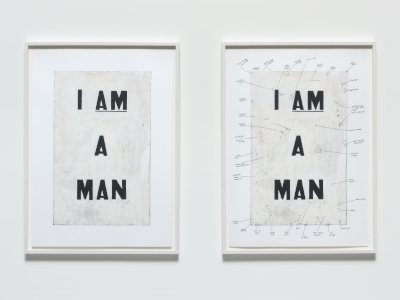
One approach to communication we have been committed to in this work is to make plain how our viewing of such an image is a discursive activity that is continuously being renegotiated. This is a strategy used in contemporary artworks such as Meleko Mokgozi’s Modern Art: The Root of African Savages, Addendum (2015) and Glenn Ligon’s Condition Report (2000), which in different ways use handwritten annotations for resignification.[9] Mokgozi’s correctives of Metropolitan Museum of Art labels, and Ligon’s notes on an aging artwork (fig. 1)—“scattered brown droplets” and “loss at edge”—are responses to, and indications of, the material and epistemological conditions under which African art and Black artists are made visible in Western art history. Their notations also unsettle the authority of reference texts/works that were authenticated by scholars and curators as masters or originals. In this article I think alongside the side notes, refusals, and redactions of these and other artists, to encourage a form of writing that shows rather than hides the tentative negotiations involved in chronicling African-diasporic life through the lopsided records in museum and archive collections. Practically, this means that crafting this article has involved moving through interpretive layers in different tones of voice, from formal to exploratory; it means that I reference images that are not reproduced due to their overly graphic nature, and conversely, that I do reproduce some outdated and offensive historical language but with editorial interventions such as strikethroughs and asterisks replacing letters. In the spirit of tenacious refusal, in the article and interactive feature I also choose not to rearticulate visual stereotypes or explain tropes concerning anonymized Black women if such descriptions are unable to transform viewing or reading of the NUC as historical social commentary. These are all imperfect but necessary decisions made to enact new possibilities for critically engaged descriptive and analytical work.
A Formal Context of Creation
Polemical artworks such as The New Union Club need contextualization, not only for the sake of art historical due diligence but also because digitization so often enacts violent orphaning of knowledge—people, places, relations, accountabilities. Thus, I begin formally with the “how” and the “why” of this print, using refreshed eyes after almost a decade away from proper engagement with it. What do we need to know? As a source of political media made amid debates on antislavery in Britain, the NUC draws on almost forty years of humorous visual communication in caricature to assert the view that antislavery proselytizing about the welfare of Africans was naive, shortsighted, and self-serving and thus was a distraction from the legitimate needs of the British. This pointed visual critique of antislavery as disloyalty expressed the outrage and rhetorical fervor of the proslavery lobby (known as the “West India interest”), which was not only economically influential but also vocal in its contempt for efforts to completely end the institution of slavery following its abolition in 1807. It is important to remember that the mainstream British abolitionist movement began in the late eighteenth century with a strong appeal to Christian and humanitarian values, exemplified by the founding in 1787 of the Society for Effecting the Abolition of the Slave Trade. The society utilized pamphlets, speeches, and public petitions, and produced a memorable set of persuasive images to document the horrors of the slave trade and to reinforce African humanity.[10] Leading advocates like Granville Sharpe and William Wilberforce played a crucial role in government and legal quarters, while Quakers, evangelicals, and other religiously motivated members played a role in civil society. Influential African writers, such as Olaudah Equiano (ca. 1745‒97), Quobna Ottobah Cuguano (life dates unknown), and Phyllis Wheatley (ca. 1753–84), who had all experienced enslavement, were uplifted in publishing, to further advocate for the moral imperative of abolition. This did not mean that British abolition was exempt from anti-Black bias and paternalistic rhetoric; those prejudices existed. But the assertive view of upholding fundamental human rights and Christian dignity propelled the movement toward its goals of legal parliamentary reforms.
However, during the intense periods of revolution in France and Haiti, particularly from 1791 to 1804, the movement was stalled and faced backlash, with proslavery lobbyists branding abolitionists as Jacobins and radicals. So, lobbyists waited, then slowly resumed their advocacy with the public, losing several attempts to pass government legislation against slavery. By 1807, when Parliament passed the Abolition of the Slave Trade Act that prohibited buying and selling enslaved people in the British Empire, the abolitionists were already espousing a more conservative model of gradual emancipation for enslaved Africans in the Caribbean. Still, they encountered fierce resistance from West Indian planters, who derided their efforts and perpetuated negative stereotypes of Africans, in part as a strategy to contain influences that could foment further insurrections across the Caribbean.[11] This tension culminated in cultural infighting characterized by pamphleteering and comic images that mocked abolitionists for their multiple reform agendas. Of particular concern to the proslavery lobby was restrictive legislation that they believed meddled in private economic affairs, like the Slave Registry Bill of 1815, which prevented illegal movement of enslaved people using detailed data and recordkeeping about births, deaths, and manumissions.[12] There was also palpable fear, disguised as contempt, about Haiti as a new, self-governing Black republic forged through radical acts of decolonization, and its commanding monarch, King Henri Christophe (1767–1820), who was actively engaged in international alliance building with leaders in Europe and abolitionists in Britain. As social reformers, Wilberforce, Thomas Clarkson (1760–1846), Zacharay Macaulay (1768–1838), and others saw in Haiti an opportunity to revive plans for Black resettlement outside of Britain. Between 1787 and 1792, they had previously tried and failed in their establishment of the “Province of Freedom” in Sierra Leone, identified as a place for resettlement of London’s poor Black community and other freed people from the Caribbean and Nova Scotia.[13] Although that initial settlement was largely unsuccessful, further attempts to stabilize, populate, and promote this model African colony continued.[14] Now that the abolitionists had direct contact with Christophe as a compelling leader, Haiti was being promoted as a new alternative for formerly enslaved people and other African descendants in the diaspora. But reactionary commentators dismissed abolitionist plans to encourage Black self-determination and characterized Christophe specifically as vain and despotic, criticizing his extravagance and his attachments to ceremonial pomp and drawing attention to sanctioned violence within the republic.
One of the loudest proslavery voices was the slaveholding member of Parliament and colonial agent Joseph Marryat (1757–1824), who abhorred what he called “modern philanthropy” of a “spurious and inverted cast,” which he considered to be “out of nature, a circumference without a centre.”[15] In a pamphlet bearing a long title that began with More Thoughts (1816), he lambasted the antislavery movement once again and further turned his critique toward a dinner held by an associated social-reform organization called the African and Asiatic Society, whose remit was addressing urban poverty.[16] He had noticed a short advertisement for the event in the Morning Chronicle newspaper on March 20, 1816, which named several high-profile abolitionists as stewards for tickets and ended with a curious statement that “a number of Africans and Asiatics are expected to dine in an adjoining room.”[17] Learning about what took place from a person who had attended, and being disturbed by what he heard, Marryat produced a detailed description of the event—based entirely on hearsay but expressed with firsthand authority—and unleashed his vitriol on the whole affair. This became the inspiration and reference for the NUC.
Marryat’s text was transformed into an image through a familial connection. His son Frederick spent most of his early life in the navy but also developed a side interest in caricaturing that became an income generator when he settled on shore and was introduced to bohemian artistic circles in London. During 1818 and 1819, Frederick brought several of his designs to be reworked and upgraded by Cruikshank, then regarded as London’s leading caricaturist after James Gillray (1756–1815).[18] The NUC exemplifies the creative synergy between the two men, who shared an interest in social commentary and admired each other as professionals. Drawing inspiration from the satirical tradition of mocking excess and debauchery, their work together paid direct homage to earlier successful caricaturists such as Thomas Rowlandson (1757–1827), Isaac Cruikshank (1764–1811), and Gillray, who was renowned for his biting parodic depictions of political figures. Gillray is important to highlight here for two reasons. First, in 1801 he produced a satiric etching on the Act of Union with Ireland, called The Union-Club, which was a dinner scene showing the Prince of Wales and Whig politicians commiserating about the incorporation of Ireland into the United Kingdom of Great Britain (fig. 2).[19] The direct visual reference, and extension of the concept of cross-cultural influence, show how Marryat and Cruikshank were communicating to and within the genre of graphic satire, and specifically political caricature. Second, Gillray was one of few artists who produced some of the most candid and influential caricatures on the topic of slavery, from various perspectives and with notorious incision. Notably, he dressed down the pretentions of abolitionist sainthood in Philanthropic Consolations (1796), the royal lip service paid to the abolitionist movement in Anti-saccharites, or, John Bull and His Family Leaving Off the Use of Sugar (1792) (fig. 3), and princely colonial debauchery in Wouski (1788). He also depicted Caribbean atrocities, in a non-humorous way, in Barbarities in the West Indias (1791).[20]
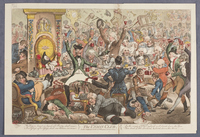
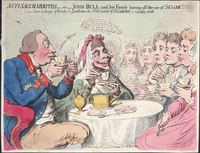
Together, Cruikshank and Marryat further developed typologies circulating within this controversial image world, and they partnered on naval and colonial-themed prints characterized by coarse and highly racialized humor. But the NUC is unlike anything they had produced before, either in scale, technique, or narrative scope. Even in their borrowed visual references from Gillray’s print of 1801, what emerges between them is something perceptibly unbound—intentionally prolific, with a graphic force—that has been unmatched since within the genre of political caricature.
Descriptive Standards, Foregrounds, and Backgrounds
I first encountered The New Union Club physically in 2006, at the British Museum, as the result of consulting chunky catalogues organizing social and political caricatures and further learning about the genre through conversations with esteemed curator and print scholar Sheila O’Connell. In the print study room, where visitors were required to wash their hands before entry and only pencils were allowed, the quietness of a few other researchers peering at historical treasures was palpable. The NUC, although not in the same league as the drawings by Rembrandt van Rijn (1606–69), Albrecht Dürer (1471–1528), or Leonardo da Vinci (1452–1519) held in the same collection, was similarly catalogued, archived, and properly protected. In retrospect, my research was uniquely located on the timeline of internet and social media growth, since it coincided with transformations in the field of collections management specifically. Within a year of my need to consult this print in person, the museum had launched a Collections Online feature on its website, allowing for open access to many of its records and making a significant portion of its historical collections searchable and viewable/readable from afar.[21] For a museum located at great distance from many who wished to use its collections, metadata mattered and keywords were essential, and a history of cataloguing was now being aggregated and unified to support public queries. Keeping in mind this bridging effort between physical artworks and surrogate digital images, I first want to consider the NUC as a cultural asset that has been problematically described and conveyed across different information systems, as a result of and in spite of its context of creation. This will specifically assess how language has already framed and predetermined engagement with reproductions of this artwork, from illustrations in catalogues to digital JPEGs floating around on Reddit and Wikimedia. The question at stake here is: Can curation adjust or intervene in this long history of signification? Counterintuitively, I begin in the present, with the help of artificial intelligence (AI).
In a recent conversation with the SuperBot AI tool, I asked the model to automatically generate a descriptive paragraph of alt text (alternative text) for the colored version of the NUC image file, which I downloaded from the British Museum’s website and then shared with the system. Alt text is a necessary component of accessibility standards on digital platforms, which enable content discovery through screen readers and other assistive technologies. This descriptive practice can also be considered a form of cataloguing that influences how images are shared and understood algorithmically in the wider internet, and it further supports authentic portrayals of appearance for visually impaired systems users.[22] However, automated alt text relies on image recognition by technologies that have been beset with problems when faced with identifying dark-skinned subjects, specifically Black people.[23] For example, one of Google Photos’ early attempts at automated image classification using a training database called ImageNet in 2015 resulted in Black software engineer Jacky Alcine having their private photographs mislabeled by the system as “Gorillas.”[24] Algorithmic-justice advocate and code poet Joy Buolamwini has similarly researched problems of what she calls a “coded gaze,” in which technologies imbibe human biases and statistical norms developed for white, male bodies. These discriminatory designs have enacted a spectrum of harms, whether they be unresponsive soap dispensers, wearable technologies that misread biodata, or surveillance cameras that misrecognize unsuspecting individuals as social threats.[25] Alexander Monea succinctly explains the tensions involved when race meets computer vision—resonating with the art historical work of intersectional curation—by noting that “the most frequent response to criticism of algorithmic racialization is to make race invisible. Rendering blackness invisible is always the flipside of the coin, in dialectical tension with racial hypervisibility. Both options are unsatisfactory, as they both provide safe haven for racism, albeit in different ways.”[26]
Bias is to be expected with computational interactions, so approaching a large language model (LLM) for assistance was risky. However, when I prompted the SuperBot AI tool on November 17, 2024, it provided the following alt text in under ten seconds:
A satirical hand-colored etching titled “The New Union Club,” depicting a chaotic and crowded scene of a dinner party. The central focus is a Black man in a light-yellow waistcoat giving a speech from a raised platform. The room is filled with a diverse mix of people, many Black, engaged in boisterous activity; some are dancing, others are eating and drinking, and some are involved in a scuffle on the floor. The walls are adorned with smaller pictures illustrating various scenes, likely satirical commentary accompanying the main image. The overall style is exaggerated and caricaturish, suggesting social commentary on race and class. The etching is dated and attributed to George Cruikshank.[27]
Taken aback by the model’s interpretive engagement with the image file, beyond the kind of didactic, distant reading we might imagine from basic content recognition in computer vision, I further inquired how this description had come into being. The bot explained that the description was composed using several sources of information that included direct image analysis in combination with title and captions, contextual information through artist recognition, and historical information about nineteenth-century British society extracted from its extensive training data. It also approximated the presence of seventy to eighty individuals in the print, although it cautioned that this was an estimation that should be verified through closer analysis. Finally, when I inquired about what it understood to be some of the tensions or issues involved in reproducing the image online, the bot detailed concerns about racial stereotyping and potential sensitivities for contemporary audiences. It further asserted the necessity for careful contextualization of the image as a safeguard against misrepresentation and distortion—an ethics it had already practiced when crafting its own version of alt text.
While the question of how a computational model “knows” is not the central concern of this article, my inquiry was one of several strategies I employ as I engage in critical practice and do the work of historical comparison in order to understand an artwork’s interpretative potential as both a physical and digital historical record. From the perspective of this project, it is also important to understand the different impressions offered by the NUC, on the one hand when seen at first glance in a digital environment and on the other after a viewer engages with the work for a more extended period of time.[28] The computer’s networked-surface scan naturally centers the Black subject as a focal point, based on the composition of the figures as a whole and the visibility of all the other characters represented, but it does so in ways that interestingly shift meaning away from some of the historical analysis conducted by human interpretation. In this interaction the evident question becomes: Who is the man at the center of this image? Concerns around language in the computational model’s articulation are also critical. Unlike many aesthetic judgments (including my own) made in prior descriptions of this print, the SuperBot does not select negative adjectives such as “grotesque,” “hideous,” or “unruly” to underscore the intensities of the image. Instead, it uses the word “boisterous” to describe the general activity of the figures, and “exaggerated and caricaturish” to describe the overall style of the image, thereby avoiding possible racial stereotyping.
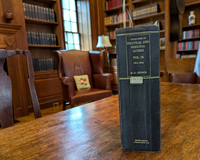
The issue of naming, labeling, and categorizing the NUC as a cultural artifact is both a driving motivator for this project and discussion and an important consideration for institutions as their collections begin to inform much larger information systems such as large language models (LLMs). But the terms of reference used in the past and today are also indicators of the specific values that inform concerted efforts to graciously reckon with history. Until historian Mary Dorothy George extensively catalogued the NUC in 1949—over three pages in volume 9 of the authoritative reference text Catalogue of Political and Personal Satires Preserved in the Department of Prints and Drawings in the British Museum—contextualization and description of the artwork was limited (fig. 4).[29] Writing in summary about the NUC in an article on the early work of Cruikshank in 1887, Harry Thornber notes that the print depicts “an anti-slavery meeting, which is of a most lively description, the bulk of those assembled being n******,” and further concludes that the print is “the most important of George’s early caricatures. It is one of the largest, and contains a vast amount of work. It is not only a very scarce, but a very valuable one. Indeed, I believe it is the most valuable.”[30] When the print appeared as a highlighted work from Minto Wilson’s collection in an exhibition at the Burlington Fine Arts Club in 1932, a feature in The Graphic weekly newspaper included a half-page reproduction, explaining that the work “is considered George Cruikshank’s best caricature. It represents [William] Wilberforce, champion of the American n**** slaves, in the chair at a meeting of the Anti-slavery society.”[31]
George’s catalogue of the British Museum’s collection was intended as the “master reference” for caricatures globally. Thus, she situated her own analysis in wider political and artistic contexts, explaining many obscure references that would not have been possible to decode without her scholarly rigor. However, throughout her writing on caricature, she used examples of racist language as “objective” descriptors (as a natural language). She also reinforced invisibilities in the NUC specifically by focusing only on its representation of the Black Londoner Billy Waters, when in fact he was one of several known and nameable Black subjects represented; this was likely because he appeared as a recurring figure in several other caricatures and print-culture images owned by the museum that depicted street life in London. George’s inclusion of the NUC under her invented subject heading “Negroes” also set a descriptive standard for the identification of artworks that has haunted subsequent research queries and curatorial practice—so much so that when digital humanities scholar James Baker produced the prototype AI bot called simGeorge to automate descriptions “in the voice” of George, based on her prolific catalogues, the quirks of her outdated language surfaced as prejudicial outcomes.[32]
Controlled racist vocabularies are a disciplining technology for stories and represented subjects that determine how curators, researchers, and everyday internet users think about themselves, other people, and history’s place in the present. This was the pertinent point made by librarian and activist cataloguer Sanford Berman, who in 1968 looked in disbelief at the Library of Congress subject headings from his research post at the University of Zambia and noticed the biased imperial logics playing out in this foundational knowledge-organization system. In his book Prejudices and Antipathies (1971),[33] Berman enacted a corrective practice of critical cataloguing that has since become a touchpoint for practitioners and institutions wanting to make the search for information more inclusive.[34] For example, Words Matter (2018), the pocket guide compiled by the National Museum of World Cultures in the Netherlands, outlines issues around language for ethnographic museums that have inherited colonial epistemologies, showing how the ecosystem is replete with outdated, oppressive, and (yet) embedded titles, labels, descriptors, and even areas of specialization.[35] The contributors to this guide necessarily confront the ambivalence (in institutions and in society) around changing or updating records. They recognize the fear of erasing what has come before while also asserting the need to take seriously different points of view. Catalogues haunted by prejudice and imbalances of power can trigger emotions. In 2016, an uncomfortable public discourse ensued after the Statens Museum for Kunst in Copenhagen swiftly changed the titles of historical artworks containing the N-word, in response to postcolonial revaluations emerging in the cultural heritage sector. The museum’s staff did not anticipate the general public’s less supportive reactions, which were indicative of unresolved debates about social equity and intolerance in the wider culture.[36] Similar struggles to initiate an ethics of care by updating outdated terminology in the naming of artworks unfolded in the Eastman Johnson Catalogue Raisonné project discussed in this journal.[37] And the discourse continued in a recent exhibition at the American Folk Art Museum titled Unnamed Figures: Black Presence and Absence in the Early American North (2023–24), where the effects of archival silences, stereotypes, and racialized social hierarchies tangibly impacted every aspect of the artwork encountered while visiting the exhibition. From the absence of names to the imbalanced information provided in the discovery of lesser-known histories, the whole experience of engaging the “unnamed” or “unknown” ultimately revealed how structural and disciplinary investments in one mode of seeing the past have contributed to uneven storytelling.[38]
In 2007, during the bicentenary of the Abolition of the Slave Trade act in Britain, the cultural heritage sector reconsidered the way it told stories in its collections.[39] As part of this effort, the National Maritime Museum in London included the NUC in its exhibition on slavery, having purchased it as one of several artifacts formerly part of the Michael Graham-Stewart collection. After over half a century of the image’s dominant narrative described as the activities of spurned abolitionists and a single Black Londoner, the museum finally recatalogued the print in Representing Slavery (2007), the book published to accompany the exhibition. In this rewriting and updating of George’s text, the curators began by asserting that “[t]his is one of the most racist and complex prints of the nineteenth century” and continued by delineating the racial stereotypes represented, explaining how the abolitionists “find themselves entirely out of their depth.”[40] They similarly signaled the presence of Waters, and added one more identification, naming the image’s central figure as the radical preacher and activist Robert Wedderburn (1762–ca. 1834)—although without explaining how this new identification was made. Since then, there has been no detailed attempt to rewrite this description for other collections, with several institutions quoting verbatim or citing the National Maritime Museum’s text as the definitive reference.
Grappling with this multifaceted information ecosystem, this project’s interactive feature presents an opportunity to interact with the print and its embedded references through highlighted details that include concepts as well as people, and, furthermore, includes links to a wider constellation of associated objects, artworks, and documents. We insert, rather than attempt to reconcile, the ambiguities surrounding the identity of the central figure, while also spotlighting other important people who continue to be obscured and thus are less known.
Conversing with a Difficult Image
Dinner at the Freemasons Tavern in London, for influential friends, has turned into a technicolor fiasco on paper.
On the left, William Wilberforce, a man considered to be the “great liberator” of African people, is depicted giving a toast to honor King Henri of Haiti, but he is doing so from a children’s chair that doubles as a commode.
Scanning the scene, several guests—all respected men of the “Clapham sect” who have furthered the cause of abolition—are distracted by the attention of large Black women.
Perhaps we are looking at African Sal, or Mrs. Lowes from Upper Charlotte Street, or Black Harriot from King’s Place, or Black Moll from Hedge Lane, who are all possible contenders for the figures we see here, yet we do not know for sure.
These women are unnamed by the print’s makers and seem instead to belong to a history of unforgiving images; more infuriating reworkings of the “Sable Venus.”
That said, unlike their male counterparts they are the only ones who are speaking.
Come to think of it, these invented Black female characters are always given something to say.
Where do they reside in the British male imagination?
So many visual stories, folded into and over each other and leading us astray, with religious undertones (or overtones) everywhere.
Look at the interracial couple, a Black man and a white woman wearing a rosary, who present their petrified, bicolored baby to the viewer.
Perhaps this child is evidence of rule breaking or unreconciled border crossing, or perhaps they offer another visual cue for how we are supposed to read this image.
In two halves, each with its own actors and message.
Or perhaps, as an inversion.
Flipped scripts.
A Black man in a fine suit is standing on the dinner table with his arms raised and mouth open, as if giving a speech, and yet there are no words pictured coming out of his mouth.
Curators have been saying that he is the radical activist Robert Wedderburn, and it makes sense because he was known for inciting revolt against all kinds of oppression.
But I cannot say for sure without a reference. Where is the basis for this identification?
Is this image one of Black revolt?
There is at least one person focusing on the central figure’s silent speech, but in their attentiveness their hair is being set on fire.
These artists are correct: conversion inevitably comes with pain.
Another Black man, seated at the table, is smoking a cigar. He is named by a paper attached to his blue frockcoat—“Prince Saunder ABC Black letter”—and seems to be enjoying what is going on.
All over in this vibrant scene, people young and old cavort and fight, gorge on food, puke and make music—quintessentially human endeavors.
Even the framed images hanging on the wall in the background appear to be in motion—animated, topical, referential.
And the Black London celebrity Billy Waters—the one I have seen before in ceramics and penny broadsides and illustrated books and in so many museum exhibitions—is playing his violin to serenade the scene.
But what is this tune?
Although I cannot quite believe my eyes that such an image exists—that an event like this could have happened—there is also something alluring about the force with which these characters are brought to life. I want to look away from this print because the images are too strong, too demeaning, too controlling,[41] and yet there is an opposing urge to read, to witness, to zoom in, to scrutinize. In the silence that contradicts the evident noise in this imagined place, we find voices and experiences visualized.
* * * * * * *
The New Union Club is an undeniably loaded comic artwork that is difficult to describe in general terms from a scholarly, or even computational, distance. My staggered, partial attempt above is a reworking with different moments of emphasis, but doing this still feels unsatisfactory, partly because of the caricature’s outrageously racist mockery (which is so hard not to restate) but also because this artwork was originally created as a source of gossip and social entertainment for a wealthy, literate, Regency London audience who would have understood its tone and paratextual references. Thus, in the very act of viewing this print and following its details, we must become involved in old political ideas, overhearing the opinions and the laughter of a completely different age—laughter that brought people together in front of print shop windows or in city parlors, and occasionally (as William Holland noted in a newspaper advertisement for his shop), laughter for “ladies and gentlemen retiring to the country.” In this setting, he suggested, prints could be displayed in “country billiard rooms, dressing rooms, print galleries, alcoves, pavillions, or other recesses of love and pleasure.”[42] If we accept that this laughter of a former age is indeed about pleasure—about the individual and collective release of energy through subversive and brutally delivered information—then our efforts to handle and describe the visual evidence with historical hindsight are tenuous. Reading and viewing the NUC today involves a high tolerance threshold and ways of navigating emotional affects that art history, as a scholarly discipline, has ill prepared us for.
A consideration of the labor involved in viewership is an important dimension of this digital project and has informed all its aspects, from writing to design. As part of the research process, I hosted what I call visual-dialogue workshops with graduate students in museology and library and information science at the University of Washington Information School who had not previously seen the NUC. Because the artwork was becoming too difficult for me to see clearly and reconcile alone, I invited them into a collaborative space to deliberate about it. You will hear some of their reflections in the curatorial video that introduces the interactive feature. By facilitating the contemplation and discussion of the NUC, I was interested in what a new generation of curators and information professionals would see with fresh eyes, and whether they believed such artworks still had cultural value for contemporary discourses on race and colonialism, particularly online. Listening to their first impressions and unfiltered commentary, I watched them grapple, viscerally, with articulating what they felt. Here are just a few of their comments: “The whole thing makes you feel uncomfortable”; “There’s so much hate and disdain in this one image, its super overwhelming”; “It’s really disturbing”; “There’s so much imagery . . . and it’s so indulgent.” Their unfolding testimony explained how difficult it was for them to focus, to read, and then to reconcile what they saw with the evidence. “The more you look at it, the worse it gets,” one participant said. Yet, still, they asked a range of questions—about people, symbolism, and ideas—and they did not look away.
What can be revealed by getting close to the NUC? How do its embedded histories communicate with the present? There are several sobering assessments that emerge from a critical reading of the print, which means taking seriously what the artists have communicated throughout this image. For example, the print most candidly illuminates British societal anxieties around racialized social mixing, portraying it as a source of chaos and moral decline that undermines antislavery efforts. The kingship of Henri Christophe and the refinement of the African American guests who attended the dinner are mocked in visual details that represent their version of social mobility as puppetry. Reiterating the idea of inversion—of things not being as they should—the print even makes a hidden reference to the ancient Roman Saturnalia festival, where traditional hierarchies were upended.[43] While the artists’ satirical approach leans on racial stereotype for dramatic effect and ventriloquizes a longer history of biased colonial reporting about blackness as a negative influence in general, nobody is spared. The print’s critique also mounts a potent attack on white abolitionist “sainthood” and sanctimonious rhetoric known as cant. We see this attitude in one of the largest framed pictures on the wall in the background of the print, where Wilberforce is being given a vulgar apotheosis to heaven, lifted at the groin by two Black angels. Similarly, the myopia of the other society members included in the image, who are distracted in differing ways by the possibilities of cross-cultural/racial intimacy, are visual statements that underscore Cruikshank and Marryat’s view of antislavery as self-serving.
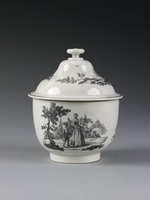
While the African participants in this imagined dinner are subjected to the artists’ most indulgent grotesquerie, their collective presence in the image foregrounds a marginalized community documented and referred to in many ways in a broader cultural archive. This includes growing numbers of colonial servants working in British homes during the 1760s pejoratively described as “a grievance that requires a remedy,”[44] and the poor Black community on the streets of Soho colloquially referred to as the “St. Giles black birds.”[45] Within London’s burgeoning commodity culture of the eighteenth and nineteenth centuries, images of Black figures—in paint, metal, ceramic, marble, and on paper—were very often used as an index for the ways Britain’s involvement in the transatlantic slave trade sustained this demographic growth while further entrenching unequal social relations (fig. 5).[46] By 1816, when the real dinner represented in the NUC took place, an estimated twenty thousand or more Black people were living and working in Britain—many homeless or working in low-paid service jobs.[47] However, approaching these demographics through the lens of gender reveals information blind spots that are yet to be reconciled. Documents citing the presence of Africans in Britain show that there were more men than women. Furthermore, it is difficult to uncover the substance of Black women’s experiences without encountering recurring sexual tropes or the basic limitations of gender roles in Georgian and Regency society. In the context of caricature and other printed imagery such as illustrations in books, Black women are relegated to roles as maids, exotic muses, and sex workers whose stories overdetermine how we approach their lives as researchers.[48] The NUC does little to disturb these stereotypes, but ironically, we do see many women in the print (at least eleven) occupying the same visual field, which implies a collective population that is rarely, if ever, represented in art.
The African and Asiatic Society that hosted the event shown in the NUC was a small, philanthropic group, founded by religious organizers specifically to address growing poverty levels in general, and the disproportionate impact of poverty on Black and Asian people in London in particular.[49] On a very basic level then, the NUC could perhaps even be read in documentary terms, as a skewed collection of attitudes toward the society’s work and its recognition of a multicultural population. Yet, nineteenth century caricatures were communicating from within a long tradition of “court” jesting—“capering before the powerful, then puncturing pretensions with jokes and riddles.”[50] In an interesting way, the NUC also manages to signal the complexity of colonial loyalties, where Africans who aided empire through naval service found themselves marginalized and impoverished on the streets of London and unable to claim their due pensions.[51] In this sense, the portrayal of the famous street characters Waters, Joseph Johnson (life dates not available), and Charles McGee (ca. 1744–ca. 1854), who all experienced dispossession and neglect, highlights further ironies within the uneven landscape of social reform driven by mainstream British abolitionism.
It is useful to pause now and ask a counterintuitive question, especially when the effort to explain the NUC is beginning to take its affective toll: Are all these readings of the print stretching art historical analysis to its limits by fabulating, pontificating, or simply refusing to see things as they are? The truth is, this is also just a mean image intended for British “posh boys” who wanted to laugh at people they felt were beneath them.[52] This candid statement seems to be a refreshing “palate cleanser.”
“Illustrious Black” Portraiture and Poetics of Recognition
As Remi H. Kalir and Antero Garcia describe in their introductory reader on the subject, annotation involves moving around the artifact or topic in question and engaging different modes of addressing it—deliberating and musing and unpacking and suggesting other ways to direct a secondary reader’s or viewer’s attention. Annotation, they write “helps author a counternarrative, or an alternative to conventional methods and messages.”[53] Thus, it is time for me to pivot, by asking: How are Afro-Atlantic histories made visible in art history? Where do they circulate and find meaning in the visual and virtual domain? Over the last thirty years, research on representations of African and African-diasporic people in the Western cultural archive (the “Black image”) has flourished, shifting initially from a focus on identifying and spotlighting marginalized or hidden figures in historical artworks to more broadly considering how Black lives are entangled in complex knowledge systems, and the ways we might access their subjectivities in modern-day research and storytelling. Black portraiture has become a particularly compelling arena for research and artistic inquiry,[54] where the very notion of subjectivity—of a whole person being looked at and looking back from a vital image—serves to counter long histories of dehumanization and erasure, in what Saidiya Hartman has precisely described as “the afterlife of property.”[55] Attentiveness to the project of subject recovery in art has encouraged different methodological projects, such as the bridges forged between multiple visual media, particularly in the nineteenth century. One example is the way photography has helped to augment our understanding of the interactions of the artists of well-known paintings and their Black models, a subject that was beautifully explored in Denise Murrell’s exhibition Le modèle noir de Géricault à Matisse (The Black Model from Géricault to Matisse) at the Musée d’Orsay in Paris in 2019.[56]
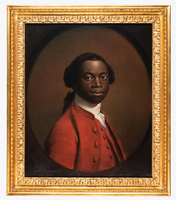
Central to these recuperative efforts is the work of naming Black figures in Western art history, which has become an important and activist methodology aimed at countering colonial mechanisms for producing value and meaning in recordkeeping specifically. In differing ways, scholarship and museum exhibitions have addressed how biographical or contextual information about enslaved and free individuals represented in artworks was intentionally omitted and/or imposed using rudimentary citations, with the overall effect of subject erasure.[57] The decades-long attempt to name both the artist and the sitter of a mid-eighteenth-century portrait depicting a man in a red coat at the Royal Albert Memorial Museum & Art Gallery in Exeter, an individual once thought to be the African writer Equiano (and painted by Allan Ramsay [1713–84] or Joshua Reynolds [1723–92]), is indicative of how easily lives slip from view and the Black experience is readily objectified through images that are employed to stand in for the whole community (fig. 6).[58]
These dynamics are also evident in the cases of artists’ models and sitters who are identified only by a first name, similarly decontextualizing them from communities and families but also making it more difficult to cross-reference them with other archival sources. This oblique knowing in part, or as archival fragment, informed Ligon’s artist installation, Some Black Parisans (2019), that appeared alongside the exhibition Le modèle noir de Géricault à Matisse (The Black Model from Géricault to Matisse) at the Musée d’Orsay. The installation consisted of a wall of twelve illuminated neons, some showing the first names of art history’s lesser-known Black models and others showing the full names of celebrities such as Josephine Baker, thus elevating the status of the latter while also making the unknown name (nom inconnu) of those without adequate reference equally visible.[59] The ongoing work of archival recovery in scholarship and curation, often brings to mind the phrase “hidden in plain sight,” which is a liberally used shorthand to explain the politic of simultaneous disappearance and visibility as it impacts the way histories are written, what artworks museums choose to hang from their existing collections, and what works museums continue to acquire. The catalogue for the previously mentioned Unnamed Figures exhibition further explored these issues and brought to the fore the emerging controversy over the creation of paintings with fake Black subjects for the sake of art-market appeal. These “imaginary ancestors,” described so vividly by Gwendolyn DuBois Shaw,[60] show how facial recognition based on racialized identity in art—as in the computational world—continues to be a fraught and often speculative project.
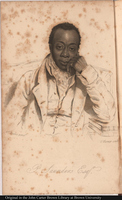
It was in spring 2007, at the British Library in London, when I finally found a portrait of Prince Saunders (ca. 1775‒1839)–one of the named characters in The New Union Club, identified by a piece of paper attached to his coat—on the frontispiece of his edited book Haytian Papers (1816). Finding out about his historical role and his presence in the image was vital. Through my research I had learned that there was a portrait attached to the manuscript of Haytian Papers, but in the first edition I initially consulted in my university library’s special collections, the image was not there. My research was regularly hindered by similar stops and starts, as I learned quickly how to second guess errors and slippages in conventions of naming—Saunders, Saunder, Sanders, and Landers, in the case of Prince Saunders—and had come to expect absences in primary sources with the implied potential to hold evidentiary keys. Opening the book, I gasped, enthralled by the sensitive sketch of a man with glistening eyes and soft, round features, casually resting his cheek on his hand with his arm propped up by a stack of three books. His handsome face and smoothly rendered, dark skin exuded warmth and sensitivity and what I can only describe as a sense of surrendering to the work of being made into a portrait image, in a way that Kevin Quashie has so beautifully theorized as “black aliveness,” or “life-as-is” (fig. 7).[61] The portrait in the frontispiece was not technically finished. Clothing and props are suggested only lightly, as if yet to fully emerge, with a stippled engraving technique concentrated on the much bolder head and hand. However, from my perspective as a researcher, the portrait was a point of connection and of transformation, moving a Black person I had followed through the exaggerated words and portrayals of others, out of a stereotype and into some kind of subjectivity. The familiar format of the frontispiece portrait also recalled images of earlier African writers such as Equiano and Wheatley, whose frontispieces were similarly used to authenticate their presence but also to assert authorial engagement with a reading audience—voices being visualized.[62]
Throughout my research, in which I used Joseph Marryat’s words to identify and trace the Black people represented in the NUC, Saunders emerged as a compelling subject, indicative of the social mobility the print was railing against but also challenging my own assumptions about agency for people of African descent during this historical period. Here, I elaborate dimensions of his story to demonstrate how other worlds and possibilities for research and connection emerged when I used the NUC as a window rather than a final statement. Sources suggest that Prince Saunders, an intellectual, educator, and missionary of sorts, was a man clearly passionate about African advancement but also entrenched in Anglo-American religious frameworks of paternalistic conversion. From his base in Boston, he set up a school with Baptist pastor Thomas Paul (1773–1831), and also served as the secretary of the African Masonic Lodge No. 1, which was the historical seat of Prince Hall freemasonry in the United States.[63] It was in this capacity as a mason that Saunders traveled to London in 1815 to join the abolitionists as they developed plans for a return-to-Africa movement, with a religious and educational focus. Wilberforce and Clarkson clearly saw in Saunders an astute diplomat, and arranged for him to become an agent for the Haitian government under Henri Christophe. There, he helped to realize the king’s dreams of freedom and his enlightenment ideals, becoming an adept communicator and overseeing the creation of several educational institutions. Later he would also bring the smallpox vaccination to Haiti. When Saunders returned to London in 1816 on behalf of Christophe and entered high society with a newly published manuscript, his mixed reception in the press and in private writing reveals a form of secondhand portraiture through which we can assess the impact of his presence. For instance, following the publication of Haytian Papers, a writer for the Military Register in August 1816 notes that the book is narrated “in the enlightened conversation of its black author in pure English,” and observes in Saunders a “gentleman” who has a “polished, mild, and yet impressive manner, acute yet modest sense.”[64] For Saunders to have entered high society as an outsider in this way, even being granted a direct audience with the Prince Regent (later King George IV), naturally evinced other less favorable responses. For example, in the posthumously published memoirs of the painter Charles Robert Leslie, the artist recalls:
He [Saunders] was noticed by Wilberforce and soon became a lion of the first magnitude in fashionable circles. The Countess of Cork could not have a party without “his Highness Prince Saunders;” for as he put his Christian name “Prince” on his cards without the addition of Mr., he was believed to be a native African Prince, and he did not undeceive those who chose to think him one.[65]
How do we know that the engraved portrait of Saunders provides a faithful likeness of the man? What are we really witnessing in these postmemorial acts of Black subject recovery? Archival sources written by European and American authors describe Saunders physically in different ways, sometimes as “coal black” and other times suggesting he was of mixed heritage. Another religious commentator notes that “[h]e was said to be of pure African blood, unprepossessing in his external appearance, but of highly polished manners and of brilliant parts.”[66] Working through these layers of identification laced with prejudice, I want to emphasize, or redirect our attention to, another dimension of this story by entertaining the idea of this Black subject willingly appearing as illustration or example, fashioning himself, with the help of artists, into an enduring image.
British artist and copyist Richard Evans (1784–1871), who sketched Saunders’s portrait for engraving early in 1816, was on his way to becoming King Henri Christophe’s official court painter. A former student of grand-manner artist Thomas Lawrence (1769–1830), he had been employed at great expense to teach at the newly established art academy in Haiti, at the palace of Sans Souci.[67] He arrived there in autumn of 1816, his trip organized and paid for by Saunders. During his time at the palace, Evans was commissioned to produce two diplomatic paintings: the now iconic, luxurious standing portrait of Henri Christophe dressed in the style of a cosmopolitan regency gentleman, and its pendant depicting his son Jacques-Victor-Henri in a similar stance and wearing an identical costume, but shown with a horse and a Black attendant. Both of these portraits were copied and sent to Wilberforce in London before being displayed at the Royal Academy exhibition in 1818.[68] A reviewer who saw the works at Somerset House would later write in The New Monthly Magazine that Evans’s paintings “are uncommonly good pictures, and prove that it is not impossible to attach pomp and dignity even unto a negro: they really look [like] very king-like personages.”[69] Significant scholarship has discussed the making and circulation of these works, their inclusion in the wider project of Haitian symbolic governance, and the role of Christophe’s early art academies in contributing to a more nuanced view of Haitian art history.[70] However, little has been said about the quiet, stippled portrait titled P. Saunders Esq. (see fig. 7) which was made before Evans arrived for his instructional post at Sans Souci and was already circulating with book buyers in multiple copies. Here I speculate about the Saunders portrait as a prologue to Evans’s formal royal paintings and consider its presence—held inside the pages of a manuscript containing Haiti’s founding documents—as a visual conversation on the unfolding terms of diasporic subjectivity in the postrevolutionary era. It is a Black Atlantic record of social and ideological transformation—a portrait revealing a “modern self-consciousness,” in the words of Gilroy describing Equiano[71]—in which subjects take over and ultimately cause prevailing imaging technologies to signify differently, whether they be printed frontispieces, painted portraits, or even metal coinage.
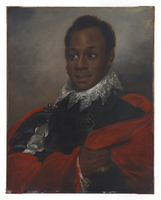
In 2022, the Los Angeles County Museum of Art purchased a half-length portrait of Prince Saunders that had not been seen before and which is considered to be his only known painted portrait (fig. 8).[72] Admittedly, it was a shock to me, and shifted my relationship with Saunders’s records and, more broadly, the ongoing conversation discussed in this article about the blossoming of Black portraiture in museum and gallery collections. Made by British miniaturist William Armfield Hobday around 1815–16, the painting shows Saunders smiling and theatrically dressed in the guise of a noble sitter for Anthony van Dyck (1599–1641) from the previous century. To suggest that the painting is a caricature of Black “nobility” might be extreme, but Hobday’s approach to painting an accomplished African American guest in England is arguably dated for its time. This does not look or feel like a fashionable portrait; rather, it resembles portrait play—like those contemporary, face-in-hole attractions that allow people to pose as another subject or in another body: Is this portrait of Saunders a likeness, a performance of a type, or something between the two? I do not know. Ambivalence in the face of compelling evidence returns. Reading the limited, fragmented biography of the artist[73]—who was best known for miniatures and was anecdotally thought to have lived beyond his means—it is possible to imagine a situation where a British painter who had become estranged from the London art scene took the opportunity to paint a Black subject as a way to return to the creative world. But who was this painting really for? Did Saunders approve of the outcome?
Thanks to research by Gwen Fries, who has been editing the newly digitized papers of US diplomat John Quincy Adams, answers to these questions edge closer.[74] It seems that Saunders developed a relationship with the Adams family while in London in 1815 and 1816, and he is referenced in several of John Quincy Adams’s diaries. Saunders is mentioned as joining them for dinner, taking the children out for educational activities, and asking for advice about his work in Haiti—always in the form of short notes documenting his inclusion in their social space. Then, on July 27, 1816, John Quincy writes:
On our return from the dinner table to the drawing Room we found a Portrait of Mr Sanders, in a splendid fancy dress, or the Court dress of the kingdom of Hayti, hung up over the Sopha. It had been brought home from the Painters while we were at dinner.—Mrs Cowell invited us to dine at her house next Monday week—Mr Sanders is to embark for Hayti the tenth of next Month; but is to return here again next Winter.[75]
No commentary from Saunders is recorded. But once again, a curious archival fragment opens up possibilities for narrating how Black portraitures are not only found but also come into being.
Conclusion: Transforming Documents
What drives annotation as practice is a decision to join a conversation—one that has just begun or is already underway. In art history, those discursive layers often span generations and become entwined with questions of economic value, meaning, hierarchy, and aesthetic quality. This can be complex terrain to navigate when we are seeking justice for what or who has been broken. In this article I have teased out one or two discursive threads and interpretive possibilities for an artwork that—at this moment in time—nobody really wants to see. In rereading old research notes, looking through hard drives filled with grainy image files, and visiting the print once more at Yale University’s Lewis Walpole Library, I have been reminded of the incredible labor involved in precious information recovery—the tentative work of claiming back memories we have lost, of chasing shadows and ghosts. The project of identifying people of African descent in Regency caricature, filled with proslavery rhetoric, is still highly ambiguous. So too is the process of handling the digital version of The New Union Club in an online context outside the bounds of institutional collections management. But the art historian’s craft is one of critical contextualization, because no one image or document stands alone. Linking past and present descriptions, registering affinities between people and artworks, pulling at interdisciplinary threads, and returning to stories from my own research process were ways for this text to more authentically capture (as well as record) what is involved in making Black presences in art more legible and dimensional. The NUC is a complicated but unique vehicle for this kind of practice, because it forces ongoing processes of ethical reflexivity that we can sometimes take for granted in relation to other more aesthetically pleasing artworks. George Cruikshank and Frederick Marryat’s thesis was one of excessive graphic force, but its outcomes were, and continue to be, the posing of questions about the terms of freedom for an interconnected Afro-Atlantic community.
Notes
[1] See Nicole R. Fleetwood, Troubling Vision: Performance, Visuality, and Blackness (Chicago: University of Chicago Press, 2011), 6.
[2] Sotheby & Co., Catalogue of the Splendid and Unique Collection of the Works of George Cruikshank Formed by R. J. H. Douglas: Which Will Be Sold by Auction by Sotheby, Wilkinson & Hodge . . . on Thursday, 9th of February, 1911, and Following Day, and on Monday, the 13th of February, and Three Following Days (London: Dryden, 1911), 90.
[3] Here, I am thinking with and alongside the possibilities described by Cecilia Sjöholm in the context of war photography. See Cecilia Sjöholm, “Images Do Not Take Sides: The Forensic Turn of Images,” Nordic Journal of Aesthetics 30, no. 61–62 (2021): 166–70.
[4] Kelly Baker Josephs and Roopika Risam, eds., The Digital Black Atlantic (Minneapolis: University of Minnesota Press, 2021), xii.
[5] This methodological unfolding is in dialogue with recent conversations on the decolonization of museums and collections. See a pertinent series of discussions in Anjalie Dalal-Clayton and Ilaria Puri Purini, eds., Doing the Work: Embedding Anti-Racism and Decolonisation into Museum Practice (London: Decolonising Arts Institute and Contemporary Art Society, 2022), https://ualresearchonline.arts.ac.uk/.
[6] Marcus Wood, Blind Memory: Visual Representations of Slavery in England and America, 1780‒1865 (New York: Routledge, 2000), 171.
[7] Remi Kalir and Antero Garcia, Annotation (Cambridge, MA: MIT Press, 2021), 12.
[8] See Temi Odumosu, Africans in English Caricature, 1769–1819: Black Jokes, White Humour (London: Harvey Miller, 2017); Temi Odumosu, “This Is How You See Her? Rachael Pringle Polgreen of Barbados by Thomas Rowlandson’s Satirical Hand,” in “Visual Cultures of the Colonial Caribbean,” ed. Emily Senior and Sarah Thomas, special issue, Atlantic Studies 19, no. 1 (2022): 10–33; Temi Odumosu, “In Bad Taste? Slavery and the African Presence in the Subversive Mockery of Royalty,” in Loyal Subversion? Caricatures from the Personal Union between England and Hanover, 1714–1837, ed. Anorthe Kremers and Elisabeth Reich (Hanover: VolkswagenStiftung, 2014), 122–39; Temi Odumosu, “Abolitionists, African Diplomats and ‘the Black Joke’ in George Cruikshank’s The New Union Club,” in The Slave in European Art: From Renaissance Trophy to Abolitionist Emblem, ed. Jean Michel Massing and Elizabeth McGrath (London: Warburg Institute; Turin: Nino Aragno Editore, 2012), 333–59; and Temi Odumosu, “Default Positions: African Icons and Stereotypes from Georgian Print Culture,” The Ephemerist 158 (Autumn 2012): 10–13.
[9] See Wayne Baerwaldt et al., Glenn Ligon: Some Changes (Toronto: Power Plant, 2005). Meleko Mokgozi’s installation was shown at the Eighth Gothenburg International Biennial of Contemporary Art in 2015, an exhibition curated by Elvira Dyangani Ose and titled A Story within a Story.
[10] For more detailed discussions on transatlantic abolitionist iconography, see Wood, Blind Memory; Sarah W. Parsons, “The Arts of Abolition: Race, Representation, and British Colonialism, 1768‒1807,” in Interpreting Colonialism, ed. Byron R. Wells and Philip Stewart (Oxford: Voltaire Foundation, 2004), 345‒68; Douglas J. Hamilton and Robert J. Blyth, Representing Slavery: Art, Artefacts and Archives in the Collections of the National Maritime Museum (Aldershot, UK: Lund Humphries, 2007); Massing and McGrath, The Slave in European Art; Teresa A. Goddu, Selling Antislavery: Abolition and Mass Media in Antebellum America (Philadelphia: University of Pennsylvania Press, 2020); and Martha J. Cutter, The Illustrated Slave: Empathy, Graphic Narrative, and the Visual Culture of the Transatlantic Abolition Movement, 1800–1852 (Athens: University of Georgia Press, 2017).
[11] For an overview discussion on the challenges of disassociating abolition from the threat of insurrection, see Seymour Drescher, “Public Opinion and Parliament in the Abolition of the British Slave Trade,” in The British Slave Trade: Abolition, Parliament and People; Including the Illustrated Catalogue of the Parliamentary Exhibition in Westminster Hall, 23 May‒23 September 2007, ed. Stephen Farrell, Melanie Unwin, and James Walvin (Edinburgh: Edinburgh University Press for the Parliamentary History Yearbook Trust, 2007), 42‒65.
[12] For a detailed discussion, see Robert Livingston Schuyler, “The Constitutional Claims of the British West Indies,” Political Science Quarterly 40, no. 1 (1925): 1‒36. See also Tessa Murphy, “Centering Slavery in the Age of Abolition: Insights from the Saint Lucia Register of Plantation Slaves, 1815,” The William and Mary Quarterly 81, no. 2 (2024): 359–94.
[13] For examples of early influential scholarship centering on this abolitionist project, see Ellen Gibson Wilson, The Loyal Blacks (New York: Capricorn Books, 1976); James W. Walker, The Black Loyalists: The Search for a Promised Land in Nova Scotia and Sierra Leone, 1783–1870 (Toronto: University of Toronto Press, 1992); and Stephen J. Braidwood, Black Poor and White Philanthropists: London’s Blacks and the Foundation of the Sierra Leone Settlement, 1786–1791 (Liverpool: Liverpool University Press, 1994).
[14] For recent historical analysis, see Padraic X. Scanlan, Freedom’s Debtors: British Antislavery in Sierra Leone in the Age of Revolution (New Haven, CT: Yale University Press, 2017); and Ruma Chopra, Almost Home: Maroons between Slavery and Freedom in Jamaica, Nova Scotia, and Sierra Leone (New Haven, CT: Yale University Press, 2018).
[15] Joseph Marryat, More Thoughts, Occasioned by Two Publications, Which the Authors Call ‘An Exposure of Some of the Numerous Misstatements and Misrepresentations Contained in a Pamphlet, Commonly Known by the Name of Mr Marryat’s Pamphlet, Entitled Thoughts, &c.’ and ‘A Defence of the Bill for the Registration of Slaves,’ 2nd ed. (London: printed for J. M. Richardson, 1816), 99.
[16] Marryat, More Thoughts, 99‒106.
[17] “African and Asiatic Society,” Morning Chronicle, March 20, 1816, n.p.
[18] For a description of Marryat’s relationship with Cruikshank and their creative collaboration, see Robert L. Patten, George Cruikshank’s Life, Times and Art, vol. 1 (London: Lutterworth, 1992), 194‒205. In qualifying their relationship, Patten writes: “A kind of alter ego, this naval captain [Marryat] led a life to which the Cruikshank brothers unavailingly aspired” (194).
[19] For a detailed discussion of Gillray’s The Union-Club and its inspiration and subsequent derivations, see Vic Gatrell, City of Laughter: Sex and Satire in Eighteenth-Century London (London: Atlantic, 2006), 287‒92.
[20] For a discussion of Gillray’s approach to the subject of slavery, see Temi Odumosu, “James Gillray’s Wouski (1788): A New Case Study,” chap. 3 in Africans in English Caricature, 137–61; and Odumosu, “This Is How You See Her?”
[21] The British Museum’s Collections Online launched in October 2007. See Antony Griffiths, “Collections Online: The Experience of the British Museum,” Master Drawings 48, no. 3 (2010): 356–67.
[22] Cynthia L. Bennett et al., “‘It’s Complicated’: Negotiating Accessibility and (Mis)Representation in Image Descriptions of Race, Gender, and Disability,” in Proceedings of the 2021 CHI Conference on Human Factors in Computing Systems (New York: Association for Computing Machinery, 2021), 1–19.
[23] These problems have been discussed at length in key studies on critical science and technology, such as Simone Browne, Dark Matters: On the Surveillance of Blackness (Durham, NC: Duke University Press, 2015); Safiya Umoja Noble, Algorithms of Oppression: How Search Engines Reinforce Racism (New York: NYU Press, 2018); Ruha Benjamin, Race after Technology: Abolitionist Tools for the New Jim Code (Cambridge, UK: Polity, 2019); and Joy Buolamwini, Unmasking AI: My Mission to Protect What Is Human in a World of Machines (New York: Random House, 2023).
[24] Alexander Monea, “Race and Computer Vision,” in The Democratization of Artificial Intelligence: Net Politics in the Era of Learning Algorithms, ed. Andreas Sudmann (Bielefeld, Germany: transcript Verlag, 2019), 199.
[25] On the “coded gaze,” see Buolamwini, Unmasking AI, xiii. She writes: “The coded gaze describes the ways in which the priorities, preferences, and prejudices of those who have the power to shape technology can propagate harm, such as discrimination and erasure. We can encode prejudice into technology even if it is not intentional.”
[26] Monea, “Race and Computer Vision,” 192.
[27] Text generated by SuperBot AI, November 17, 2024.
[28] The question of first responses is something the project is exploring through so-called visual-dialogue workshops with graduate students.
[29] Mary Dorothy George, Catalogue of Political and Personal Satires Preserved in the Department of Prints and Drawings in the British Museum, vol. 9, 1811–1819 (London: British Museum, 1949), 910–12.
[30] Harry Thornber, “The Early Work of George Cruikshank,” The Manchester Quarterly 6 (1887): 213.
[31] Anon., “Quizzing Glass on History: An Exhibition of English Caricature at a London Club,” The Graphic, January 2, 1932, 22.
[32] For an overview of the project, see James Baker et al., “Detecting and Characterising Transmission from Legacy Collection Catalogues,” Digital Humanities Quarterly 16, no. 2 (2022), n.p.
[33] See Sanford Berman, Prejudices and Antipathies: A Tract on the LC Subject Heads Concerning People (Metuchen, NJ: Scarecrow Press, 1971).
[34] For examples of, approaches to, and current discussions about reparative cataloguing in information science, see Billey Albina, Rebecca Uhl, and Elizabeth Nelson, eds., Inclusive Cataloging: Histories, Context, and Reparative Approaches (Chicago: ALA Editions, 2024).
[35] Wayne Modest and Robin Lelijveld, eds., Words Matter, Work in Progress I (Amsterdam: National Museum of World Cultures, 2018).
[36] For more context, see Temi Odumosu, “What Lies Unspoken: A Remedy for Colonial Silences in Denmark,” Third Text 33, no. 4–5 (2019): 615–29.
[37] Abigael MacGibeny and Patricia Hills, “Dealing with Historical Titles: The Case of the Eastman Johnson Catalogue Raisonné,” Nineteenth-Century Art Worldwide 20, no. 3 (Autumn 2021), https://doi.org/10.29411/ncaw.2021.20.3.7.
[38] I attended the exhibition Unnamed Figures: Black Presence and Absence in the Early American North when it traveled to Historic Deerfield’s Flynt Center of Early American Life in Deerfield, Massachusetts, where it was on view from May 1 to August 4, 2024. See Emelie Gevalt, R. L. Watson, and Sadé Ayorinde, eds., Unnamed Figures: Black Presence and Absence in the Early American North, exh. cat. (New York: American Folk Art Museum, 2023).
[39] For a critical summation of events and research in response to the bicentenary in 2007 of the Abolition of the Slave Trade Act in Britain, see Laurajane Smith, ed., Representing Enslavement and Abolition in Museums: Ambiguous Engagements (New York: Routledge, 2011).
[40] Hamilton and Blyth, Representing Slavery, 290.
[41] On the concept of “controlling images” as stereotypes that initiate and then reproduce oppression, see Patricia Hill Collins, Black Feminist Thought: Knowledge, Consciousness, and the Politics of Empowerment (London: Routledge, 2000), 69–96.
[42] “Advertisements,” The World, June 13, 1788, n.p.
[43] See Odumosu, Africans in English Caricature, 182.
[44] “Short Notes from the Papers,” Gentleman’s Magazine, October 1764, 493.
[45] See Peter Fryer, Staying Power: The History of Black People in Britain, new ed. (London: Pluto Press, 2018), 77.
[46] For a critical overview of historical scholarship on Britain’s Black presence, see Gretchen Gerzina, ed., Britain’s Black Past (Oxford: Liverpool University Press, 2020). For the Black presence in the visual and decorative arts in Britain, see Beth Fowkes Tobin, Picturing Imperial Power: Colonial Subjects in Eighteenth-Century British Painting (Durham, NC: Duke University Press, 1999); Miranda Stacey, The Black Presence: The Representation of Black People in the Paintings of National Museums and Galleries on Merseyside (Liverpool: Bluecoat Press, 1999); Susan D. Amussen, Caribbean Exchanges: Slavery and the Transformation of English Society, 1640‒1700 (Chapel Hill: University of North Carolina Press, 2007); Zoe Nicole Whitley, Uncomfortable Truths: The Shadow of Slave Trading on Contemporary Art and Design (London: V&A, 2007); Esther Chadwick et al., Figures of Empire: Slavery and Portraiture in Eighteenth-Century Atlantic Britain (New Haven, CT: Yale Center for British Art, 2014); and Alison Smith et al., Artist and Empire: Facing Britain’s Imperial Past (London: Tate, 2015).
[47] For a nuanced account of the Black population in London and its location and growth during the long eighteenth century, as well as where that population is both visible and hidden in the archives, see Kathleen Chater, “The Black Population of London,” chap. 2 in Untold Histories: Black People in England and Wales during the Period of the British Slave Trade, c. 1660‒1807 (Manchester, UK: Manchester University Press, 2009), 35‒73. Chater reminds us that estimations of the size of the Black population, ranging from three to twenty thousand people, as often cited in historiographic accounts, came from newspaper articles and from writers such as the abolitionist Granville Sharp and the colonist Edward Long (25‒27).
[48] See the section on women in Kathleen Chater, “Job Mobility amongst Black People in England and Wales during the Long Eighteenth Century,” in Belonging in Europe: The African Diaspora and Work, ed. Hakim Adi and Caroline Bressey (London: Routledge, 2011), 19–20. For Black women in British print culture, see Temi Odumosu, “What a Nice Bit!: The Comic ‘Sable Mistress’ and Her Suitors,” chap. 2 in Africans in English Caricature, 99–135.
[49] The most complete description of the African and Asiatic Society can be found in Robert Young, “The African Stranger: A Sermon, Preached at London Wall, in the Evening of Sunday, 17 January, 1808, for the Benefit of the African and Asiatic Society, and Published at the Request of the Committee,” Sermons (London, 1808). An exemplary copy of this text (which is rare) is in the archives of the United Reform Church History Society at Westminster College in Cambridge, UK (URC BX9178.Y66).
[50] Constance C. McPhee and Nadine M. Orenstein, Infinite Jest: Caricature and Satire from Leonardo to Levine (New York: Metropolitan Museum of Art, 2011), 3.
[51] See Charles R. Foy, “The Royal Navy’s Employment of Black Mariners and Maritime Workers, 1754–1783,” International Journal of Maritime History 28, no. 1 (2016): 6–35. On Black loyalists across the Atlantic, see John W. Pulis, ed., Moving On: Black Loyalists in the Afro-Atlantic World (New York: Garland, 1999); and Alan Gilbert, Black Patriots and Loyalists: Fighting for Emancipation in the War for Independence (Chicago: University of Chicago Press, 2012).
[52] On “posh boys” and art history, see Temi Odumosu “Touching the Void: On Becoming an Art Historian and Studying Slavery at Cambridge,” in Rise Up: Resistance, Revolution, Abolition, ed. Victoria Avery and Wanja Kimani (London: Philip Wilson, 2025), 190–99.
[53] Kalir and Garcia, Annotation, 111.
[54] The multiyear Black Portraitures conferences, initiated and directed by Professor Deborah Willis Thomas at New York University’s Tisch School of the Arts, have been very influential in this regard.
[55] Saidiya Hartman, “Venus in Two Acts,” Small Axe: A Journal of Criticism 12, no. 2 (2008): 13. Specifically, Hartman explains this afterlife as “the detritus of lives with which we have yet to attend, a past that has yet to be done, and the ongoing state of emergency in which black life remains in peril.”
[56] See Adrienne L. Childs, exhibition review of Le modèle noir de Géricault à Matisse, Nineteenth-Century Art Worldwide 18, no. 2 (Autumn 2019), https://doi.org/10.29411/ncaw.2019.18.2.18.
[57] In addition to works already cited, see also Gwendolyn DuBois Shaw et al., Portraits of a People: Picturing African Americans in the Nineteenth Century, exh. cat. (Andover, MA: Addison Gallery of American Art, Phillips Academy, 2006); and Jennifer Van Horn, Portraits of Resistance: Activating Art during Slavery (New Haven, CT: Yale University Press, 2022).
[58] For a useful overview of the interpretive processes surrounding this portrait, see Melissa Percival, “Decolonial Practices around ‘Portrait of a Man in a Red Suit’ (Formerly ‘Portrait of an African’), in the Royal Albert Memorial Museum (RAMM), Exeter,” Interfaces 51 (June 30, 2024), http://journals.openedition.org/.
[59] For an extended discussion on naming that includes a photograph of Ligon’s installation, see Jennifer Van Horn and Virginia Anderson, “Naming Black Presence: Issues of Titling and Re-Titling in the Museum,” in Gevalt, Watson, and Ayorinde, Unnamed Figures, 244–73.
[60] Gwendolyn DuBois Shaw, “Foreword: Imaginary Ancestors and Blacked-Up Imposters,” in Gevalt, Watson, and Ayorinde, Unnamed Figures, 8–13.
[61] Kevin Quashie, Black Aliveness, or A Poetics of Being (Durham, NC: Duke University Press, 2021), 10. Methodologically, I am inspired by Quashie’s assertion that “to ‘image in Black world’ is both a way to read texts and a way to understand what is instantiated by the text itself, a choral subjunctive that exemplifies but does not plead” (14).
[62] For a discussion of the function of the frontispiece for African writers, see Barbara E. Lacey, “Visual Images of Blacks in Early American Imprints,” The William and Mary Quarterly 53, no. 1 (1996): 137–80; Vincent Carretta, “Defining a Gentleman: The Status of Olaudah Equiano or Gustavus Vassa,” Language Sciences 22, no. 3 (2000): 385–99; Marcia Pointon, “Slavery and the Possibilities of Portraiture,” in Slave Portraiture in the Atlantic World, ed. Agnes Lugo-Ortiz and Angela Rosenthal (New York: Cambridge University Press, 2013), 41–70; and Megan Walsh, “Phyllis Wheatley and the Durability of the Author Portrait,” chap. 3 in The Portrait and the Book: Illustration and Literary Culture in Early America (Iowa City: University of Iowa Press, 2017), 63–102.
[63] The African Masonic Lodge No. 1 (Later African Lodge No. 459) was founded in 1784 by a craftsman named Prince Hall, who (on the eve of revolution) petitioned for African Americans to be included in American lodges, but after little success, applied to the Grand Lodge of England to establish a separate chapter. See Maurice Wallace, ‘“Are We Men?’: Prince Hall, Martin Delany, and the Masculine Ideal in Black Freemasonry, 1775‒1865,” American Literary History 9, no. 3 (1997): 396‒424; Paul Lawrence Dunbar, “Hidden in Plain Sight: African American Secret Societies and Black Freemasonry,” Journal of African American Studies 16, no. 4 (2012): 622‒37; and Edward Nelson Palmer, “Negro Secret Societies,” Social Forces 23, no. 2 (1944): 207‒12.
[64] “Hayti—Mr. Prince Sanders,” Military Register, August 14, 1816, 156 (emphasis in original).
[65] Charles Robert Leslie, Autobiographical Recollections, vol. 1, ed. Tom Taylor (London: John Murray, 1860), 243–44.
[66] William Douglass, Annals of the First African Church, in the United States of America, Now Styled the African Episcopal Church of St. Thomas, Philadelphia (Philadelphia: printed by King & Baird, 1862), 124.
[67] On the financial preparations to ship Evans from England to Haiti, see Kathryn Cave, ed., The Diary of Joseph Farington, vol. 14 (New Haven, CT: Yale University Press, 1984), 4878. For Evans as drawing master, see King Henry to Thomas Clarkson, November 18, 1816, in Henry Christophe and Thomas Clarkson: A Correspondence, ed. Earl Leslie Griggs and Clifford H. Prator (Berkeley: University of California Press, 1952), 98.
[68] For Wilberforce portraits, see Robert Isaac Wilberforce and Samuel Wilberforce, The Life of William Wilberforce, vol. 4 (London: John Murray, 1838), 353. These portraits were noted at the time to be in the Wilberforce family collection.
[69] Quoted in “Fine Arts: Exhibition of the Royal Academy Continued,” The New Monthly Magazine, and Universal Register 9 (January–June 1818): 536.
[70] See Rosalie Smith McCrea, “Portrait Mythology? Representing the ‘Black Jacobin’ Henry Christophe in the British Grand Manner,” British Art Journal 6, no. 2 (2005): 66‒70; Humberto Garcia Muñiz et al., “La colección Alfred Nemours de Historia Haitiana, una fuente olvidada, en el bichentenario de la independencia de Haití,” Caribbean Studies 32, no. 2 (2004): 181‒241, esp. 206‒16; Tabitha McIntosh and Grégory Pierrot, “Capturing the Likeness of Henry I of Haiti (1805–1822),” Atlantic Studies 14, no. 2 (2017): 127–51; Erica Moiah James, “Decolonizing Time: Nineteenth-Century Haitian Portraiture and the Critique of Anachronism in Caribbean Art,” NKA 44, no. 1 (2019): 8–23; and Esther Chadwick, “The Aesthetics of Postrevolutionary Haiti: Currency, Kingship, and Circum‐Atlantic Numismatics,” Art History 46, no. 5 (2023): 1014–45. For a discussion of early art academies in the early years of the new republic, see Edward J. Sullivan, From San Juan to Paris and Back: Francisco Oller and Caribbean Art in the Era of Impressionism (New Haven, CT: Yale University Press, 2014), 24–26.
[71] Paul Gilroy, Against Race: Imagining Political Culture beyond the Color Line (Cambridge, MA: Belknap Press of Harvard University Press, 2000), 122.
[72] See Christine Y. Kim and Myrtle Elizabeth Andrews, eds., Black American Portraits: From the Los Angeles County Museum of Art (Los Angeles: Los Angeles County Museum of Art, 2023), 132.
[73] See “Memoir of William Armfield Hobday Esq.,” Library of the Fine Arts 2, no. 11 (1831): 384–91.
[74] Gwen Fries, “An American Prince in London: John Quincy Adams Meets Prince Saunders,” The Beehive (blog), Massachusetts Historical Society, January 10, 2025, https://www.masshist.org/.
[75] John Quincy Adams, diary entry, July 27, 1816, in Diary 30, June 1, 1816–December 31, 1818, p. 42, John Quincy Adams Diary: An Electronic Archive, Massachusetts Historical Society, 2004, https://www.masshist.org/.