Object Name: Photograph album of Allston family and other portraits
Compiled by: Compiler once known
Manufactured by: Edward Posen & Co., active 1880s–90s
Distributed by: J. H. McKinnon & Co., American, active 1884–91
Located in: Waterbury, New Haven County, Connecticut
Date: 1880s–1910
Medium: Paper and linen with leather or leatherlike material, batting, and metal
Description: A photograph album containing thirty portraits and one memorial card, dating from the 1880s to the early 20th century. The album has a padded linen cover partially bound in a dark brown, textured, leather or leatherlike material. The album pages have gilt edges. The interiors of the covers and facing pages are lined with endpapers with a stylized emerald-green-and-gilt floral motif. A pink paper label adhered to the lower right corner of the interior of the front cover reads “J. H. McKINNON & Co. / STATIONERS PRINTERS / AND / BLANK BOOK MANUF’RS / WATERBURY, Conn.” The title page has a gilt floral design around an arched white window that contains gilt flowers. A banner with the word “ALBUM” in gilt letters runs across the upper portion of the window. Overlapping the bottom of the window is an emblem with a lion holding a shield containing text reading “E P & Co.” Following the title page are pages with windows for cabinet cards, which slide into place through a slit below the window. The album closes with a metal clasp on the right side.
Dimensions: 10 1/2 × 8 × 3 in. (26.7 × 20.3 × 7.6 cm)
Collection Title: Photograph album of Allston family and other portraits
Credit Line: Smithsonian National Museum of African American History and Culture, Gift of the Family of Keith M. Jones in honor of Lonnie Bunch
Accession number: 2009.31
Edward Posen & Co. (manufacturer) and J. H. McKinnon & Co. (distributor), Front cover, before 1892. From a photograph album of Allston family and other portraits, 1880s–1910. Paper and linen with leather or leatherlike material, batting, and metal. 2009.31.
This photograph album is dated 1880s–1910 in order to include the dates of the album and its contents, but the album itself cannot be dated later than 1891: the stationer, printer, and blank-book manufacturer J. H. McKinnon & Co., which had a shop in downtown Waterbury and whose label is on the inside front cover, closed by 1892.[1] Originally the album cover was bound with brown leather or a brown, leatherlike material. The album was more than one hundred years old when it entered the museum’s collection in 2009, and by that time its covering was badly tattered, exposing much of the padded, linen-wrapped support underneath. What remains of the leather or leatherlike material is on the back cover.
Before the album was conserved, museum staff and the book conservator who performed the treatment on the album discussed the extent to which the covers should be restored or replaced. Everyone agreed that it was worthwhile to preserve what was left of the original covering on the back but not to replace the material missing on the front cover and elsewhere. Replacing the missing areas of the covering or substituting a new covering overall would have made the album look more like it did when it was new, but this would have obscured historical evidence that the album had been heavily used. Photograph albums were displayed in people’s homes with the intention of making the contents accessible; the signs of wear in this album indicate that many people handled and paged through it. The covers were damaged, but they protected what was more valued: the photographs and ephemera stored inside.
Leaving the linen-wrapped support for the covers exposed did not pose any threat to the contents of the album, but the album also arrived at the museum with a missing spine and a badly deteriorated and weak spine lining, which were more problematic. This damage made the album nearly impossible to handle and look through safely because many of the pages were loose. Museum staff and the conservator agreed that for long-term preservation, the best option was to replace the spine lining in a way that would hold the covers and pages together but still allow the album to be opened wide enough for digitization without damaging the pages.[2] The spine piece was not replaced because it was not possible to know what it looked like, and replacing it was not critical for safe handling and opening of the album.
Around the turn of the twentieth century, retailers and mail-order catalogs offered a broad range of albums, from simple to deluxe, some with fancy embellishments or lettering on silk or leather covers. The variety reflects the wide appeal and ubiquity of photographs, which were affordable for nearly everyone by the end of the nineteenth century. This album was plainer than many on the market, but it was well made using quality materials and served its purpose admirably.
Notes
[1] For the location of, and information about, J. H. McKinnon & Co., see “McKinnon, J. H. & Co., Booksellers and Stationers, 85 Bank” and “Books and Stationery: McKinnon, J. H. & Co., 85 Bank,” Waterbury Directory for 1884 (New Haven, CT: Price, Lee, 1884), 159, 254. Entries for the company also appeared in subsequent years of the directory until 1892, when the entry for J. H. McKinnon reads: “rem [moved] to Boston, Mass.” Waterbury and Naugatuck Directory, 1892 (New Haven, CT: Price, Lee, 1892), 262.
[2] For additional information about the conservation of the album, see Mirasol Estrada, “The Conservation of the Photograph Album of Allston Family and Other Portraits: Considerations, Collaboration, Treatment, and Impact,” and the video in the Conservation component of this project.
Object Name: Photograph album of Allston family and other portraits
Compiled by: Compiler once known
Manufactured by: Edward Posen & Co., active 1880s–90s
Distributed by: J. H. McKinnon & Co., American, active 1884–91
Located in: Waterbury, New Haven County, Connecticut
Date: 1880s–1910
Medium: Paper and linen with leather or leatherlike material, batting, and metal
Description: A photograph album containing thirty portraits and one memorial card, dating from the 1880s to the early 20th century. The album has a padded linen cover partially bound in a dark brown, textured, leather or leatherlike material. The album pages have gilt edges. The interiors of the covers and facing pages are lined with endpapers with a stylized emerald-green-and-gilt floral motif. A pink paper label adhered to the lower right corner of the interior of the front cover reads “J. H. McKINNON & Co. / STATIONERS PRINTERS / AND / BLANK BOOK MANUF’RS / WATERBURY, Conn.” The title page has a gilt floral design around an arched white window that contains gilt flowers. A banner with the word “ALBUM” in gilt letters runs across the upper portion of the window. Overlapping the bottom of the window is an emblem with a lion holding a shield containing text reading “E P & Co.” Following the title page are pages with windows for cabinet cards, which slide into place through a slit below the window. The album closes with a metal clasp on the right side.
Dimensions: 10 1/2 × 8 × 3 in. (26.7 × 20.3 × 7.6 cm)
Collection Title: Photograph album of Allston family and other portraits
Credit Line: Smithsonian National Museum of African American History and Culture, Gift of the Family of Keith M. Jones in honor of Lonnie Bunch
Accession number: 2009.31
Edward Posen & Co. (manufacturer) and J. H. McKinnon & Co. (distributor), Inside front cover, before 1892. From a photograph album of Allston family and other portraits, 1880s–1910. Paper and linen with leather or leatherlike material, batting, and metal. 2009.31.
Endpapers in an abstract, gold floral design printed on a blue-green field grace the inside of the front cover and facing page and the inside of the back cover and facing page. The album is dated 1880s–1910 in order to include the dates of the album and its contents, but a pink label in the bottom-right corner of the inside of the front cover provides a major clue for dating the album itself. The label reads: J. H. McKINNON & CO. / STATIONERS PRINTERS / AND / BLANK BOOK MANUF’RS / WATERBURY, Conn. J. H. McKinnon & Co. had a presence in downtown Waterbury, Connecticut, at 85 Bank Street from 1884 to 1891, but by 1892 the store had closed.[1]
J. H. McKinnon & Co. is included in the Waterbury section of Leading Business Men of New Haven County (1887), which includes a description of the company by Mr. McKinnon, “a Massachusetts man by birth.” It reads in part:
As manufacturers of blank books, and in this connection as art printers, and dealers in fine stationery, the firm . . . [has] maintained leadership in Waterbury. The facilities of this house for supplying work and merchandise of the highest order of merit, are exceptionally good. Their factory and printing establishment are models of completeness; a large force of hands are employed, and at short notice all kinds of work is executed in the best style of art.[2]
Also located on Bank Street in the late nineteenth and early twentieth centuries, at least during some of their years of operation, were the photography studios Adt & Brother Portrait Studio; Buckley; Crane Art Co.; and Smith. This made J. H. McKinnon & Co.’s shop on Bank Street a convenient place to find an album in which to keep photographs just picked up from a studio.[3]
Notes
[1] For the location of, and information about, J. H. McKinnon & Co., see “McKinnon, J. H. & Co., Booksellers and Stationers, 85 Bank,” and “Books and Stationery: McKinnon, J. H. & Co., 85 Bank,” Waterbury Directory for 1884 (New Haven, CT: Price, Lee, 1884), 159, 254. Entries for the company also appeared in subsequent years of the directory until 1892, when the entry for J. H. McKinnon reads: “rem [moved] to Boston, Mass.” Waterbury and Naugatuck Directory, 1892 (New Haven, CT: Price, Lee, 1892), 262.
[2] Leading Business Men of New Haven County (Boston: Mercantile, 1887), 218, https://play.google.com/.
[3] For information about Adt & Brother Portrait Studio; Buckley studio; Crane Art Co.; and Smith studio, see the Appendix, “Photography Studios Represented in the Photograph Album of Allston Family and Other Portraits.”
Object Name: Photograph album of Allston family and other portraits
Compiled by: Compiler once known
Manufactured by: Edward Posen & Co., active 1880s–90s
Distributed by: J. H. McKinnon & Co., American, active 1884–91
Located in: Waterbury, New Haven County, Connecticut
Date: 1880s–1910
Medium: Paper and linen with leather or leatherlike material, batting, and metal
Description: A photograph album containing thirty portraits and one memorial card, dating from the 1880s to the early 20th century. The album has a padded linen cover partially bound in a dark brown, textured, leather or leatherlike material. The album pages have gilt edges. The interiors of the covers and facing pages are lined with endpapers with a stylized emerald-green-and-gilt floral motif. A pink paper label adhered to the lower right corner of the interior of the front cover reads “J. H. McKINNON & Co. / STATIONERS PRINTERS / AND / BLANK BOOK MANUF’RS / WATERBURY, Conn.” The title page has a gilt floral design around an arched white window that contains gilt flowers. A banner with the word “ALBUM” in gilt letters runs across the upper portion of the window. Overlapping the bottom of the window is an emblem with a lion holding a shield containing text reading “E P & Co.” Following the title page are pages with windows for cabinet cards, which slide into place through a slit below the window. The album closes with a metal clasp on the right side.
Dimensions: 10 1/2 × 8 × 3 in. (26.7 × 20.3 × 7.6 cm)
Collection Title: Photograph album of Allston family and other portraits
Credit Line: Smithsonian National Museum of African American History and Culture, Gift of the Family of Keith M. Jones in honor of Lonnie Bunch
Accession number: 2009.31
Edward Posen & Co. (manufacturer), Title page, printed before 1892. Ink on paper mounted on cardboard. From a photograph album of Allston family and other portraits, 1880s–1910. 2009.31.
The covers of the album not only protected the photographs and ephemera inside; they also shielded the decorative title page. Without this protection, the areas colored in gold surely would have been easily scratched and damaged. The purpose of the album is imparted on this title page: the arched motif in the center of the page recalls the cutout windows for displaying photographs in the later pages in the album, and the scroll unfurled across the window motif proclaims ALBUM. The trademark lion holding a shield with a monogram was registered for Edward Posen & Co.[1] Posen probably manufactured the entire album, with J. H. McKinnon & Co. in Waterbury simply acting as the reseller.[2] Posen mixed different types of pages in the album, perhaps accidentally. Some of the windows on the album pages are arched while others are oval, and there is no discernable pattern to the order of the pages. While the photograph album is dated 1880s–1910 in order to include the dates of the album and its contents, the album itself, including this title page, cannot be dated later than 1891: J. H. McKinnon & Co., which sold the album, closed by 1892.[3]
Notes
[1] “Trade Items,” The American Stationer, August 9, 1888, 352.
[2] Email from Todd Pattison to Jessica Henze, June 21, 2024, forwarded to the author.
[3] To see the label on the inside front cover, and for more information about J. H. McKinnon & Co., see the Lives tab for Inside front cover (2009.31).
Object Name: Cabinet card of an unidentified child wearing a christening gown
Photograph by: Adt & Brother Portrait Studio, American, active 1881–1909
Located in: Waterbury, New Haven County, Connecticut
Studio operated by: Alfred A. Adt, American, 1863–1907
Lived in: Waterbury, New Haven County, Connecticut
Subject of: Unidentified child
Date: 1891–1909
Place made: Waterbury, New Haven County, Connecticut
Medium: Albumen and silver on paper on card mount
Description: A cabinet card comprising a portrait photograph, mounted on card, of an unidentified child, wearing a long christening gown, seated on chair covered in a blanket or rug with a dark ground and light floral pattern. The child clasps its hands in its lap. The text “Adt. Waterbury, Conn.” is printed along the bottom of the card mount. The reverse of the card mount has printed text reading “Adt. / The ADT & BROTHER / PORTRAIT / STUDIO / 56 BANK ST., WATERBURY, / CONN. / Manufacturers / of Picture Frames / DUPLICATES / AT REDUCED RATES.”
Dimensions: 6 1/2 x 4 1/4 in. (16.5 x 10.8 cm)
Collection Title: Photograph album of Allston family and other portraits
Credit Line: Smithsonian National Museum of African American History and Culture, Gift of the Family of Keith M. Jones in honor of Lonnie Bunch
Accession number: 2009.31.1
Adt & Brother Portrait Studio, Cabinet card of an unidentified child wearing a christening gown, 1891–1909. Albumen and silver on paper on card mount. From a photograph album of Allston family and other portraits, 1880s–1910. 2009.31.1.
The identity of this baby is unknown, but if the original order of the photographs in the album has been preserved—and no evidence exists to indicate that this is not the case—he or she was important enough to the compiler to be the first photograph in the album. The studio in which this cabinet card was taken, Adt & Brother Portrait Studio, operated at 56 Bank Street in Waterbury, Connecticut—the address for the studio on the back of the card—from 1891 until 1909.[1] This album has a label in it from J. H. McKinnon & Co., a stationer, printer, and book manufacturer, which had a presence at 85 Bank Street in Waterbury between 1884 and 1891, closing by 1892.[2] Possibly the compiler purchased the album specifically for this cabinet card; if so, the photograph may have been taken in 1891, the date Adt & Brother Portrait Studio and J. H. McKinnon & Co. were both located on Bank Street.
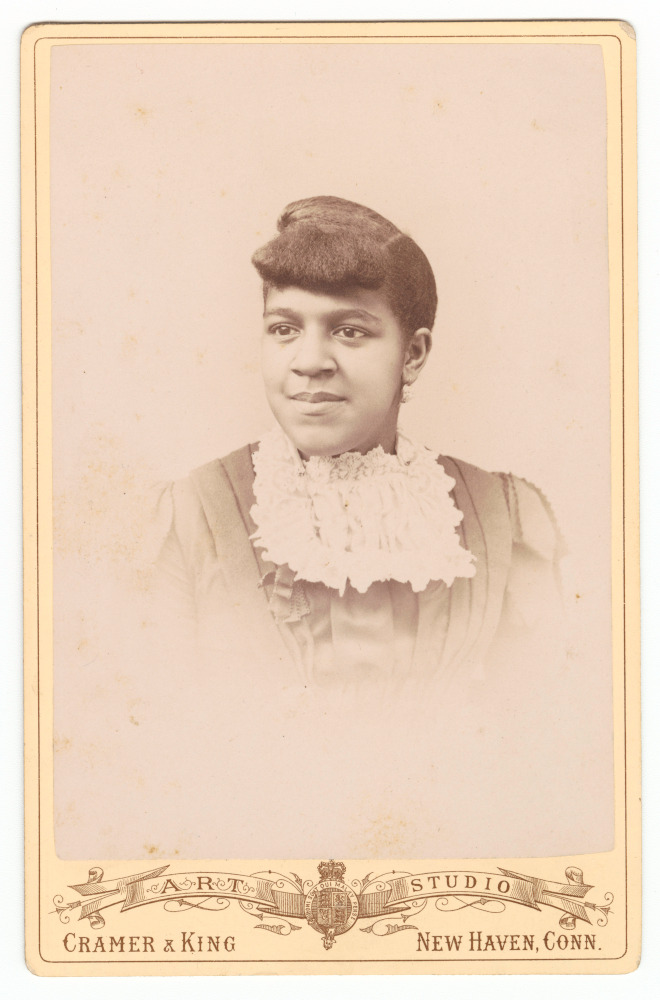
If this photograph is from 1891, the baby may be Marshall Robinson (1891–between 1891 and 1900), the second of ten children born in the family of Sarah Allston (1870–1949) and Foster Marshall Robinson (ca. 1860–1920).[3] Sarah was the eldest sister of Mary Evelina Allston (1888–1975; fig. 1) and Ida Allston (1872–between 1930 and 1948; fig. 2), who are portrayed in this album.[4] Although eight of Sarah and Foster’s children survived into adulthood, Marshall and his brother James (1907–8) died young.[5] If this is Marshall, he did live long enough to be christened. Many children in this era died in infancy, and mortality rates for Black babies were much higher than for white babies. In 1900, the overall mortality rate for white children under one year of age in Connecticut was 176 per thousand, but for children of all other races it was 304 per thousand, or almost a third of the infants born, a devasting statistic.[6]
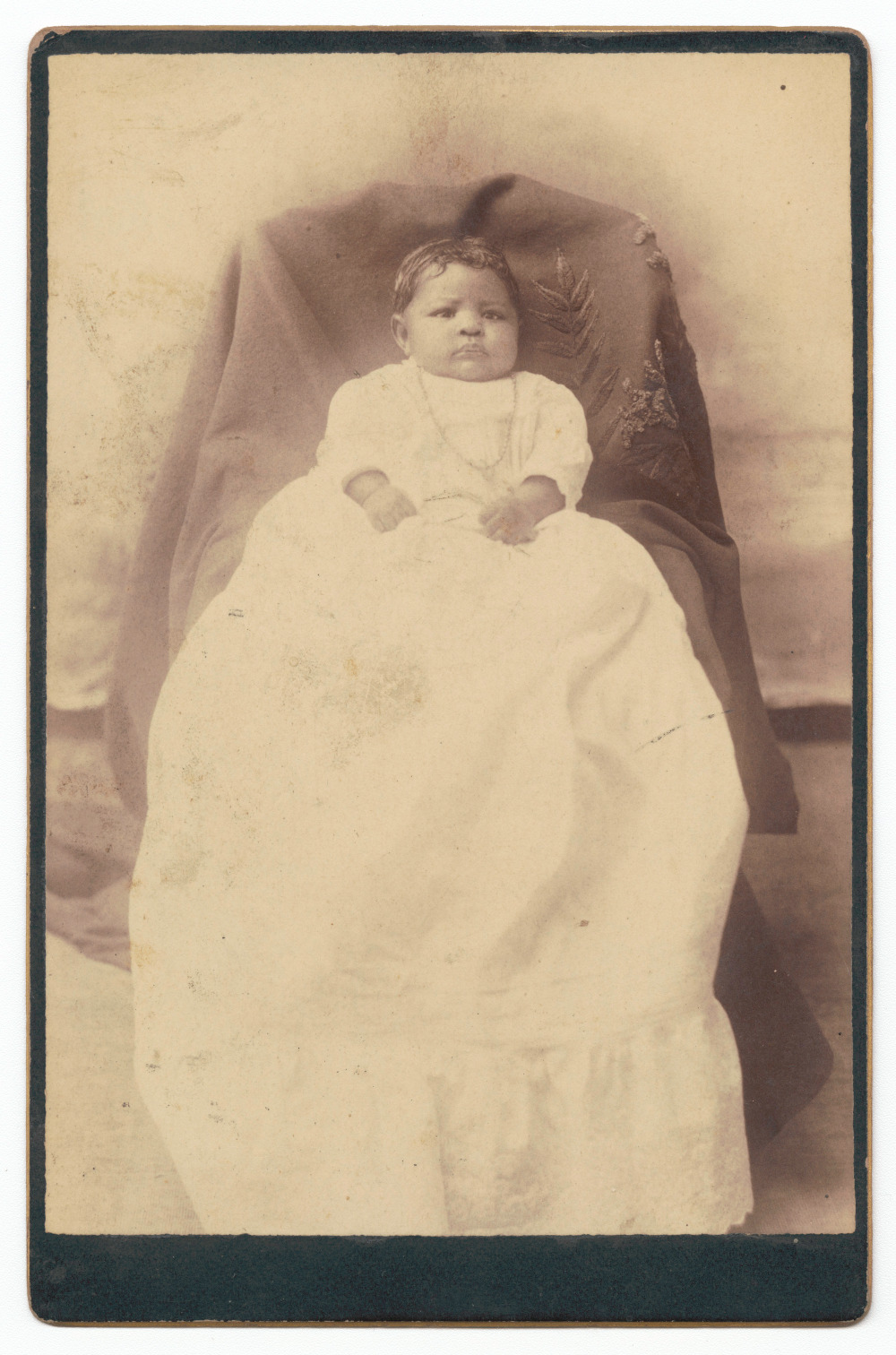
Alternatively, this could be a photograph of one of the other five children born to Sarah and Foster in Waterbury between 1893 and 1907, when the family left Waterbury. All these children—Ethel Isabella (b. 1893), Florence Beatrice (1896–1979), Gladys M. (b. 1898), Franklin Foster (b. ca. 1902), and Annie Azalea (b. ca. 1905)—survived to adulthood, and one of their portraits would have been a much happier sight to see upon opening this album.
Children are precious to all families, but it was only after the Civil War that mothers and fathers who had been enslaved, which was true for almost all African American parents in the United States, could count on keeping and raising their surviving children to adulthood. By 1894, children born free during Reconstruction (1865–77) and later were having their own children. Photograph albums complied by African American families during this period celebrated and documented intergenerational family ties that other families had always taken for granted.
Notes
[1] For information about Adt & Brothers Portrait Studio, see the Appendix, “Photography Studios Represented in the Photograph Album of Allston Family and Other Portraits.”
[2] For information about J. H. McKinnon & Company, see the Lives tab for Inside front cover (2009.31).
[3] For information about Sarah Allston and her children, see the Lives tab for Cabinet card of an unidentified woman (2009.31.5). For information about Foster M. Robinson, see the Lives tab for Cabinet card of an unidentified man (2009.31.10). For information about Marshall Robinson, see Births in the Town of New Haven, September 1891, name of child: Marshall Robinson; date of birth, Sept. 25, 1891; sex: male; name of father: Foster M. Robinson; maiden name of mother: Sarah Allston; residence of parents: Waterbury, CT; place of birth: 133 Butler Street; physician or person certifying: H. Pierpont, M.D., 105. Although a death record for Marshall has not been located, he does not appear in the US census for 1900, where the surname of each member of the Robinson family is misrecorded as Roberts. 1900 US Census, Connecticut, New Haven County, Waterbury (Enumeration District 424, sheet 26A), dwelling no. 74, Foster Roberts, Sarah L. Roberts, Alvira [sic] Roberts, Ethel Roberts, Beatrice Roberts, and Gladys Roberts. Marshall also does not appear in later census records for the Robinson family. Records available from Ancestry.com [login required].
[4] For information about Mary Evelina Allston, see the Lives tab for Cabinet card of a child, Mary Evelina Allston, in a christening gown (2009.31.4). For information about Ida Allston, see the Lives tab for Cabinet card of Ida Allston (2009.31.14).
[5] See note [3] about Marshall. For information about James, see Massachusetts Vital Records, 1911–1915, Return of a Death, Becket, Mass., name: James R. Robinson; age: 4 months; birth date: about 1907; death date: Feb. 22, 1908; death place: Becket, Mass; father: Foster Robinson; mother: Sarah Allston, 468. Record available from Ancestry.com [login required].
[6] Forrest E. Linder and Robert D. Grove, Sixteenth Census of the United States: 1940; Vital Statistics Rates in the United States, 1900–1940 (Washington, DC: Government Printing Office, 1943), 151, table 4 (Specific Death Rates by Age and Race: Death-Registration States and Each State, 1900, 1910, 1920, 1930, and 1940).
Object Name: Cabinet card of an unidentified child wearing a christening gown
Photograph by: Buckley, American, active 1894–1906
Located in: Waterbury, New Haven County, Connecticut
Studio operated by: Ambrose H. Buckley, active 1894–1906
Subject of: Unidentified child
Date: 1894–1906
Place made: Waterbury, New Haven County, Connecticut
Medium: Silver and collodion on printing-out paper on card mount
Description: A cabinet card comprising a portrait photograph, mounted on card, of an unidentified child wearing a long christening gown and seated on a chair covered with a fur pelt. The mount has an embossed design of fretwork with text embossed along the bottom reading “BUCKLEY / 50 BANK ST. / WATERBURY, CONN.” The reverse of the card mount is blank.
Dimensions: 6 1/2 x 4 1/4 in. (16.5 x 10.8 cm)
Collection Title: Photograph album of Allston family and other portraits
Credit Line: Smithsonian National Museum of African American History and Culture, Gift of the Family of Keith M. Jones in honor of Lonnie Bunch
Accession number: 2009.31.2
Buckley, Cabinet card of an unidentified child wearing a christening gown, 1894–1906. Silver and collodion on printing-out paper on card mount. From a photograph album of Allston family and other portraits, 1880s–1910. 2009.31.2.
This infant, wearing a crocheted white sweater over a long white gown and snugly supported by a fur pelt lining a spindled chair, appears twice in this album.[1] The photograph dates from between 1894 and 1906, the years Buckley photography studio was located at 50 Bank Street, the address imprinted on the bottom front of the cabinet card.[2] It seems likely that the baby lived in Waterbury, because simply getting someone this age photographed at a local studio was likely a challenge.
Like several other infants in the album, this child was photographed in a long, fancy dress. Always white and frequently embroidered and trimmed with lace, these gowns were worn during christening, a centuries-old religious ritual still practiced in the United States in most Christian denominations. The same gown was often worn by more than one infant in the same family and passed down for future generations. During christening, a child is welcomed into the congregation and given their Christian name. Often christening is combined with the sacrament of baptism, during which the baby is splashed or immersed in water by a minister or priest, cleansed of sin, and reborn as a Christian. Baptism includes a commitment by the parents or guardians who present the person for baptism and who promise to bring up the child in the faith.[3] In Connecticut around the turn of the twentieth century, some congregations took up a public collection as a gift to the family of the baby being baptized.[4]
The compiler of the album thought christening was important—several babies in the photo album are dressed in christening gowns. By 1906, the latest possible date for this photograph, African Americans in Waterbury had two churches run by Blacks from which to choose for a christening. The first was Mount Olive A.M.E. Zion Church, where Rev. G. H. S. (George Henry Service) Bell (1838–1911; fig. 1), whose photograph is included in this album, probably served from 1892–94 and 1896–1900.[5] The second was Grace Baptist Church of Waterbury.[6]
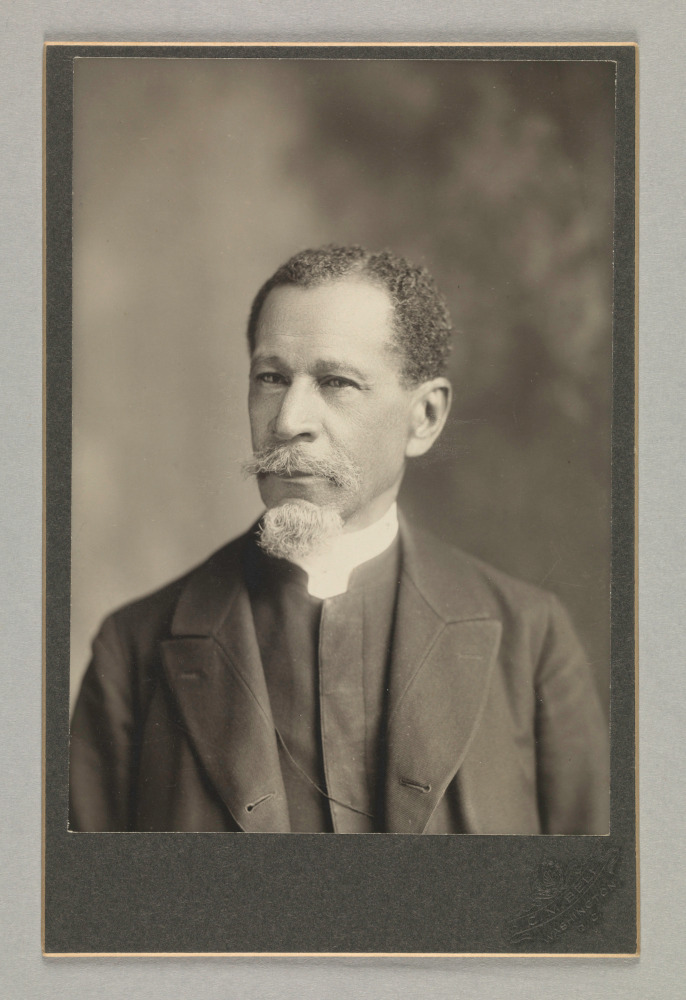
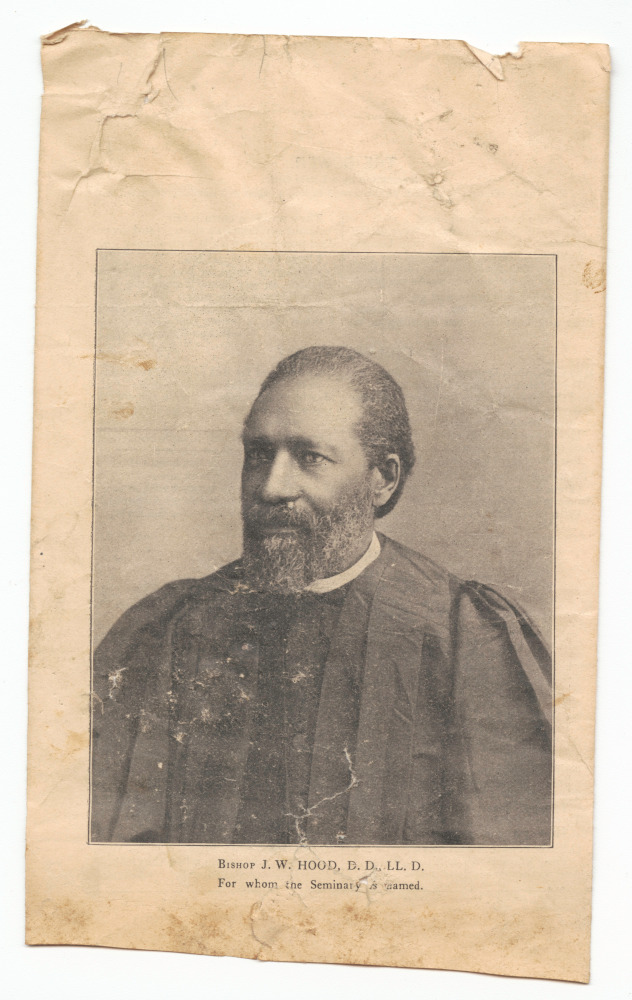
The photographs of babies in christening gowns in this album, along with the photographs of the Rev. Bell and Bishop James W. Hood (1831–1918; fig. 2), also in the album, suggest the compiler belonged to a Christian-faith tradition, most probably the African Methodist Episcopal (A.M.E.) Zion Church, where Rev. Bell and Bishop Hood held leadership positions.[7]
Notes
[1] See also the Lives tab for Cabinet card of an unidentified child wearing a christening gown (2009.31.12).
[2] For information about Buckley studio, see the Appendix, “Photography Studios Represented in the Photograph Album of Allston Family and Other Portraits.”
[3] “Bridge Street AME Church Baptism Guide,” Bridge Street AME Church, Brooklyn, NY, accessed July 28, 2024, http://www.bridgestreetbrooklyn.org/.
[4] For example, at the Mount Olive A.M.E. Zion Church in Waterbury in 1883, “the infant son of Mr. and Mrs. Holden was baptized with the name of Edward Holden. The public collection amounted to $38.82.” New York Globe, September 15, 1883, 4.
[5] For information about Rev. Bell, see the Lives tab for Cabinet card of Rev. G. H. S. Bell (2009.31.7).
[6] For information about Grace Baptist Church, see “History,” Grace Baptist Church, Waterbury, CT, accessed August 1, 2024, https://gracebaptistchurch-waterbury.com/.
[7] For information about Bishop Hood, see the Lives tab for Halftone portrait of Bishop James W. Hood (2009.31.26).
Object Name: Cabinet card portrait of Izetta Alexander
Photograph by: Goodman Photographer, American, active 1888–89
Located in: New Haven, New Haven County, Connecticut
Studio operated by: Isaac E. Goodman, active 1888–89
Lived in: New Haven, New Haven County, Connecticut
Subject of: Izetta Alexander Smith, American, ca. 1861–1936[1]
Born in: Virginia
New Haven, New Haven County, Connecticut
Waterbury, New Haven County, Connecticut
Southampton, Suffolk County, New York
Date: 1888–89
Place made: New Haven, New Haven County, Connecticut
Medium: Albumen and silver on paper on card mount
Description: A cabinet card comprising a portrait photograph, mounted on card, of a young woman, Izetta Alexander, looking to her right. She wears a dark, high-button bodice with a standing collar and a light-colored jacket, metal hoop earrings, and a metal pin at her collar. Text printed along the bottom of the card mount in black ink reads “Goodman / 69 CHURCH ST., / NEW HAVEN, CONN.” Printed on the reverse of the card mount is a blooming rose over a sheet of paper with text reading “GOODMAN / Photographer / 69 CHURCH STREET / NEW HAVEN, / CONN.” At the left of the paper sheet is a small boat preparing to cross a body of water, with buildings on the opposite shore.
Dimensions: 6 1/2 x 4 3/16 in. (16.5 x 10.6 cm)
Collection Title: Photograph album of Allston family and other portraits
Credit Line: Smithsonian National Museum of African American History and Culture, Gift of the Family of Keith M. Jones in honor of Lonnie Bunch
Accession number: 2009.31.3
Notes
[1] The “Object Name” of this cabinet card reflects the name of the person depicted at the time the photograph was taken. The “Subject of” for this cabinet card uses the form of the person’s name by which she was probably most widely known. Izetta Alexander married Leander James Smith (b. 1886). See State of Connecticut, Connecticut Vital Records—Index of Marriages, 1897–2001, Groom: Leander Smith, Bride: Izetta Alexander, Date: November 11, 1916, https://data.ct.gov/.
Goodman Photographer, Cabinet card of Izetta Alexander, 1888–89. Albumen and silver on paper on card mount. From a photograph album of Allston family and other portraits, 1880s–1910. 2009.31.3.
This photograph of Izetta Alexander (ca. 1861–1936) was probably taken in 1888–89, when Goodman Photographer operated on Church Street in New Haven, the address printed on the card.[1] Izetta was a dressmaker who lived with her parents, John Alexander (b. ca. 1841) and Charlotte Alexander (b. ca. 1843), and her younger sister, Caroline (b. ca. 1867), in New Haven.[2] Much about Izetta is uncertain because records for her are not consistent: her birthplace is recorded variously as Virginia, Rhode Island, and Connecticut, and her birthdate in census records ranges from about 1861 to about 1882.[3]
Inconsistencies in census records appear for various reasons: informants for the enumerators do not always provide accurate information, African Americans born to a mother who was enslaved usually do not have birth records to refer to later in life, and people sometimes intentionally misrepresent their place or date of birth to the census taker.[4] A combination of those reasons may have been true for Izetta. One or more of the enumerators may have recorded inaccurate information about her birthdate, age, or birthplace. Her parents were born in the 1840s in Virginia, where nearly 90 percent of African Americans were enslaved at the beginning of the Civil War; consequently, Izetta may not have had an official birth record.[5] Some people from the South from families who had been enslaved altered their birthdates to indicate they were born after emancipation (January 1, 1863, in slaveholding states) to avoid the stigma of having been born in bondage. And when Izetta married in 1916, her husband Leander J. Smith (1886–1946) was about thirty and she might have been as old as fifty-five, which might have encouraged her to misrepresent her birthdate to seem closer in age to her husband.[6]
In 1887, close to the time the photograph was taken, Izetta was named secretary of the first African American branch in Connecticut of the Young People’s Society of Christian Endeavor, organized by the Emmanuel Baptist Church in New Haven.[7] This organization, founded in 1880 to encourage youth to “work together to know God in Jesus Christ,” was probably also an excellent and proper way for young people to socialize.[8] The African American communities in Connecticut at that time were small, less than 3 percent of the population even in larger cities, so a society like this, which attracted people from nearby towns and cities from a range of Christian congregations, allowed a greater sense of belonging among Black people across the state.
In 1900, Izetta is listed in the US census for Waterbury as a servant living at St. Margaret’s School, a boarding school for girls, but at the same time, she was listed in the New Haven City Directory as dressmaker, boarding in her father’s home in New Haven.[9] As a single woman, she may have had to hold more than one job to support herself. Dressmaking was a respectable profession, but as sewing machines became less expensive and patterns for fashionable clothing became more easily accessible, it was not as secure or profitable as it had once been.[10] On the other hand, a dressmaker was likely to have been able to dress herself very stylishly and have better-fitting and better-looking clothes than those made by a less experienced seamstress or those purchased by mail order or at a department store. In an era when nearly everyone wanted to appear fashionable, a dressmaker had a distinct advantage.
In 1900, countering her demure image, Izetta was involved in a sensational crime, throwing acid at the face of a suitor who had jilted her.[11] The charges against her were dropped, and she seems to have mended whatever damage the incident had done to her reputation. In 1905, she is listed among those who attended a festive event covered in the society pages of The Guardian, an African American paper published in Boston: “A lawn party was given at the home of Mrs. Martha Ruffins of Winthrop Avenue [New Haven] by a club of young men. The evening was spent in games, and the lawn was beautifully decorated with Japanese lanterns. Tea was served.”[12] In 1916, after her marriage to Leander, the couple lived on Long Island.[13] She died on November 19, 1936, and is buried in Evergreen Cemetery in New Haven, Connecticut.[14]
Notes
[1] For information about Goodman Photographer, see the Appendix, “Photography Studios Represented in the Photograph Album of Allston Family and Other Portraits.”
[2] Izetta Alexander first appears in the New Haven City Directory in 1887: “Alexander Izeetta [sic] E. Miss, dress-maker 87 Starr.” Her father is listed on the same page of the directory for 1887, at the same home address: “Alexander John C. T., butler, 129 Whitney av, h [house or householder (owner of the house)] 87 Starr.” New Haven City Directory, 1887 (New Haven, CT: Price, Lee, 1887), 27. Entries for Izetta Alexander, her father, and sometimes her sister also appeared in subsequent directories until 1904, when the entries read: “Alexander Izetta Miss, 87 Starr bds [boards] do [ditto],” “Alexander, John C. T., emp [employee] Y. U. [Yale University] Commons, h [house or householder (owner of the house)] 87 Starr,” and “Dressmakers: Alexander Izetta, Miss, 87 Starr.” New Haven Directory, Including West Haven, 1904 (New Haven, CT: Price, Lee, 1904), 30, 755. After 1904, Izetta Alexander appears in the directory intermittently until 1917, when the entry for her reads: “Alexander Izetta E. rem [moved] to Quogue NY.” New Haven Business Directory, Including West Haven, 1917 (New Haven, CT: Price, Lee, 1917), 321.
[3] The census records for Izetta Alexander include: 1880 US Census, Rhode Island, Newport County, Newport (Enumeration District 92, sheets 7–8), dwelling no. 84, John Alexander, Charlotte Alexander, Isa [sic] Alexander (age 15, born Virginia, [imputed birthdate: 1864 or 1865]), and Caroline Alexander; 1900 US Census, Connecticut, New Haven County, Waterbury (Enumeration District 425, sheet 14A), dwelling no. 190, Isatte [sic] Alexander (servant, born November 1861 Rhode Island, age 38); 1920 US Census, New York, Suffolk County, Southampton (Enumeration District 141, sheet 8 B), dwelling no. 75, Leanda [sic] Smith, Izetta Smith (age 44, birthplace Connecticut, [imputed birthdate: 1875 or 1876]); and 1930 US Census, New York, Suffolk County, Southampton (Enumeration District 52-113, sheet 4B), dwelling no. 103, Leander J. Smith, Izetta A. Smith (age 48, born Rhode Island [imputed birthdate: 1881 or 1882]). Records available from Ancestry.com [login required].
[4] Hollis Gentry, genealogy specialist, Smithsonian Libraries and Archives, confirms that the census records from 1880–1940 for Izetta Alexander appear to be for the same person, and explains why inconsistencies appear in census records for African Americans in an email to the author, March 21, 2023.
[5] “1825 to 1861,” Slavery, Virginia Museum of History & Culture, Virginia Historical Society, Richmond, VA, accessed July 18, 2024, https://virginiahistory.org/; and Susanna M. Lee, “Free Blacks during the Civil War,” Encyclopedia Virginia, Virginia Humanities, last updated July 6, 2023, https://encyclopediavirginia.org/.
[6] State of Connecticut, Connecticut Vital Records—Index of Marriages, 1897–2001, groom: Leander Smith, bride: Izetta Alexander; date: November 19, 1916, https://data.ct.gov/. In a strange coincidence, Hollis Gentry (see note 4) is a descendant of the same Afro-Native family with ties to the Shinnecock Indian tribe as Leander J. Smith. Hollis Gentry, email to the author, March 21, 2023.
[7] “News Items,” The Golden Rule, August 18, 1887, 12.
[8] “Young People’s Society of Christian Endeavour,” Wikipedia, accessed June 17, 2024, https://en.wikipedia.org/.
[9] See note 3. See also “Alexander Izetta E. Miss, dressmaker 87 Starr bds [boards] do [ditto]” and “Dressmakers: Alexander Izetta Miss, 87 Starr,” New Haven Directory, Including West Haven, 1900 (New Haven, CT: Price, Lee, 1900), 30, 693.
[10] Marla R. Miller, “Mehitable Primus and Addie Brown: Women of Color and Hartford’s Nineteenth-Century Dressmaking Trades,” in Dressing New England: Clothing, Fashion, and Identity: The Dublin Seminar for New England Folklife Annual Proceedings, June 18–20, 2010, ed. Peter Benes and Jane Montague Benes (Deerfield, MA: Trustees of Historical Deerfield, 2014), 84.
[11] “Vitriol Thrower. Izetta Alexander Dashes Acid in the Face of John Haile Because She Believed He Was Paying Attention to Another Woman,” Sunday Herald (Bridgeport, CT), December 30, 1900, 5.
[12] “News from the Nutmeg State: Elm City Notes,” The Guardian (Boston, MA), August 5, 1905, 3.
[13] See note 3.
[14] State of Connecticut, Connecticut Vital Records—Index of Deaths, 1897–2001, Name: Izetta Smith, Date: March 19, 1936, City: New Haven, https://data.ct.gov/; and Memorial page for Izetta Smith (ID 147395759; March 19, 1936, Evergreen Cemetery, New Haven, CT), Find a Grave, June 3, 2015, https://www.findagrave.com/.
Object Name: Cabinet card of a child, Mary Evelina Allston, in a christening gown
Photograph by: Woodin, American, active 1885–89
Located in: New Haven, New Haven County, Connecticut
Studio operated by: Frank H. Woodin, American, 1851–after 1910
Lived in: Orange, New Haven County, Connecticut
Subject of: Mary Evelina Allston Da Costa, American, 1888–1975[1]
Born in: New Haven, New Haven County, Connecticut
New York, New York County, New York
Died in: Brooklyn, Kings County, New York
Date: 1888
Place made: New Haven, New Haven County, Connecticut
Medium: Albumen and silver on paper on card mount
Description: A cabinet card comprising a portrait photograph, mounted on card, of a child, Mary Evelina Allston, wearing a long christening gown and a necklace. She is seated in a chair covered in a dark blanket with a decorative floral design. Text stamped on the reverse of the card mount reads “Woodin / 831 CHAPEL ST. / NEW HAVEN, CT.”
Dimensions: 6 1/2 x 4 3/16 in. (16.5 x 10.6 cm)
Collection Title: Photograph album of Allston family and other portraits
Credit Line: Smithsonian National Museum of African American History and Culture, Gift of the Family of Keith M. Jones in honor of Lonnie Bunch
Accession number: 2009.31.4
Notes
[1] The “Object Name” of this cabinet card reflects the name of the person depicted at the time the photograph was taken. The “Subject of” for this cabinet card uses the form of the person’s name by which she was probably most widely known. Mary Evelina Allston married Joseph Da Costa (b. 1880) on December 22, 1921. See US Department of Labor, Immigration and Naturalization Service, Petition for Naturalization by Joseph Da Costa, State of New York, Southern District of New York, no. 307471, April 8, 1938. Record available from Ancestry.com [login required].
Woodin, Cabinet card of a child, Mary Evelina Allston, in a christening gown, 1888. Albumen and silver on paper on card mount. From a photograph album of Allston family and other portraits, 1880s–1910. 2009.31.4.
The name Evelina Allston is written across the slot on the album page where this photograph was inserted when the album entered the museum’s collection. Mary Evelina Allston (1888–1975) was the youngest of James Allston’s (1843–1911) and Anna Crawford Allston’s (1848–after 1910) seven children. Mary Evelina’s sister Ida Allston (1872–between 1930 and 1948; fig. 1) is also represented in the album.[1] This cabinet card photograph was probably taken a few weeks after Mary Evelina was born on September 2, 1888.[2] The baby is finely dressed in a long christening gown, which was appropriate for girls and boys, but the necklace signals that this is a girl.[3]
Over her lifetime, Mary Evelina went by a variety of first names, and she is the “Little Evelina” who was a flower girl at the wedding of another sister, Rebecca Lauretta Allston (b. 1875), who married Henry Scroggins (b. 1875) in 1897.[4] Although Mary Evelina’s father James held working-class jobs as a janitor, cook, and chef, and the family was not wealthy, the Allstons’ lifestyle was probably considered at the time to be middle class. Markers of this status included allowing all their children to stay in school until at least high school, having a mother who stayed home to raise the children, owning their own home and piano, and being mentioned in newspaper society pages.[5] In this photograph, the necklace is another sign of prosperity because it was not a required part of traditional dress for a christening or baptism.
By 1920, Mary Evelina was living in New York City at 20 West 137th Street, in West Harlem, with her brother James Allston (b. 1880), a hotel cook. In the census for that year, Mary Evelina’s age is listed as twenty-six, about five years younger than she actually was.[6] She and her brother were living with Joseph Da Costa (1880–between 1942 and 1950), whom Mary Evelina married the next year.[7] Joseph was born in Saint Kitts, British Virgin Islands, to a father born in England and mother born in Portugal.[8] In census and other official papers, Joseph’s race is recorded in various ways: “black,” “negro,” “white, complexion dark,” and even “Portuguese.”[9] The only known photograph of him is clipped to one of these sets of naturalization papers, and any one of these designations could apply.
Joseph arrived in New York in 1903 by way of Hamilton, Bermuda.[10] Around the time he married, he was a sexton who provided maintenance for a church and perhaps a graveyard, and later he was a janitor.[11]
By 1929, Mary Evelina and Joseph had two children, Rosalie (b. 1925) and Joseph (b. 1929).[12] In the 1920s until at least 1940, Mary Evelina and Joseph rented apartments at various addresses in West Harlem, a neighborhood associated with the Harlem Renaissance (1910s–30s).[13] As in many other cities, the area was devastated by job losses during the Great Depression.
Joseph Sr. petitioned multiple times for naturalization, but it is not certain that he obtained citizenship.[14] By the time of the US census of 1940, he was sixty years old and no longer working; a life of employment as a manual laborer may have worn him out. Mary Evelina, however, is listed as a pianist for a theater.[15] Her father was known for his singing, and she probably learned to play on the piano as a child in the family’s New Haven home.[16] She later lived in Brooklyn, New York, where she died in October 1975.[17]
Notes
[1] For information about James Allston, see the Lives tab for Cabinet card of an unidentified man (2009.31.13). For information about Ida Allston, see the Lives tab for Cabinet card of Ida Allston (2009.31.14).
[2] Births in the Town of New Haven, CT, September 1888, name of child: Mary Evelina Allston; date of birth: September 2; sex: F.; name and birthplace of father: James Allston, NC; name and birthplace of mother: Annie Crawford, Macon, GA; place of birth: Butler Street; name of physician or person certifying: H. Pierpont, M.D., 96. Record available from Ancestry.com [login required].
[3] For information about christenings and baptisms, see the Lives tab for Cabinet card of an unidentified child wearing a christening gown (2009.31.2).
[4] “From New Haven. A Brilliant Wedding—Other Entertainments—Personal Items,” Richmond Planet, March 13, 1897, 1.
[5] The US census in 1900 notes that James Allston owned his home. 1900 US Census, Connecticut, New Haven County, New Haven (Enumeration District 383, sheet 8A), dwelling no. 136, James Allston (owns home, 133 Butler Street), Anna R. Allston, Walter W. Alston, Mary E. Allston, Henry Scroggins, Rebecca L. Scroggins, Lillian E. Scroggins, and Helen M. Scroggins. Record available from Ancestry.com [login required]. The piano is mentioned in “From New Haven. A Brilliant Wedding,” 1.
[6] 1920 US Census, New York, New York County, New York, Borough of Manhattan (Enumeration District 1342, sheet 4A), dwelling no. 5, 20 West 137th Street, Joseph Da Costa (race: black; born: British Virgin Islands; father born: England; mother born Portugal; occupation: sexton); James Allston, and Evelina Allston (age 26). Record available from Ancestry.com [login required]. People recorded as age twenty-six in the census of 1920 would have been born in 1893 or 1894; Mary Evelina was born in 1888.
[7] For information about Mary Evelina and Joseph’s marriage, see US Department of Labor, Immigration and Naturalization Service, State of New York, Southern District of New York, no. 307471, April 8, 1938, Petition for Naturalization by Joseph Da Costa (born: September 17, 1880; birthplace: St. Kitts, B.W.I.; emigrated from: Hamilton, B.W.I.; vessel: Trinidad; entered at: New York, NY; date entered: August 10, 1903; wife: Evelyn; married: December 22, 1921).
[8] See note 7.
[9] For information about Joseph Da Costa’s race, see note 6. See also US Department of Labor, Naturalization Service, Declaration of Intention by Joseph Da Costa, State of New York, Southern District of New York, no. 227057, January 19, 1927 (color: white; complexion: dark; race not requested); 1930 US Census, New York, New York County, New York (Enumeration District 31-876, sheet 4B), dwelling no. 20, 506 West 134th Street, Joseph Da Costa (color or race: negro; occupation: janitor for an apartment house), Mary E. Da Costa, Regina Da Costa (age 4), and Joseph Da Costa (age 5 months); US Department of Labor, Immigration and Naturalization Service, Declaration of Intention by Joseph Da Costa, State of New York, Southern District of New York, no. 368716, October 21, 1935, includes a photograph of Joseph Da Costa (color: white; complexion: dark; race: Portuguese); and 1940 US Census, New York, New York County, New York City (Enumeration District 31-1131, sheet 7B), household no. 118, 268 133rd Street, Joseph Da Costa (race: negro), Mary E. Da Costa (occupation: pianist; industry: theater), Rosalie R. Da Costa, and Joseph Da Costa. Records available from Ancestry.com [login required].
[10] See note 7.
[11] See notes 6 and 9.
[12] See note 9.
[13] See notes 6 and 9.
[14] For information about Joseph Da Costa’s quest for citizenship, see notes 7 and 9.
[15] See note 9.
[16] “Camp Tuxis Entertains: A Party of Well Known and Prominent People,” Daily Morning Journal and Courier (New Haven, CT), July 12, 1902, 12. The piano is mentioned in “From New Haven. A Brilliant Wedding,” 1.
[17] Social Security Death Index, 1935–2014: Evelyn Dacosta [sic], last place of residence: Brooklyn, Kings County, New York; age: 87; born September 2, 1888; died October 1975 in Brooklyn, New York. Record available from Ancestry.com [login required].
Object Name: Cabinet card of an unidentified woman
Photograph by: Cramer & King, American, active 1888–91
Located in: New Haven, New Haven County, Connecticut
Subject of: Unidentified woman
Date: 1888–91
Place made: New Haven, New Haven County, Connecticut
Medium: Albumen and silver on paper on card mount
Description: A cabinet card comprising a portrait photograph, mounted on card, of an unidentified woman looking to her right. She wears a bodice with puffed sleeves and a dark, ruffled lace collar. A cartouche and banner with the text “ART STUDIO” inside the banner is printed on the bottom of the card mount. Beneath it is the text “CRAMER & KING / NEW HAVEN, CONN.” Printed on the reverse of the mount is a design of a winged cherub on the right taking a photograph of a woman in classical-style dress who sits on the left. Text in the upper right reads “PHOTOGRAPHERS / CRAMER & KING / 818 CHAPEL STREET / NEW HAVEN / CONN / SOLAR ENLARGEMENTS / DUPLICATES / CAN BE HAD / AT ANY TIME.”
Dimensions: 6 1/2 x 4 1/4 in. (16.5 x 10.8 cm)
Collection Title: Photograph album of Allston family and other portraits
Credit Line: Smithsonian National Museum of African American History and Culture, Gift of the Family of Keith M. Jones in honor of Lonnie Bunch
Accession number: 2009.31.5
Cramer & King, Cabinet card of an unidentified woman, 1888–91. Albumen and silver on paper on card mount. From a photograph album of Allston family and other portraits, 1880s–1910. 2009.31.5.
The identity of this sitter is unknown, but she is dressed and posed similarly and was photographed in the same studio as Ida Allston (1872–between 1930 and 1948; fig. 1), whose portrait appears in this album.[1] Both photographs date to 1888–91.[2] The woman in this cabinet card strongly resembles Ida, with the same shaped face, large, wide-set eyes, and strong eyebrows, and a similar nose and mouth. Like Ida, she also wears her hair up, with curly bangs, and wears a solid-colored dress gussied up with a lace collar, although hers is black and Ida’s is white. It seems possible that the photographs were taken on the same day.
Although the woman in this cabinet card is posed like Ida, she has a completely different bearing. This may be Ida’s older sister, Sarah Allston (1870–1949). The woman in this photograph appears more mature and confident than Ida, with a no-nonsense demeanor. If this is Sarah, she would need this fortitude as the eldest child in a large family and as the mother of ten children born between 1889 and about 1913: Emma Elvira (1889–1950), Marshall (1891–between 1891 and 1900), Ethel Isabella (b. 1893), Florence Beatrice (1896–1979), Gladys M. (b. 1898), Franklin Foster (b. ca. 1902), Annie Azalea (b. ca. 1905), James R. (1907–8), David Randolph (ca. 1910–73), and Louise (b. ca. 1913).[3]
Sarah was born in Philadelphia but moved to New Haven with her parents James and Anna Allston and siblings Ida, Rebecca Lauretta (b. 1875), and James (b. 1880) by 1881.[4] In about 1888, around the time the photograph in this cabinet card was taken, she married Foster Marshall Robinson (ca. 1860–1920).[5] Born in South Carolina, he was in New Haven working as a blacksmith in 1887. Not long after Foster and Sarah moved to Waterbury, they had their first child, Emma Elvira.[6]
A few years later, the family was living on Pearl Street across the street from Mount Olive Church A.M.E. Zion Church; the barn Foster rented for his trucking business was on the same site. A fire in 1895 killed his horse and destroyed his carriage, express wagon, and other things he owned, but he was back in business soon after. Foster and Sarah lived in Waterbury until 1907, when they moved with their children to Becket, Massachusetts. Mount Olive A.M.E. Zion Church held a farewell reception in honor of Foster and his family.[7] In Becket, they owned a farm, where Sarah and Foster lived for the rest of their lives.[8]
Notes
[1] For information about Ida Allston, see the Lives tab for Cabinet card of Ida Allston (2009.31.14). Another of Sarah’s sisters, Mary Evelina, is also in the album. For information about Mary Evelina Allston, see the Lives tab for Cabinet card of a child, Mary Evelina Allston, in a christening gown (2009.31.4).
[2] For information about Cramer & King studio, see the Appendix, “Photography Studios Represented in the Photograph Album of Allston Family and Other Portraits.”
[3] The eight children who survived to adulthood are: Emma Elvira, Ethel Isabella, Florence Beatrice, Gladys M., Franklin Foster, Annie Azalea, David Randolph, and Louise. Two children died before they could be counted in a census: Marshall and James R. For census information about the family, see the US census for 1900, where their surnames are misrecorded as Roberts. 1900 US Census, Connecticut, New Haven County, Waterbury (Enumeration District 424, sheet 26A), dwelling no. 74, Foster Roberts (age 37, born April 1863, married 11 years, owns home, farms), Sarah L. Roberts (age 29, born Nov. 1870, married 11 years), Alvira [sic] Roberts (age 9, born Oct. 1890 [sic; born 1889], CT), Ethel Roberts (age 6, born Dec. 1893, CT), Beatrice Roberts (age 3, born July 1896, CT), Gladys Roberts (age 1, born Sept. 1898, CT). See also 1910 US Census, Massachusetts, Berkshire County, Becket (Enumeration District 27, sheet 1B), dwelling no. 17, F. M. Robinson (46, married 22 years), Sarah L. Robinson (age 41, married 22 years), Elvira V. Robinson (age 20, born CT), Ethel Isabella Robinson (age 16, born CT), Florence Beatrice Robinson (age 13, born CT), Gladys M. Robinson (age 11, born CT), Franklin Foster Robinson (age 8, born CT), Annie Azalea Robinson (age 5, born CT), and David Randolph Robinson (age 1, born MA); and 1920 US Census, Massachusetts, Berkshire County, Becket (Enumeration District 9, sheet 5A), dwelling no. 104, Foster M. Robinson (age 55) Sarah L. Robinson (age 50), Anna A. Robinson (age 14), David R. Robinson (age 10), Louise Robinson (age 7). For information about Marshall Robinson, see the Lives tab for Cabinet card of an unidentified child wearing a christening gown (2009.31.1). For information about James Robinson, see Births Registered in the Town of Becket, 1907, name: James R. Robinson; born: October 19, 1907; father: Foster M. Robinson; mother: Sarah Allston at Becket; birthplace: Becket, MA, 7; and Commonwealth of Massachusetts, Return of Death, name: James R. Robinson; place of death: Becket, MA; date of death: February 22, 1908; age: about 4 months; father: Foster M. Robinson; mother: Sarah Robinson. Records available from Ancestry.com [login required].
[4] 1870 US Census, Pennsylvania, Philadelphia County, Philadelphia (District 19, sheet 99), dwelling no. 660, James Allston, Annie Allston, Sarah L. Allston (age 0 months), and Theodore Crawford. In 1880, Sarah’s family surname is misrecorded as Austin: US 1880 Census, Pennsylvania, Philadelphia County, Philadelphia (Enumeration District 81, sheet 1), dwelling no. 1, James Austin, Annie Austin, Sarah Austin, Ida Austin, Rebecca Austin, and James Austin. James Allston first appears in the New Haven directory in 1881: “Allston James, cook, h [house or householder (owner of the house)] 16 Dow,” New Haven City Directory, 1881 (New Haven, CT: Price, Lee, 1881), 20.
[5] The census records listed in note 3 date the marriage of Foster and Sarah to about 1888. For information about Foster Marshall Robinson, see the Lives tab for Cabinet card of an unidentified man (2009.31.10).
[6] Births in the Town of New Haven, October 1889, Emma Elvira Robinson, born October 9, 1889, to Foster M. Robinson and Sarah L. Allston, at 133 Butler Street, New Haven, CT, 58. Record available from Ancestry.com [login required].
[7] Waterbury Evening Democrat, March 22, 1907, 7. The farm is still in the Robinson family. Scott Stafford, “The Agricultural Commissioner Is Coming to Visit,” Berkshire Eagle, July 20, 2022, https://www.berkshireeagle.com/.
[8] Town of Becket, Deaths Registered in the Town of Becket, Massachusetts, 1949, name: Sarah Alston [sic] Robinson; spouse: Foster M. Robinson; condition: widowed, age 79; residence: Becket, Massachusetts, 40; and Memorial page for Foster Marshall Robinson (ID 136820184; born: April 25, 1862; died: June 19, 1920; burial: North Becket Cemetery, Becket, Berkshire County, MA), Find a Grave, October 4, 2014, https://www.findagrave.com/.
Object Name: Cabinet card of an unidentified girl
Photograph by: Adt & Brother Portrait Studio, American, active 1881–1909
Located in: Waterbury, New Haven County, Connecticut
Studio operated by: Alfred A. Adt, American, 1863–1907
Lived in: Waterbury, New Haven County, Connecticut
Subject of: Unidentified child
Date: 1891–1909
Place made: Waterbury, New Haven County, Connecticut
Medium: Albumen and silver on paper on card mount
Description: A cabinet card comprising a portrait photograph, mounted on card, of an unidentified girl looking directly at the camera. She is wearing a short, dark dress with a white collar and sleeves and button-up boots and stands with her right palm resting on the seat of a side chair. The text “Adt. Waterbury, Conn.” is printed along the bottom of the card mount. The reverse of the card mount has printed text reading “Adt. / The ADT & BROTHER / PORTRAIT / STUDIO / 56 BANK ST., WATERBURY, / CONN. / Manufacturers / of Picture Frames / DUPLICATES / AT REDUCED RATES.”
Dimensions: 6 1/2 x 4 1/4 in. (16.5 x 10.8 cm)
Collection Title: Photograph album of Allston family and other portraits
Credit Line: Smithsonian National Museum of African American History and Culture, Gift of the Family of Keith M. Jones in honor of Lonnie Bunch
Accession number: 2009.31.6
Adt & Brother Portrait Studio, Cabinet card of an unidentified girl, 1891–1909. Albumen and silver on paper on card mount. From a photograph album of Allston family and other portraits, 1880s–1910. 2009.31.6.
This solemn little girl is carefully posed, standing as tall as her small frame allows. One hand is placed on the seat of a wicker side chair to hold herself steady, while the other is tucked behind her back. She looks to be about five years old. Her hair is pulled back from her oval face, and with wide eyes she gazes a bit to the left. She takes this studio visit seriously.
She wears a long-sleeve, white blouse under a dress made of a heavy fabric with a prominent floral design. Around her neck she wears a wide, white, detachable embroidered or lace collar, used to make a plain dress for girls and women look fancier. Although the undulating columns of paisley-like designs on the bodice and skirt are aligned, the seam at the dropped waist between the top and bottom of the dress is uneven, signaling that the dress is homemade. This dress may have been made from an adult’s dress, where the elaborate pattern would have been more in proportion with the wearer. Perhaps the dress had gone out of fashion, was worn out, or damaged—in the photograph, one can see that the fabric between the columns of embroidery has puckered. To complete her outfit, the child wears scuffed, high-button boots, and her heavy black stockings, perhaps hand-me-downs, are sagging between the hem of her dress and tops of her boots.
To viewers today, the effect of her homemade dress, drooping stockings, and worn boots is endearing. At the time, however, this probably signaled to African American viewers that the family was not affluent. Still, these viewers could be proud of her, just as her parents surely were. She has put her best foot forward: she is neat and tidy, and she seems bright and healthy. These characteristics were probably considered by most African Americans at the time as essential for racial uplift and upward mobility, traits that would help her succeed as an adult, and possibly be more successful than her parents.
The wide date range for the photograph makes it is difficult to speculate about who this might be, but perhaps she is one of Sarah Allston and Foster M. Robinson’s girls born in Waterbury, where this photography was taken: Emma Elvira (1889–1950), Ethel Isabella (b. 1893), Florence Beatrice (1896–1979), or Gladys M. (b. 1898), who lived until 1907 in Waterbury, Connecticut.[1]
Notes
[1] For information about Adt & Brother Portrait Studio, see the Appendix, “Photography Studios Represented in the Photograph Album of Allston Family and Other Portraits.” For information about Sarah Allston and her children, see the Lives tab for Cabinet card of an unidentified woman (2009.31.5). For information about the farewell reception planned for the Robinson family before they left Waterbury, see “Coming Events,” Waterbury Evening Democrat, March 22, 1907, 7.
Object Name: Cabinet card of Rev. G. H. S. Bell
Photograph by: C. M. Bell Studio, American, active 1868–1909
Located in: Washington, District of Columbia
Studio operated by: Charles M. Bell, American, 1848–93
Lived in: Washington, District of Columbia
Studio operated by: Annie E. Colley Bell, American, 1859–1932
Lived in: Washington, District of Columbia
Photograph by: Annie E. Colley Bell, American, 1859–1932
Lived in: Washington, District of Columbia
Subject of: Rev. G. H. S. Bell, Bermudian American, 1838–1911
Born in: Caribbean, Saint George, Bermuda
Cambridge, Middlesex County, Massachusetts
Waterbury, New Haven County, Connecticut
Hartford, Hartford County, Connecticut
Died in: Hartford, Hartford County, Connecticut
Date: February–March 5, 1894
Place made: Washington, District of Columbia
Medium: Silver and collodion on printing-out paper on card mount
Description: A cabinet card comprising a portrait photograph, mounted on card, of Rev. G. H. S. Bell looking to his right. He has a mustache and a chin beard and wears a dark suit with a white collar. The text “C. M. BELL / WASHINGTON / D.C.” is embossed in the lower right corner of the card mount. The reverse of the mount is blank.
Dimensions: 6 9/16 x 4 1/4 in. (16.7 x 10.8 cm)
Collection Title: Photograph album of Allston family and other portraits
Credit Line: Smithsonian National Museum of African American History and Culture, Gift of the Family of Keith M. Jones in honor of Lonnie Bunch
Accession number: 2009.31.7
Annie E. Colley Bell, C. M. Bell Studio, Cabinet card of Rev. G. H. S. Bell, February–March 5, 1894. Silver and collodion on printing-out paper on card mount. From a photograph album of Allston family and other portraits, 1880s–1910. 2009.31.7.
Rev. G. H. S. (George Henry Service) Bell (1838–1911) and his wife Susan (1836–94; fig. 1) were living in Waterbury, Connecticut, when they had their photographs taken in Washington, DC, in early 1894.[1] For his portrait, Rev. Bell is dressed appropriately for his role in Waterbury as pastoral leader of Mount Olive A.M.E. Zion Church, also known as the Pearl Street Church. At the time, this was the only Black church in Waterbury, and it was the heart of the African American community, hosting many social as well as religious events. Bell was described as “a manly man of the first rank” and was apparently an excellent speaker.[2] In 1900, after Rev. Bell delivered an “impressive sermon,” a writer for the A.M.E. Zion Church newspaper, The Star of Zion, wrote that “a more modest and generous pastor and people than the pastor and membership of the Pearl St. A.M.E. Zion Church of [Waterbury, Connecticut] are not easily found.”[3]
Rev. Bell was born free in Bermuda to parents who had been recently emancipated.[4] He married Susan in Bermuda, where they had their only child, Samuel Bell, born about 1858.[5] Rev. Bell decided to become a preacher around 1856 after reading Bishop C. Rush’s A Short Account of the Rise and Progress of the African Methodist Episcopal Church in America (1843), which piqued his interest in Black churches. In 1872, he received a preacher’s license from the Methodist Episcopal Church in Bermuda.[6] In April 1880, he visited the A.M.E. Zion Conference in New Haven, Connecticut. He applied for membership, was accepted, and was sent to serve in Cambridge, Massachusetts, where he lived with Susan and their son Samuel, who was a printer.[7] Rev. Bell served in several other cities including Waterbury, probably from 1892–94 and then from 1896–1900.[8] He lived in New England for the rest of his life.
While he was serving in Waterbury, “his beloved consort” Susan died.[9] Rev. Bell remarried in 1895, to Mary Bell (life dates unknown).[10] In 1903, a writer describes him in The Star of Zion:
Rev. G. H. S. Bell, D. D., ex-presiding elder, another prominent leader of high moral character and much learning, is one of those conscientious, studious and laborious men whose value steadily increases as years and experience add to his mental acquisitions and influence.[11]
Rev. Bell died on July 11, 1911, at his home on Capen Street in Hartford, Connecticut.[12]
Notes
[1] For information about Susan Bell, see the Lives tab for Cabinet card of Susan Bell (2009.31.8). The embossed mounts for the photographs of Rev. and Susan Bell identify the place the photographs were taken as C. M. Bell Studio in Washington, DC. The Bells can be identified because the glass-plate negatives from C. M. Bell Studio for these photographs are preserved at the Library of Congress along with the studio’s logbooks. The negative for Rev. Bell’s photograph is labeled “46868 G. H. S. Bell 6,” Prints and Photographs Division, Library of Congress, Washington, DC, https://www.loc.gov/; the negative for Susan Bell’s photograph is “46869 [?] Mrs. Bell 6,” Prints and Photographs Division, Library of Congress, Washington, DC, https://www.loc.gov/. The logbooks help narrow the date of the photographs to February 1894 or the first few days of March 1894. This was after Annie E. Colley Bell took over studio operations following the death of C. M. Bell, her husband, in May 1893 but before Susan Bell died on March 5, 1894. Barbara Orbach Natanson, “C. M. Bell Studio Collection of Photographs at the Library of Congress,” Prints and Photographs Division, Library of Congress, Washington, DC, last updated April 2022, https://www.loc.gov/.
[2] Rev. J. Sulla Cooper, “Flashes: From the New England Conference—56th Session,” The Star of Zion, June 28, 1900, 3.
[3] Rev. F. H. Hill, “New A.M.E. Zion Church: Completed at Hartford, Conn.—Its Able Pastor,” The Star of Zion, June 14, 1900, 6.
[4] Bishop J. W. Hood, One Hundred Years of the African Methodist Episcopal Zion Church; or The Centennial of African Methodism (New York: A.M.E. Zion Book Concern, 1895), 315. On August 1, 1834, 750,000 enslaved people in the British West Indies were formally emancipated; Rev. Bell was born in 1838. “The West Indian Colonies and Emancipation,” UK Parliament, London, accessed July 19, 2024, https://www.parliament.uk/.
[5] 1880 US Census, Massachusetts, Middlesex County, Cambridge (Enumeration District 431, sheet 42), dwelling no. 223, George H. S. Bell (age 43), Susan Bell (age 44), and Samuel H. Bell (age 22, occupation: printer). Record available from Ancestry.com [login required].
[6] Hood, One Hundred Years, 316–18.
[7] Hood, One Hundred Years, 319, and note 5.
[8] For information about Rev. Bell’s appointment as pastor in 1892 to the A.M.E Zion Church in Waterbury, see Hood, One Hundred Years, 320. Rev. Bell is not listed in the Waterbury and Naugatuck Directory, 1892, but he was probably appointed in 1892 after the directory for that year was published. For information about Rev. Bell’s appointment in Waterbury after 1892, see “Bell G. H. S. Rev., pastor A.M.E. Church [sic], h [house or householder (owner of the house)] 84 Pearl,” Waterbury and Naugatuck Directory, 1893 (New Haven, CT: Price, Lee, 1893), 45; and “Bell George H. S. Rev., pastor A.M.E. Zion Church, h [house or householder (owner of the house)] 84 Pearl,” Waterbury and Naugatuck Directory, 1894 (New Haven, CT: Price, Lee, 1894), 34. He does not appear in Waterbury and Naugatuck Directory, 1895. It is possible that he took leave from his appointment and left Waterbury after his wife Susan died in March 1894, returning to Waterbury by 1896, when the entry for him reads: “Bell George H. S. Rev., pastor A.M.E. Zion Church, h [house or householder (owner of the house)] 84 Pearl.” Waterbury and Naugatuck Directory, Including Watertown, 1896 (New Haven, CT: Price, Lee, 1896), 38. Rev. Bell is listed in subsequent directories until 1901, when his entry reads: “Bell George H. S. Rev., rem [moved to] Hartford.” Waterbury and Naugatuck Directory, Including Watertown, 1901 (New Haven, CT: Price, Lee, 1901), 44.
[9] The quote is from Rev. Wm. B. Bowens in a tribute to Susan Bell. Rev. Wm. B. Bowens, “At Rest,” The Star of Zion, March 22, 1894, 3.
[10] Will of George Henry Service Bell, died July 11, 1911, and application of Mary A. and Samuel H. Bell for probate of the will, July 20, 1911, records for George H. S. Bell, Town of Hartford, 1911, Hartford District, Estate Files, Wills and Probate Records, 1609–1999, vol. 257, 176. Record available from Ancestry.com [login required].
[11] “New England Conference,” The Star of Zion, May 14, 1903, 4.
[12] “Rev. Dr. G. H. S. Bell,” Hartford Courant (CT), July 13, 1911, 2.
Object Name: Cabinet card of Susan Bell
Photograph by: C. M. Bell Studio, American, active 1868–1909
Located in: Washington, District of Columbia
Studio operated by: Charles M. Bell, American, 1848–93
Lived in: Washington, District of Columbia
Studio operated by: Annie E. Colley Bell, American, 1859–1932
Lived in: Washington, District of Columbia
Photograph by: Annie E. Colley Bell, American, 1859–1932
Lived in: Washington, District of Columbia
Subject of: Susan Bell, Bermudian American, 1836–94
Born in: Caribbean, Bermuda
Cambridge, Middlesex County, Massachusetts
Waterbury, New Haven County, Connecticut
Died in: Waterbury, New Haven County, Connecticut
Date: February–March 5, 1894
Place made: Washington, District of Columbia
Medium: Silver and collodion on printing-out paper on card mount
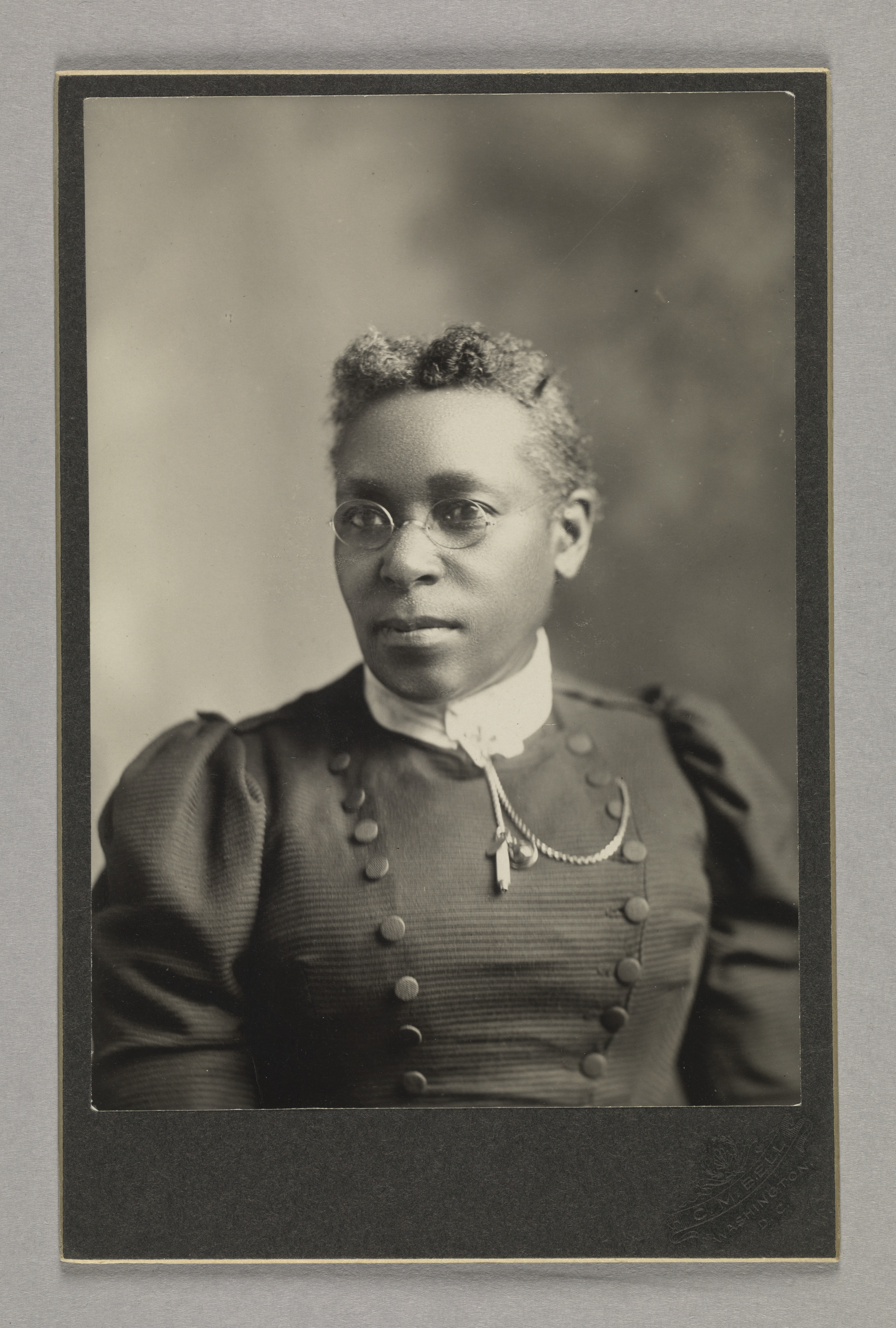
Description: A cabinet card comprising a portrait photograph, mounted on card, of Susan Bell wearing spectacles and looking to her right. She wears a dark, striped bodice with puffed sleeves and a double row of buttons and a watch chain pinned to her collar. The text “C. M. BELL / WASHINGTON / D.C.” is embossed in the lower right corner of the card mount. The reverse of the card mount is blank.
Dimensions: 6 9/16 x 4 1/4 in. (16.7 x 10.8 cm)
Collection Title: Photograph album of Allston family and other portraits
Credit Line: Smithsonian National Museum of African American History and Culture, Gift of the Family of Keith M. Jones in honor of Lonnie Bunch
Accession number: 2009.31.8
Annie E. Colley Bell, C. M. Bell Studio, Cabinet card of Susan Bell, February–March 5, 1894. Silver and collodion on printing-out paper on card mount. From a photograph album of Allston family and other portraits, 1880s–1910. 2009.31.8.
Susan Bell (1836–94) was born in Bermuda. Her grandfather on her mother’s side, a freeman named Peter Herbert, was appointed class leader in the Wesleyan Methodist Church, the first class leader in Bermuda.[1] The United Methodist Church describes class leaders as “disciples who disciple others . . . who are ready to be more intentional about their discipleship.”[2] In Bermuda, Susan met and married Rev. G. H. S. Bell (1838–1911; fig. 1) and gave birth to their son, Samuel Bell, in about 1858.[3] When her husband was accepted as a minister in the A.M.E. Zion Church in the New England Conference, Susan and her son joined Rev. Bell for his appointment in Cambridge, Massachusetts, and she accompanied him as he moved from congregation to congregation in Connecticut and Massachusetts.[4]
The varied and critical roles that women play in the Black church are widely acknowledged, but only recently have scholars begun to center this work in the context of religious history.[5] While women could be ordained in the A.M.E. Zion Church as early as 1891, men held nearly all clerical appointments in that era.[6] As in many churches, however, women in the A.M.E. Zion Church did much of the work. In her role as the minister’s wife, Susan surely helped him care for the congregation, manage the many events that took place at church in addition to services, and meet his obligations as a community leader. Rev. Bell earned an excellent reputation, and Susan, described as “an ideal pastor’s wife,” deserves some of the credit.[7]
In a society dominated by men, one of the ways women in the late nineteenth century could assert their presence was through photography. Social norms informed women about how to dress and present themselves, but women usually determined what they would wear and how they would appear in photographs. Susan’s portrait projects respectability, propriety, and restraint. She wears a fashionable but conservative dress, in a single, dark color. Its fanciest aspects are stylish leg-of-mutton sleeves and a double row of covered buttons. Her only adornment is her fobbed watchchain. Her spectacles give her a bookish air and probably suggested to peers that she was literate and well-educated.[8]
Susan passed away on March 5, 1894, soon after this photograph was taken.[9] Her memorial card is inserted into the next page of the album.[10] A short time after she died, the A.M.E. Zion Church newspaper, The Star of Zion, published “Resolutions of Sympathy” by the Daughters of Conference of the A.M.E. Zion Church in Worcester, Massachusetts. These resolutions were for their “former friend and beloved associate, sister Susan Bell . . . and those who were nearest and dearest to her,” and include: “Resolved, that it is out [of] a just tribute to the memory of the departed, to say in regretting her removal from our midst, we mourn for one who was in every way worthy of our respect and regard.”[11]
Notes
[1] Bishop J. W. Hood, One Hundred Years of the African Methodist Episcopal Zion Church; or The Centennial of African Methodism (New York: A. M. E. Zion Book Concern, 1895), 315.
[2] “Class Leader Job Description,” Discipleship Ministries, United Methodist Church, December 2017, https://www.umcdiscipleship.org/.
[3] For information about Rev. G. H. S. Bell, see the Lives tab for Cabinet card of Rev. G. H. S. Bell (2009.31.7). For information about the Bells in Massachusetts, see 1880 US Census, Massachusetts, Middlesex County, Cambridge (Enumeration District 431, sheet 42), dwelling no. 223, George H. S. Bell (age 43), Susan Bell (age 44), and Samuel H. Bell (age 22, occupation: printer). Record available from Ancestry.com [login required].
[4] See note 3. Susan may be the “Mrs. [?] Bell,” age 40, who appears on the passengers list of the SS Muriel, which departed from Bermuda and landed at the Port of New York in 1880. Passengers List, District of New York, Port of New York, May 24, 1880. Record available from Ancestry.com [login required].
[5] For information about the lack of, and need for, religious-history scholarship on the role of women in the Black Church, see Judith Weisenfeld, “Invisible Women: On Women and Gender in the Study of African American Religious History,” Journal of Africana Religions 1, no. 1 (2013): 133–49, https://doi.org/10.5325/jafrireli.1.1.0133.
[6] Sandra L. Barnes, “Whosoever Will Let Her Come: Social Activism and Gender Inclusivity in the Black Church,” Journal for the Scientific Study of Religion 45, no. 3 (2006): 373, http://www.jstor.org/stable/3838290.
[7] Rev. Wm. B. Bowens, “At Rest,” The Star of Zion, March 22, 1894, 3.
[8] Gemma Almond, “A ‘Spectacle’ of the Face: Eyewear in the Nineteenth Century,” Effaced from History? (blog), July 19, 2017, https://effacedblog.wordpress.com/.
[9] The embossed mounts for the photographs of Rev. and Susan Bell identify the place the photographs were taken as C. M. Bell Studio in Washington, DC. The Bells can be identified because the glass-plate negatives from C. M. Bell Studio for these photographs are preserved at the Library of Congress along with the studio’s logbooks. The negative for Rev. Bell’s photograph is labeled “46868 G. H. S. Bell 6,” Prints and Photographs Division, Library of Congress, Washington, DC, https://www.loc.gov/; the negative for Susan Bell’s photograph is “46869 [?] Mrs. Bell 6,” Prints and Photographs Division, Library of Congress, Washington, DC, https://www.loc.gov/. The logbooks help narrow the date of the photographs to February 1894 or the first few days of March 1894. This was after Annie E. Colley Bell took over studio operations following the death of Charles M. Bell, her husband, in May 1893 but before Susan Bell died on March 5, 1894. Barbara Orbach Natanson, “C. M. Bell Studio Collection of Photographs at the Library of Congress,” Prints and Photographs Division, Library of Congress, Washington, DC, last updated April 2022, https://www.loc.gov/.
[10] For additional information about Susan Bell, see the Lives tab for Memorial card for Susan Bell (2009.31.9).
[11] Mrs. M. E. Anderson, Pres., and Mrs. S. L. Dutton, Secretary, “Resolutions of Sympathy,” The Star of Zion, April 5, 1894, 3 (emphasis in original).
Object Name: Memorial card for Susan Bell
Print by: Maker once known
Subject of: Susan Bell, Bermudian American, 1836–94
Born in: Caribbean, Bermuda
Waterbury, New Haven County, Connecticut
Died in: Waterbury, New Haven County, Connecticut
Date: March 5, 1894
Place used: Waterbury, New Haven County, Connecticut
Medium: Ink on pasteboard
Description: A memorial card printed with metallic copper and silver ink on a black card mount. The card reads “TO THE MEMORY OF / Susan Bell / the Beloved Wife of Rev. G. H. S. Bell / DIED / Mar. 5, 1894 / AGED / 58y, 5d.” A poem is printed on the bottom half of the card. The reverse of the card is blank.
Dimensions: 6 1/2 x 4 1/4 in. (16.5 x 10.8 cm)
Collection Title: Photograph album of Allston family and other portraits
Credit Line: Smithsonian National Museum of African American History and Culture, Gift of the Family of Keith M. Jones in honor of Lonnie Bunch
Accession number: 2009.31.9
Maker once known, Memorial card for Susan Bell, March 5, 1894. Ink on pasteboard. From a photograph album of Allston family and other portraits, 1880s–1910. 2009.31.9.
This memorial card is for Susan Bell (1836–94), who appears in the Cabinet card of Susan Bell (fig. 1) and was married to Rev. G. H. S. Bell (fig. 2).[1] The cabinet card and the memorial card together suggest that the compiler of the album attended Susan’s memorial service. Susan died at home, at the parsonage of the Mount Olive A.M.E. Zion Church on Pearl Street in Waterbury, Connecticut.[2] Rev. William B. Bowens writes:
Her death was peaceful, and one of christian triumph, and of her it can truthfully be said “’Twas sweet to die.” She possessed those strong aimable qualities of heart and mind that makes a noble and beautiful womanhood. She was a great church-worker and an ideal pastor’s wife, and rendered invaluable service to her (now greatly afflicted) husband in the pastorate.[3]
Rev. Bowens was an A.M.E. Zion minister born in New Berne, North Carolina, who had made Worcester, Massachusetts, his home and joined the New England Conference in the mid-1870s.[4] At the time of Susan’s passing, he was serving in the A.M.E. Zion Church in Derby, Connecticut, about twenty miles south of Waterbury, but because the Bells had served in Worcester and, more importantly, because A.M.E. Zion ministers within the New England Conference met frequently all around New England, Rev. Bowens probably knew the Bells before his arrival in Derby.[5] He attended Susan’s funeral, writing about the service and referring to himself in the third person:
The funeral ceremonies were held Wednesday, March 7th, at 1:30 and the church was filled with a congregation composed of both races who truly mourn her [Susan’s] death. The choir sang very affectionately. . . . Rev. Davenport of the Congregational church (white) read selections from the scripture and Rev. Elsie of the white Baptist church offered a very pataetic [sic] prayer. Rev. W. B. Bowens of Derby preached a very able sermon and paid an eloquent tribute to her precious memory from the words, “Blessed are the dead who die in the Lord,” Revelation xiv, 1–3. The household of Ruth read their impressive service.
The body was taken to Hartford, Conn., for interment.[6]
Notes
[1] For information about Susan Bell, see the Lives tab for Cabinet card of Susan Bell (2009.31.8). For information about Rev. G. H. S. Bell, see the Lives tab for Cabinet card of Rev. G. H. S. Bell (2009.31.7).
[2] “Local News: Brief Mention,” New Haven Daily Morning Journal and Courier, March 7, 1894, 1; and “City News,” Waterbury Evening Democrat, March 6, 1894, 4.
[3] Rev. Wm. B. Bowens, “At Rest,” The Star of Zion, March 22, 1894, 3.
[4] Bishop J. W. Hood, One Hundred Years of the African Methodist Episcopal Zion Church; or The Centennial of African Methodism (New York: A.M.E. Zion Book Concern, 1895), 261.
[5] Bowens, “At Rest,” 3. For information about the organization of the church in Derby, see “About Us,” Clinton A.M.E. Zion Church, Ansonia, CT, accessed July 18, 2024, https://clintonamez.wixsite.com/.
[6] Bowens, “At Rest,” 3.
Object Name: Cabinet card of an unidentified man
Photograph by: G. W. Babb, American, active 1882–88
Boston, Suffolk County, Massachusetts
Studio operated by: George W. Babb, American, 1836–1915
Boston, Suffolk County, Massachusetts
Subject of: Unidentified man
Date: 1888
Place made: New Haven, New Haven County, Connecticut
Medium: Albumen and silver on paper on card mount
Description: A cabinet card comprising a portrait photograph, mounted on card, of an unidentified man with a mustache looking directly at the camera. He stands with his left arm behind his back and a walking stick in his right hand. He wears a dark, double-breasted long coat with a boutonniere on his left lapel. Text printed on the bottom of the card mount reads “G. W. Babb / 916 CHAPEL STREET, / NEW HAVEN, CONN.” The reverse of the card is blank.
Dimensions: 6 1/2 x 4 1/4 in. (16.5 x 10.8 cm)
Collection Title: Photograph album of Allston family and other portraits
Credit Line: Smithsonian National Museum of African American History and Culture, Gift of the Family of Keith M. Jones in honor of Lonnie Bunch
Accession number: 2009.31.10
G. W. Babb, Cabinet card of an unidentified man, 1888. Albumen and silver on paper on card mount. From a photograph album of Allston family and other portraits, 1880s–1910. 2009.31.10.
The gentleman on this cabinet card is not identified, but given the date and context of the album, it may be Foster Marshall Robinson (ca. 1860–1920). In about 1888, Foster married Sarah Allston (1870–1949), the eldest sister of Mary Evelina Allston (1888–1975) and Ida Allston (1872–between 1930 and 1948), who are included in this album.[1] This photograph dates to 1888, so perhaps it commemorates Foster and Sarah’s engagement or marriage.[2] The man in the photograph wears a crisp white shirt over a long, double-breasted coat and stands with one arm and hand behind his back, a common pose. In his other hand he holds a walking stick. Tucked into his buttonhole is a sprig of flowers.
Eight years earlier, Foster was working as a farm laborer in South Carolina.[3] The enumerator of the US census of 1880 noted that Foster could neither read nor write, but the opposite was noted in the census of 1900—perhaps he became literate as an adult or one of the records is inaccurate.[4] If his education limited his prospects, it did not appear to limit his ambition. Just before he married Sarah, he was living in New Haven. He held the office of senior deacon in the Widow’s Son Lodge No. 1, Free & Accepted Masons, and was working as a blacksmith. At approximately the time he married, he is listed as a waiter at Elliott House in the “large handsome dining room” said to have had a table that “is one of the best to be found at any New England hotel; well supplied with the best the market affords and admirably cooked.”[5]
Foster and Sarah soon moved to Waterbury, Connecticut, and in 1889 had their first child, Emma Elvira (1889–1950).[6] For a few years after they married, Foster worked as a janitor, but in 1894 he is listed as a truckman, working for himself. He and his family were living on Pearl Street, down the street from the Mount Olive A.M.E. Zion Church, and he had rented a barn on the same site for his business.[7]
In 1895, Foster suffered a huge loss when a fire, probably arson, destroyed his carriage and express wagon and killed his horse.[8] If he was targeted in order to put a rival or a Black man out of business, the effort failed: he is listed in the city directory the next year, at a new address.[9] In 1899, he paid for the first of several advertisements in Waterbury’s directory for services as an “Expressman and Truckman, Light and Heavy Teaming.”[10]
By 1900, he and Sarah had four girls, and he owned his house.[11] In 1906, Foster purchased land in Becket, Massachusetts, where he and Sarah moved with their six children: Emma Elvira (1889–1950), Ethel Isabella (b. 1893), Florence Beatrice (1896–1979), Gladys M. (b. 1898), Franklin Foster (b. ca. 1902), and Annie Azalea (b. ca. 1905).[12] The family farmed and had three more children in Massachusetts: James R. (1907–8), who was about four months old when he died; David Randolph (ca. 1910–73); and Louise (b. ca. 1913).[13] Foster lived on the farm until he died in 1920.[14]
Notes
[1] For information about Sarah Allston, her marriage to Foster Marshall Robinson, and their children, see the Lives tab for Cabinet card of an unidentified woman (2009.31.5). For information about Mary Evelina Allston, see the Lives tab for Cabinet card of a child, Mary Evelina Allston, in a christening gown (2009.31.4). For information about Ida Allston, see the Lives tab for Cabinet card of Ida Allston (2009.31.14).
[2] For information about G. W. Babb studio, see the Appendix, “Photography Studios Represented in the Photograph Album of Allston Family and Other Portraits.”
[3] 1880 US Census, South Carolina, Abbeville County, Donaldsonville (Enumeration District 11, sheet 5), dwelling no. 47, Foster Robinson (age 20, farm laborer; can read and write: no).
[4] In the US census for 1900 the Robinsons’ surnames are misrecorded as Roberts: 1900 US Census, Connecticut, New Haven County, Waterbury (Enumeration District 424, sheet 26A), dwelling no. 74, Foster Roberts (married: 11 years; owns home: yes; can read and write: yes), Sarah L. Roberts (married: 11 years), Alvira [sic] Roberts, Ethel Roberts, Beatrice Roberts, Gladys Roberts. Record available from Ancestry.com [login required].
[5] “Widow’s Son Lodge,” Morning Journal and Courier (New Haven, CT), June 29, 1887, 2; “Robinson F. M, blacksmith, bds [boards at] 175 George,” New Haven City Directory, 1887 (New Haven, CT: Price, Lee), 381; and “Robinson F. M., waiter Elliott House,” New Haven City Directory, 1888 (New Haven, CT: Price, Lee, 1888), 406. The quotes about Elliott House come from Leading Business Men of New Haven County (Boston: Mercantile, 1887), 115.
[6] Births in the Town of New Haven, October 1889, Emma Elvira Robinson, born October 9, 1889, to Foster M. Robinson and Sarah L. Allston, at 133 Butler Street, New Haven, CT, 58. Record available from Ancestry.com [login required].
[7] “Robinson, Foster M., truckman, h [house or householder (owner of the house)] 75 Pearl,” Waterbury and Naugatuck Directory, 1894 (New Haven, CT: Price, Lee, 1894), 324. Entries for Foster Robinson as a truckman also appeared in subsequent years of the directory until 1906, when there are two entries for him: “Robinson Foster M. truckman 58 E Hawkins h [house or householder (owner of the house)] do [ditto]” and “F. M. Robinson, Expressman and Truckman, Light and Heavy Teaming, will receive prompt attention. Order Slate, 77 No. Main St., Residence, 58 E. Hawkins St., Waterbury, Conn.” Waterbury and Naugatuck Directory, Including Watertown, 1906 (New Haven, CT: Price, Lee, 1906), 507, 1068.
[8] “City News,” Waterbury Evening Democrat, July 9, 1895, 4.
[9] See note 7.
[10] “F. M. Robinson, Expressman and Truckman, Light and Heavy Teaming, will secure prompt attention. Order Slate, 77 North Main St. – Residence, 14 George St., Waterbury, Conn.,” Waterbury and Naugatuck Directory, Including Watertown, 1899 (New Haven, CT: Price, Lee, 1899), 943.
[11] See note 4.
[12] Marshall (1891–between 1891 and 1900), one of their children born in Connecticut, died before the family moved to Massachusetts. For information about Marshall Robinson, see the Lives tab for Cabinet card of an unidentified child wearing a christening gown (2009.31.1).
[13] 1920 US Census, Massachusetts, Berkshire County, Becket (Enumeration District 9, sheet 5A), dwelling no. 104, Foster M. Robinson, Sarah L. Robinson, Anna A. Robinson, David R. Robinson, and Louise Robinson. About James R. Robinson, see Commonwealth of Massachusetts, Return of Death, name: James R. Robinson; place of death: Becket, MA; date of death: February 22, 1908; age: 4 months; father: Foster M. Robinson; mother: Sarah Robinson. Records available from Ancestry.com [login required].
[14] See Memorial page for Foster Marshall Robinson (ID 136820184; born: April 25, 1862; died: June 19, 1920; burial: North Becket Cemetery, Becket, Berkshire County, MA), Find a Grave, October 4, 2014, https://www.findagrave.com/.
Object Name: Cabinet card of an unidentified child
Photograph by: Atlantic Photo and Portrait Co., American, active 1896–1901
Located in: Philadelphia, Philadelphia County, Pennsylvania
Subject of: Unidentified child
Date: ca. 1896–1901
Place made: Philadelphia, Philadelphia County, Pennsylvania
Medium: Silver and collodion on printing-out paper on card mount
Description: A cabinet card comprising a portrait photograph, mounted on card, of an unidentified child, wearing a white dress and seated in a chair covered with a fur pelt. Text printed on the bottom of the mount reads “Atlantic Photo / AND / Portrait Co. / 915 Arch Street, / Philadelphia.” The reverse of the card is blank.
Dimensions: 6 1/2 x 4 1/4 in. (16.5 x 10.8 cm)
Collection Title: Photograph album of Allston family and other portraits
Credit Line: Smithsonian National Museum of African American History and Culture, Gift of the Family of Keith M. Jones in honor of Lonnie Bunch
Accession number: 2009.31.11
Atlantic Photo and Portrait Co., Cabinet card of an unidentified child, ca. 1896–1901. Silver and collodion on printing-out paper on card mount. From a photograph album of Allston family and other portraits, 1880s–1910. 2009.21.11.
Infants cannot refuse to have their photos taken, so how they are presented is entirely up to their parents and the photographer. Photographers usually positioned a baby at eye level, which, along with the baby being the sole person represented in the photograph, seems to elevate the baby’s status. By the late 1800s, exposures were fast enough that photographers no longer needed special supports and devices to hold sitters still, but even so, it was necessary to keep squirmy babies upright and prevent them from sliding or falling off their perch. Covering a chair with a thick fur, a heavy blanket, or a substantial length of fabric, and propping the babies up in one of these, was a common strategy that allowed infants who were too young to hold themselves upright to be photographed alone—or seemingly alone. Often someone, usually the mother, hid behind the chair and under the covering, holding the baby in place to keep him or her from escaping.[1] That may be the case here.
Around the turn of the twentieth century, baby boys and girls were dressed alike. Mothers usually chose fancy dresses or gowns, often in white, for their babies’ photographs. The adult fashion for dresses and bodices, and shirtwaists with puffed shoulders, translates here into a dress with tiny, puffed, three-quarter sleeves. The effect of such fancy dress and an upright, solitary pose is often regal, as if the solemn baby is presiding from a throne. Here, this impression is a bit undone by the baby’s tilted head and splayed feet, visible in little shoes peeping from beneath the dress’s scalloped hem.
This cabinet card is difficult to date because the name of the studio appears only twice in Philadelphia’s city directory, in 1896 and 1910.[2] The child is unidentified, but given the Allston family’s connection to Philadelphia, he or she may be related to Mary Evelina Allston (1888–1975) and Ida Allston (1872–between 1930 and 1948), who are portrayed in this album.[3] Mary Evelina and Ida’s mother, Anna (1848–after 1910), was from Philadelphia; her parents were William H. Crawford (ca. 1823–90) and Sarah Crawford (ca. 1830–after 1910), who reared seven additional children in Philadelphia. Perhaps the child in the photograph is their grandchild or great-grandchild.[4]
Notes
[1] Emily von Hoffmann for Polarr, “The Secret behind Child Portraiture of the 1800s,” Pixel Magazine, November 2, 2015, https://medium.com/.
[2] For information about Atlantic Photo and Portrait Company, see the Appendix, “Photography Studios Represented in the Photograph Album of Allston Family and Other Portraits.”
[3] For information about Mary Evelina Allston, see the Lives tab for Cabinet card for a child, Mary Evelina Allston, in a christening gown (2009.31.4). For information about Ida Allston, see the Lives tab for Cabinet card of Ida Allston (2009.31.14).
[4] For more information about the Crawford family, see the Lives tab for Cabinet card of an unidentified man (2009.31.29).
Object Name: Cabinet card of an unidentified child wearing a christening gown
Photograph by: Buckley, American, active 1894–1906
Located in: Waterbury, New Haven County, Connecticut
Studio operated by: Ambrose H. Buckley, active 1894–1906
Subject of: Unidentified child
Date: 1894–1906
Place made: Waterbury, New Haven County, Connecticut
Medium: Silver and collodion on printing-out paper on card mount
Description: A cabinet card comprising a portrait photograph, mounted on card, of an unidentified child, wearing a long christening gown and seated on chair covered with a fur pelt. The mount has an embossed design of fretwork with text embossed along the bottom reading “BUCKLEY / BANK ST. / WATERBURY, CONN.” The reverse of the card mount is blank.
Dimensions: 6 1/2 x 4 1/4 in. (16.5 x 10.8 cm)
Collection Title: Photograph album of Allston family and other portraits
Credit Line: Smithsonian National Museum of African American History and Culture, Gift of the Family of Keith M. Jones in honor of Lonnie Bunch
Accession number: 2009.31.12
Buckley, Cabinet card of an unidentified child wearing a christening gown, 1894–1906. Silver and collodion on printing-out paper on card mount. From a photograph album of Allston family and other portraits, 1880s–1910. 2009.31.12.
This infant, wearing a crocheted white sweater over a long white gown and snugly supported by a fur pelt over a spindled chair, appears twice in this album.[1] The photograph dates from between 1894 and 1906, the years Buckley photography studio was located at 50 Bank Street, the address imprinted on the bottom front of the cabinet card.[2] It seems likely that the baby lived in Waterbury because simply getting someone this age photographed at a local studio was likely a challenge.
Like several other infants in the album, this child was photographed in a long, fancy dress. Always white and frequently embroidered and trimmed with lace, these gowns were worn during christening, a centuries-old religious ritual still practiced in the United States in most Christian denominations. The same gown was often worn by more than one infant in the same family and passed down for future generations. During christening, a child is welcomed into the congregation and given their Christian name. Often christening is combined with the sacrament of baptism, during which the baby is splashed or immersed in water by a minister or priest, cleansed of sins, and reborn as a Christian. Baptism includes a commitment by the parents or guardians who present the person for baptism and who promise to bring up the child in the faith.[3] In Connecticut around the turn of the twentieth century, some congregations took up a public collection as a gift to the family of the baby being baptized.[4]
The compiler of the album thought christening was important—several babies in the photo album are dressed in christening gowns. By 1906, the latest possible date for this photograph, African Americans in Waterbury had two churches run by Black from which to choose for a christening. The first was Mount Olive A.M.E. Zion Church, where Rev. G. H. S. Bell (1838–1911; fig. 1), whose photograph is included in this album, probably served from 1892–94 and 1896–1900.[5] The second was Grace Baptist Church of Waterbury.[6]
The photographs of babies in christening gowns in this album, along with the photographs of the Rev. Bell and Bishop James W. Hood (1831–1918; fig. 2), also in the album, suggest the compiler belonged to a Christian-faith tradition, most probably the African Methodist Episcopal (A.M.E.) Zion Church, where Rev. Bell and Bishop Hood held leadership positions.[7]
Notes
[1] See also the Lives tab for Cabinet card of an unidentified child wearing a christening gown (2009.31.2).
[2] For information about Buckley studio, see the Appendix, “Photography Studios Represented in the Photograph Album of Allston Family and Other Portraits.”
[3] “Bridge Street AME Church Baptism Guide,” Bridge Street AME Church, Brooklyn, NY, accessed July 28, 2024, http://www.bridgestreetbrooklyn.org/.
[4] For example, at the Mount Olive A.M.E. Zion Church in Waterbury in 1883, “the infant son of Mr. and Mrs. Holden was baptized with the name of Edward Holden. The public collection amounted to $38.82.” New York Globe, September 15, 1883, 4.
[5] For information about Rev. Bell, see the Lives tab for Cabinet card of Rev. G. H. S. Bell (2009.31.7).
[6] For information about Grace Baptist Church, see “History,” Grace Baptist Church, Waterbury, CT, accessed August 1, 2024, https://gracebaptistchurch-waterbury.com/.
[7] For information about Bishop Hood, see the Lives tab for Halftone portrait of Bishop James W. Hood (2009.31.26).
Object Name: Cabinet card of an unidentified man
Photograph by: Ideal Portrait Company, American, active 1894–95
Located in: New Haven, New Haven County, Connecticut
Subject of: Unidentified man
Date: 1894–95
Place made: New Haven, New Haven County, Connecticut
Medium: Silver and collodion on printing-out paper on card mount
Description: A cabinet card comprising a portrait photograph, mounted on card, of an unidentified man with a mustache looking directly at the camera. He stands with his left arm behind his back and wears a dark, double-breasted long coat, a white shirt, and a dark bow tie. Printed on the bottom of the card mount is the text “Ideal / PORTRAIT CO. / 69 Church Street, / NEW HAVEN, CONN.” The reverse of the card is blank.
Dimensions: 6 1/2 x 4 1/4 in. (16.5 x 10.8 cm)
Collection Title: Photograph album of Allston family and other portraits
Credit Line: Smithsonian National Museum of African American History and Culture, Gift of the Family of Keith M. Jones in honor of Lonnie Bunch
Accession number: 2009.31.13
Ideal Portrait Company, Cabinet card of an unidentified man, 1894–95. Silver and collodion on printing-out paper on card mount. From a photograph album of Allston family and other portraits, 1880s–1910. 2009.31.13.
This gentleman has not been identified, but his photograph was taken in 1894 or 1895, the only years Ideal Portrait Company operated in New Haven.[1] It is possible that he is James Allston (1843–1911), father of Mary Evelina Allston (1888–1975) and Ida Allston (1872–between 1930 and 1948), who are portrayed in the album.[2] If this is James, he would have been about fifty years old.[3]
James was probably born in Edenton, North Carolina, or adopted it as his birthplace.[4] It was once North Carolina’s second largest port and was part of the Maritime Underground Railroad.[5] It is not known whether James was born into enslavement or into a free family, but he was in Philadelphia by 1870 and married to Anna Crawford (1848–after 1910).[6] Anna, her parents, and her siblings had been living in Philadelphia since well before the Civil War; they are listed as free inhabitants in the US census of 1860.[7]
The census of 1870 in Philadelphia shows that James, Anna, and their newborn, Sarah Allston (1870–1949), were living with or next to Anna’s parents.[8] Their second child, Ida Allston, was also probably born in Pennsylvania. In December 1876, James enlisted in the Navy, joining the crew of the USS Ranger in Philadelphia as a steward.[9] In 1880, he and his family, now with two more children, Rebecca Lauretta (b. 1875) and James (b. 1880), were still living in Philadelphia, where his occupation is listed as seaman.[10] James Sr.’s stint in the Navy is likely where he learned or honed his skills cooking for large groups of people. From 1880 on, his occupation is listed as a janitor, cook, or chef.[11] In about 1900, he opened a restaurant with Mack Jones in Waterbury.[12] It seems to have closed within a year or two, but his fame as a camp cook is noted in New Haven newspapers:
No mention of Tuxis Island is complete without a word concerning the famous camp cook, James Allston. Mr. Allston has catered to the camp ever since it was first organized four years ago, to the abundant satisfaction of all concerned. Mr. Allston is a famous singer and one of his songs is such a favorite with the boys that the refrain may be heard from some part of the island at almost any time. It runs as follows: “Sittin’ round the golding alter, chillen. Sittin’ round the golding altar, chillen, over in the promised land.”[13]
He seems to have worked hard to provide for his large family, eventually owning his own home, but in 1904, Anna abandoned him.[14] In 1910, she was working as a nurse and living with her mother in New York City; by then, James had mortgaged the family home on Butler Street in New Haven to his daughter Rebecca and her husband Henry Scroggins (b. 1875) and moved to Becket, Massachusetts, to live with his daughter Sarah, her husband Foster Marshall Robinson (ca. 1860–1920), and their children.[15] James’s will, which he signed with an X, suggesting he could not read and write or was too ill to sign the document, lists only six of his seven children: the name of the last and youngest, Mary Evelina Allston, is missing.[16] She was only about sixteen when her mother Anna left James; perhaps Mary Evelina left home with her mother. When James died, his estate consisted of the second mortgage for his home, one gold watch, two walking canes, and one set of cooking knives.[17]
Notes
[1] For information about Ideal Portrait Company, see the Appendix, “Photography Studios Represented in the Photograph Album of Allston Family and Other Portraits.”
[2] For information about Mary Evelina Allston, see the Lives tab for Cabinet card for a child, Mary Evelina Allston, in a christening gown (2009.31.4). For information about Ida Alston, see the Lives tab for Cabinet card of Ida Allston (2009.31.14).
[3] James Allston was twenty-six in 1870, so in 1894–95 he would been about fifty. 1870 US Census, Pennsylvania, Philadelphia County, Philadelphia (District 19, sheet 99), dwelling no. 660, James Allston (26), Annie Allston, Sarah L. Allston, and Theodore Crawford. Record available from Ancestry.com [login required].
[4] In US Navy records, James Allston’s birthplace is listed as Eddington, NC, a place that does not exist. This entry was probably a misrecording of Edenton, NC. See US Navy, Enlistments at Philadelphia 1876, Return of the United States Navel Rendezvous at Philadelphia for the week ending Saturday, December 9, 1876, James Allston, enlisted: December 5, 1876; born at: Eddington [sic], NC; age: 31; occupation: steward; eyes: brown; hair: black; complexion: [illegible] mulatto; inches: 59 3/4 in. Record available from Ancestry.com [login required].
[5] “Historic Edenton,” North Carolina Historic Sites, North Carolina Division of State Historic Sites and Properties, Raleigh, NC, accessed July 25, 2024, https://historicsites.nc.gov/.
[6] For the US census of 1870, see note 3.
[7] 1860 US Census, Pennsylvania, Philadelphia County, Philadelphia (Free Inhabitants; Ward 1, Precinct 5, sheet 226), dwelling no. 1590, William H. Crawford, Sarah A. Crawford, Anna Crawford, Mary A. Crawford, William Crawford, Henry L. Crawford (age 6), and Sarah V. Crawford. Record available from Ancestry.com [login required].
[8] For James Allston in Philadelphia in 1870, see note 3. For the Crawfords, see 1870 US Census, Pennsylvania, Philadelphia County, Philadelphia (District 19, sheet 98), dwelling no. 659, William Crawford (driver for [illegible]), Sarah Crawford, Mary Crawford, Willie Crawford, Henry Crawford, Evelina Crawford, and Eliza Crawford. For information about Sarah Allston, see the Lives tab for Cabinet card of an unidentified woman (2009.31.5).
[9] For information about James Allston’s service, see note 4. For information about the USS Ranger, see Robert W. Neeser, “Historic Ships of the Navy—Ranger,” Proceedings, March 1929, US Naval Institute, https://www.usni.org/.
[10] 1880 US Census, Pennsylvania, Philadelphia County, Philadelphia (Enumeration District 81, sheet 1), dwelling no. 1, James Austin (occupation: seaman), Annie Austin, Sarah Austin, Ida Austin, Rebecca Austin, and James Austin.
[11] “Allston James, cook, h [house or householder (owner of the house)] 16 Dow,” New Haven City Directory, 1881 (New Haven, CT: Price, Lee, 1881), 20; “Allston James, janitor, h [house or householder (owner of the house)] 155 Goffe,” New Haven City Directory, 1885 (New Haven, CT: Price, Lee, 1885), 22; and “Allston James, janitor, Y.C. [Yale College], h [house or householder (owner of the house)] Cave,” New Haven City Directory, 1886 (New Haven, CT: Price, Lee, 1886), 26. Entries for James Allston as a janitor at Yale College or Yale University also appeared in subsequent years of the directory until 1895, when his entry reads: “Allston James, janitor, Y.U. [Yale University], h [house or householder (owner of the house)] 133 Butler.” New Haven City Directory, Including West Haven, 1895 (New Haven, CT: Price, Lee, 1895), 32.
[12] “Allston James, restaurant 280 Cherry, rms [rooms] 16 George” and “Restaurants: Allston James, 280 Cherry,” Waterbury and Naugatuck Directory, Including Watertown, 1900 (New Haven, CT: Price, Lee, 1900), 23, 597; and “Allston James (Allston & Jones) 287 Cherry, rms [rooms] 14 George & Jones (James Allston and Mack Jones), restaurant 287 Cherry,” Waterbury and Naugatuck Directory, Including Watertown, 1901 (New Haven, CT: Price, Lee, 1901), 23. See also this announcement: “James Allston, 14 George street [sic], who conducts a restaurant at 280 Cherry street [sic], called at the police station this afternoon and informed Chief Egan that his nephew . . . stole a pocketbook containing $23 from him last night.” “City News,” Waterbury Evening Democrat, February 20, 1900, 1.
[13] “Camp Tuxis Entertains,” New Haven Morning Journal and Courier, July 12, 1902, 12.
[14] According to James’s probate papers, Anna “abandoned” him on October 3, 1904, and he did not list her as an heir. Will of James Allston, died August 7, 1911, and application of Foster M. Robinson for probate of the will, September 7, 1911, records for James Allston, Town of New Haven, 1911, New Haven District, Estate Files, Wills and Probate Records, 1609–1999, vol. 418, 475. Records available from Ancestry.com [login required].
[15] For James Allston, see 1910 US Census, Massachusetts, Berkshire County, Becket (Enumeration District 27, sheet 1B), dwelling no. 17, F. M. Robinson, Sarah L. Robinson, Elvira V. Robinson, Ethel Isabella Robinson, Florence Beatrice Robinson, Gladys M. Robinson, Franklin Foster Robinson, Annie Azalea Robinson, David Randolph Robinson, and James Allston (age 64). For Anna Allston, see 1910 US Census, New York State, New York County, New York (Enumeration District 503, sheet 12A), dwelling no. 35, Anna R. Allston (age 61) and Sarah Crawford (age 81). Both women are listed as widowed, but Anna’s husband James was still alive in 1910; he passed away on August 7, 1911. Records available from Ancestry.com [login required].
[16] His children and heirs are listed in the will and probate documents cited in note 14.
[17] For his estate, see note 14.
Object Name: Cabinet card of Ida Allston
Photograph by: Cramer & King, American, active 1888–91
Located in: New Haven, New Haven County, Connecticut
Subject of: Ida Allston Brown Scott, American, 1872–between 1930 and 1948[1]
New York, New York County, New York
Date: 1888–91
Place made: New Haven, New Haven County, Connecticut
Medium: Albumen and silver on paper on card mount
Description: A cabinet card comprising a portrait photograph, mounted on card, of a young woman, Ida Allston, looking to her right. She wears a dark, pleated bodice with a white, ruffled lace collar and earrings. A cartouche and banner with the text “ART STUDIO” inside the banner is printed on the bottom of the card mount. Beneath it is the text “CRAMER & KING / NEW HAVEN, CONN.” Printed on the reverse of the mount is a design of a winged cherub on the right taking a photograph of a woman in classical-style dress who sits on the left. Text in the upper right reads “PHOTOGRAPHERS / CRAMER & KING / 818 CHAPEL STREET / NEW HAVEN / CONN / SOLAR ENLARGEMENTS / DUPLICATES / CAN BE HAD / AT ANY TIME.”
Dimensions: 6 1/2 x 4 1/4 in. (16.5 x 10.8 cm)
Collection Title: Photograph album of Allston family and other portraits
Credit Line: Smithsonian National Museum of African American History and Culture, Gift of the Family of Keith M. Jones in honor of Lonnie Bunch
Accession number: 2009.31.14
Notes
[1] The “Object Name” of this cabinet card reflects the name of the person depicted at the time the photograph was taken. The “Subject of” for this cabinet card uses the form of the person’s name by which she was probably most widely known. Ida Allston married Richard W. Brown (1869–1919) around 1893. See 1900 US Census, Connecticut, New Haven County, New Haven (Enumeration District 379, sheet 17B), dwelling no. 267, Richard W. Brown, Ida O. Brown (married 7 years), Cora E. Brown, Annie E. Brown, and Ann Piggot. Record available from Ancestry.com [login required]. After Richard W. Brown died in 1919, Ida married Daniel Scott (1856–1948) on June 12, 1923. State of Connecticut, Connecticut Vital Records—Index of Marriages, 1897–2001, Groom: Daniel Scott, Bride: Ida Brown, Date: June 12,1923, https://data.ct.gov/.
Cramer & King, Cabinet card of Ida Allston, 1888–91. Albumen and silver on paper on card mount. From a photograph album of Allston family and other portraits, 1880s–1910. 2009.31.14.
The young woman portrayed here is identified on the back of the card as Ida Allston (1872–between 1930 and 1948), sister of Mary Evelina Allston (1888–1975), who appears earlier in the album.[1] Visits that Ida and her mother, Anna Allston (1848–after 1910), made from New Haven, Connecticut, to Waterbury, Connecticut, in 1891, provide a clue that helps confirm the association of the Allston family with a third photograph in the album. The society pages of the New York Age newspaper reported in 1891 that Anna and Ida had called on Anna’s daughter and Ida’s sister, Mrs. Foster M. Robinson, whose maiden name was Sarah Allston (1870–1949).[2] Sarah’s married name, Sarah Robinson, is written on the back of a cabinet card in the album taken in Philadelphia of an unidentified man (fig. 1), who may be her grandfather (and Anna’s father), William H. Crawford (ca. 1823–90).[3]
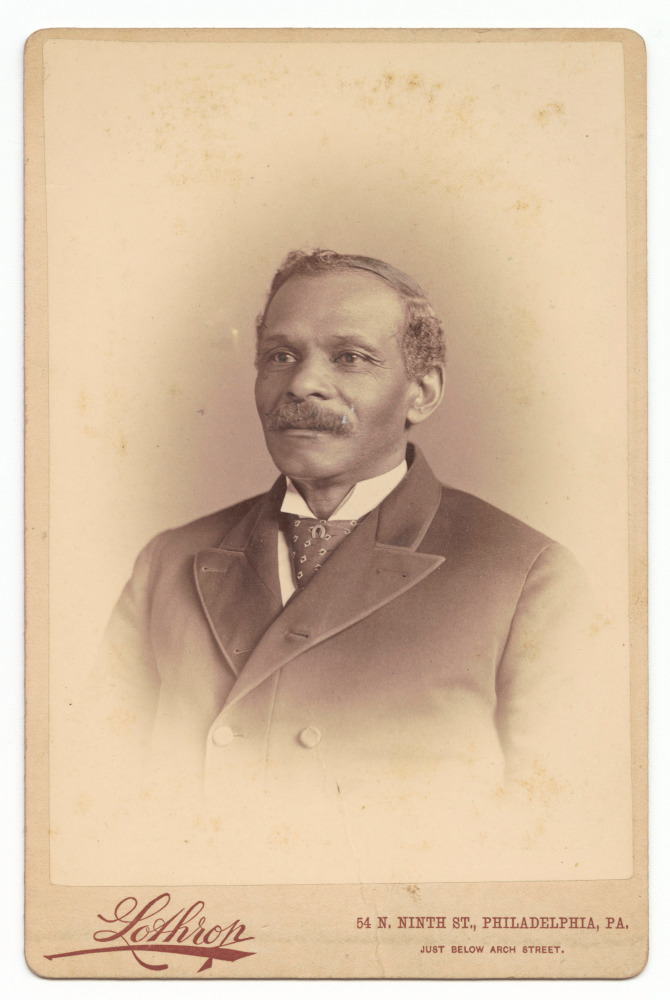
Ida was probably born in Philadelphia, where her parents lived for a time with or next door to her grandparents, William H. and Sarah Crawford (1839–after 1910).[4] Ida and her family were living in Philadelphia in 1880, but they moved to New Haven by 1881, the earliest date her father is listed in the New Haven city directory.[5] In about 1893, Ida married Richard W. Brown (1869–1919), who was born in Maryland and may be the man in the last photograph in the album.[6] He worked as a machinist for the major hardware manufacturer Sargent & Company, which made him one of the few African Americans employed in a skilled occupation in a Connecticut factory; he remained at Sargent for most of his career. Steady employment probably helped him to purchase the house he owned on Shelton Avenue in New Haven.
When Richard died in 1919, he left Ida a widow with five children: Annie (b. 1895), Cora E. (b. 1894), James R. (b. ca. 1902), Alvin (b. ca. 1905), and Kermit (b. ca. 1910). Ida was working as a nurse for a private family and living with her three boys in New Haven in 1920, but in 1923, she was remarried to Daniel Scott (1856–1948), and they moved to 121st Street in New York with Alvin and Kermit.[7] Ida died sometime between the 1930 census and the death of her second husband in 1948.[8]
Notes
[1] For information about Mary Evelina Allston, see the Lives tab for Cabinet card of a child, Mary Evelina Allston, in a christening gown (2009.31.4).
[2] For information about Anna and Ida’s Allston’s visits to Waterbury to see Sarah, see “Waterbury News,” New York Age, January 3, 1891, 2; and “Waterbury News,” New York Age, January 31, 1891, 4.
[3] For information about William H. Crawford, see the Lives tab for Cabinet card of an unidentified man (2009.31.29).
[4] In the US census of 1870, the Crawfords and the Allstons are listed one after the other, living in dwellings no. 659 and 660. 1870 US Census, Pennsylvania, Philadelphia County, Philadelphia (District 19, sheet 98), dwelling no. 659, William Crawford (driver for [illegible]), Sarah Crawford, Mary Crawford, Willie Crawford, Henry Crawford, Evelina Crawford, and Eliza Crawford; and 1870 US Census, Pennsylvania, Philadelphia County, Philadelphia (District 19, sheet 99), dwelling no. 660, James Allston, Annie Allston, Sarah L. Allston, and Theodore Crawford. Ida was probably born in Philadelphia, but census records for her are conflicting. The US census in 1880, where the family surname is misrecorded as Austin, indicates she was born in Pennsylvania. 1880 US Census, Pennsylvania, Philadelphia County, Philadelphia (Enumeration District 81, sheet 1), dwelling no. 1, James Austin, Annie Austin, Sarah Austin, Ida Austin (born: Pennsylvania), Rebecca Austin, and James Austin. The US census in 1900 indicates she was born in Connecticut. 1900 US Census, Connecticut, New Haven County, New Haven (Enumeration District 379, sheet 17B), dwelling no. 267, Richard W. Brown, Ida O. Brown (age 36, married: 7 years, born: Connecticut), Cora E. Brown (b. 1894), Anna E. Brown (b. 1895), and Ann Piggot. Records available from Ancestry.com [login required].
[5] “Allston James, cook, h [house or householder (owner of the house)] 16 Dow,” New Haven City Directory, 1881 (New Haven, CT: Price, Lee, 1881), 20. For information about James Allston, see the Lives tab for Cabinet card of an unidentified man (2009.31.13).
[6] The photograph that may be of Richard W. Brown is Cabinet card of an unidentified man (2009.31.31). For information about Richard W. Brown, see the Lives tab for this cabinet card.
[7]1920 US Census, Connecticut, New Haven County, New Haven (Enumeration District 367, sheet 24B), dwelling no. 310, Ida Brown (nurse for a private family), Richard Brown, Alvin C. Brown, and Kermit E. Brown. Record available from Ancestry.com [login required]; State of Connecticut, Connecticut Vital Records—Index of Marriages, 1897–2001, groom: Daniel Scott; bride: Ida Brown; date: June 12, 1923, https://data.ct.gov/; and 1925 New York State Census, New York County, New York (Election District 36, sheet 29) 521 West 135th Street, Daniel Scott, Ida Scott, Alvin Brown, and Kermit Brown. Record available from Ancestry.com [login required].
[8] 1930 US Census, New York, New York County, New York (Enumeration District 31-902, sheets 6B–7A), dwelling no. 20, Daniel Scott, Ida Brown, Alvin Brown, Ann Brown, Kermit Brown, and Vanita Brown. Death record for Daniel Scott, New York, New York City Municipal Deaths, 1795–1949, Daniel Scott, birth date: December 25, 1856; event [death] date: May 20, 1948; marital status: widowed. Records available from FamilySearch.com [login required].
Object Name: Cabinet card of an unidentified man
Photograph by: Rand, American, active 1891–1903
Located in: New Haven, New Haven County, Connecticut
Studio operated by: Stillman N. Rand, active 1891–1901
Lived in: New Haven, New Haven County, Connecticut
Studio operated by: Belle M. Rand, active 1902–03
Lived in: New Haven, New Haven County, Connecticut
Subject of: Unidentified man
Date: 1891–1903
Place made: New Haven, New Haven County, Connecticut
Medium: Albumen and silver on paper on card mount
Description: A cabinet card comprising a portrait photograph, mounted on card, of an unidentified man, standing and looking to his left. He wears a suit with a single-breasted coat, vest, trousers, and a striped necktie. A pocket square is tucked into the chest pocket of his coat and a watch fob is attached to his vest. Text printed on the bottom of the card mount reads “Rand. / 775 Chapel St., / New Haven.” Printed on the reverse of the card is an engraving of a tall monument in a landscape setting with the text “Soldiers’ Monument, East Rock Park.” below the engraving.
Dimensions: 6 7/16 x 4 1/4 in. (16.4 x 10.8 cm)
Collection Title: Photograph album of Allston family and other portraits
Credit Line: Smithsonian National Museum of African American History and Culture, Gift of the Family of Keith M. Jones in honor of Lonnie Bunch
Accession number: 2009.31.15
Rand, Cabinet card of an unidentified man, 1891–1903. Albumen and silver on paper on card mount. From a photograph album of Allston family and other portraits, 1880s–1910. 2009.31.15.
The gentleman on this card has not been identified, and because the Rand studio operated in New Haven from 1891 to 1903, it is difficult to associate him credibly with anyone in the Allston family circle.[1] He is nattily dressed, in a suit with a crisp white shirt and wide silk tie. Tucked into his jacket pocket is a carefully folded pocket square. Beneath his jacket, he wears a matching waistcoat. His trousers are made of a different, lighter and coarser material. Like most men in the 1890s who were neither wealthy nor poor, he probably wore mass-produced clothing, sold in standardized sizes and available in stores and by mail order. This clothing was relatively inexpensive, allowing working- and middle-class men to dress fashionably.[2] He is also carefully groomed, with his wavy hair parted and probably held in place with pomade and his full mustache tidy and trimmed. A fancy fob hangs from his watch chain; the watch hidden in his vest pocket may have been his most valuable possession. Whether he was dressed for a special event or simply for the photograph, by looking his best, dressing fashionably, and showing off his watch chain, he would have signaled to his contemporaries that he was respectable and prosperous.
Young men and women used cabinet cards for social purposes. They sent their portraits by mail to introduce themselves, presented them to friends and suitors, and traded them with one another. Recipients generally kept these cards, but occasionally the giver asked for one back, perhaps a sign that the relationship between giver and receiver was not working out. Given that the sitter often relied on a photograph to make a first impression and could expect to have his or her photograph passed around and commented on by the recipient’s family and friends, the effort put into dressing for the camera is understandable.
Notes
[1] For information about Rand studio, see the Appendix, “Photography Studios Represented in the Photograph Album of Allston Family and Other Portraits.”
[2] Joan L. Severa, Dressed for the Photographer: Ordinary Americans and Fashion, 1840–1900 (Kent, OH: Kent State University Press, 1995), 471.
Object Name: Cabinet card of an unidentified woman
Photograph by: Ramsdell Photo Artist, American, active 1879–1900
Located in: New Haven, New Haven County, Connecticut
Studio operated by: Daniel P. Ramsdell, American, 1850–1913
Lived in: New Haven, New Haven County, Connecticut
Subject of: Unidentified woman
Date: ca. 1890
Place made: New Haven, New Haven County, Connecticut
Medium: Albumen and silver on paper on card mount
Description: A cabinet card comprising a portrait photograph, mounted on card, of an unidentified woman standing and looking directly at the camera. Her left hand rests on a short pillar draped in ivy. She wears a dark velvet dress with a high neck and a bodice that buttons down the front with many small metal buttons. She has a metal brooch pinned to her collar. Printed on the bottom of the card mount is the word “Ramsdell.” A logo featuring a circular medallion with a strip of film running through it has text reading “Ramsdell PHOTO ARTIST / 817 CHAPEL STREET / NEW HAVEN. Ct. / NEGATIVES PRESERVED.”
Dimensions: 6 7/16 x 4 1/4 in. (16.4 x 10.8 cm)
Collection Title: Photograph album of Allston family and other portraits
Credit Line: Smithsonian National Museum of African American History and Culture, Gift of the Family of Keith M. Jones in honor of Lonnie Bunch
Accession number: 2009.31.16
Ramsdell Photo Artist, Cabinet card of an unidentified woman, ca. 1890. Albumen and silver on paper on card mount. From a photograph album of Allston family portraits and other portraits, 1880s–1910. 2009.31.16.
The identity of this woman is unknown. The Ramsdell studio operated at the address on the card for sixteen years, from 1884–1900, but based on the style of the woman’s elegant dress, the photograph was probably taken in about 1890.[1] The dress is made of velvet, a fabric long associated with luxury, but advances in textile manufacturing during the nineteenth century made fabrics such as velvet, satin, and tulle much more widely accessible and very popular.[2] This was probably an afternoon or dinner dress because it has long sleeves and a high neckline; in the late nineteenth century, evening dresses and ball gowns generally had short sleeves or were sleeveless, and had lower necklines.[3]
The color in the woman’s face, hair, and hands appears washed out, but this effect was probably not intentional. Black and dark-colored velvets absorb nearly all the light shined on them. To see any of the details of this dress, the photographer probably had to significantly increase the lighting, inadvertently overlighting the woman’s face, hair, and hands.
Notes
[1] For information about the Ramsdell Photo Artist studio, see the Appendix, “Photography Studios Represented in the Photograph Album of Allston Family and Other Portraits.” For information about nineteenth-century dress styles, see Harper Franklin, “1880–1889: Womenswear,” Fashion History Timeline, Fashion Institute of Technology, State University of New York, last updated August 18, 2020, https://fashionhistory.fitnyc.edu/; and Harper Franklin, “1890–1899: Womenswear,” Fashion History Timeline, Fashion Institute of Technology, State University of New York, last updated August 18, 2020, https://fashionhistory.fitnyc.edu/.
[2] Gillian Vogelsang-Eastwood, “Clothing and Velvets,” Velvet!, section 7, 2019, TRC Online Exhibitions, Textile Research Centre, Leiden, the Netherlands, https://trc-leiden.nl/.
[3] Franklin, “1890–1899: Womenswear.”
Object Name: Cabinet card of an unidentified child
Photograph by: Rogers, American, active 1892–1914
Located in: New Haven, New Haven County, Connecticut
Studio operated by: George E. Rogers, American, 1858–1923
Lived in: New Haven, New Haven County, Connecticut
Died in: Frederick County, Maryland
Subject of: Unidentified child
Date: 1892–1911
Place made: New Haven, New Haven County, Connecticut
Medium: Silver and collodion or photographic gelatin on printing-out paper on card mount
Description: A cabinet card comprising a portrait photograph, mounted on card, of an unidentified child looking to its left, wearing a white dress and seated in a chair. Text embossed onto the bottom section of the card mount reads “Rogers / 787 / CHAPEL STREET. / NEW HAVEN, CONN.” The reverse of the card is blank.
Dimensions: 6 1/2 x 4 1/4 in. (16.5 x 10.8 cm)
Collection Title: Photograph album of Allston family and other portraits
Credit Line: Smithsonian National Museum of African American History and Culture, Gift of the Family of Keith M. Jones in honor of Lonnie Bunch
Accession number: 2009.31.17
Rogers, Cabinet card of an unidentified child, 1892–1911. Silver and collodion or photographic gelatin on printing-out paper on card mount. From a photograph album of Allston family and other portraits, 1880s–1910. 2009.31.17.
This very young child has not been identified. Baby boys and girls were dressed similarly in the late nineteenth and early twentieth centuries, so it is difficult to determine whether the sitter is a boy or a girl. Because very young children were often dressed in white, and because the dress looks shorter than the christening gowns in other photographs in the album, it is not known whether this photograph marks a special occasion. The baby is propped in the corner of a spindled chair with a woven seat to keep the child from toppling over. Photographers had to be creative in order to keep their small sitters safe; often an adult hid behind the child to steady him or her.[1] It would have been easier for an infant and a photographer if an adult held the baby and appeared with it in the photograph, but based on the number of photographs that survive picturing a baby alone, it must have been important to the parents to have the baby hold center stage on his or her own.
Notes
[1] Emily von Hoffmann for Polarr, “The Secret behind Child Portraiture of the 1800s,” Pixel Magazine, November 2, 2015, https://medium.com/.
Object Name: Cabinet card of an unidentified woman
Photograph by: Woodin, American, active 1885–89
Located in: New Haven, New Haven County, Connecticut
Studio operated by: Frank H. Woodin, American, 1851–after 1910
Born in: Ansonia, New Haven County, Connecticut
Lived in: Orange, New Haven County, Connecticut
Subject of: Unidentified woman
Date: 1885–89
Place made: New Haven, New Haven County, Connecticut
Medium: Albumen and silver on paper on card mount
Description: A cabinet card comprising a portrait photograph, mounted on card, of an unidentified woman standing, with her right hand resting on a table, looking to her left. She wears a dark skirt and medium-tone bodice with dark velvet details at the collar, front opening, and cuffs. Printed on the reverse of the card mount is the text “Woodin / 831 CHAPEL ST., / NEW HAVEN, CT.”
Dimensions: 6 1/2 x 4 1/4 in. (16.5 x 10.8 cm)
Collection Title: Photograph album of Allston family and other portraits
Credit Line: Smithsonian National Museum of African American History and Culture, Gift of the Family of Keith M. Jones in honor of Lonnie Bunch
Accession number: 2009.31.18
Woodin, Cabinet card of unidentified woman, 1885–89. Albumen and silver on paper on card mount. From a photograph album of Allston family and other portraits, 1880s–1910. 2009.31.18.
This photograph was taken at Woodin studio in New Haven, which operated at 831 Chapel Street between 1885 and 1889.[1] The name of the young woman depicted is not known, but her of-the-moment tailored outfit, her jewelry, her watch, and her smooth hands, unmarred by manual labor, signal a level of prosperity and middle-class status. Her standing pose allows her to show off her fashionable, two-piece ensemble. Over a dark skirt she wears a lighter basque, a closely fitted bodice extending past the waistline, with tight sleeves. The basque, with pointed central panels, was inspired by menswear and was a popular look.[2] Providing variety are the many light-colored buttons down its center as well as its dark-colored velvet asymmetrical trim, cuffs, and stand-up collar. She wears a white blouse beneath the basque. Clipped to a buttonhole is a watch chain, draped in a long loop and attached to a watch hidden in her bodice. Her collar is held closed with a bar pin, and she wears small, dangling earrings, perhaps made of pearl.
The woman’s waist is tightly corseted, which was common during this period when fashion trumped comfort and even health. Her skirt is full and is gathered at the hips; it probably had a bustle.[3] Basques and skirts like this could be purchased at a store or through a mail-order catalogue, but the skillful tailoring, construction, and fancy flourishes of those worn by the sitter suggest that she had hired a professional dressmaker to create this ensemble. To make the photograph more engaging, the photography studio provided a backdrop, painted with plants, and a fancy stone or cast urn or stand.
Notes
[1] For information about Woodin studio, see the Appendix, “Photography Studios Represented in the Photograph Album of Allston Family and Other Portraits.”
[2] Harper Franklin, “1880–1889: Womenswear,” Fashion History Timeline, Fashion Institute of Technology, State University of New York, last updated August 18, 2020, https://fashionhistory.fitnyc.edu/.
[3] Franklin, “1880–1889: Womenswear.”
Object Name: Cabinet card of an unidentified woman
Photograph by: J. Starr, American, active ca. 1885–94
Located in: Philadelphia, Philadelphia County, Pennsylvania
Studio operated by: Jesse Starr, American, active ca. 1878–1901
Philadelphia, Philadelphia County, Pennsylvania
Subject of: Unidentified woman
Date: 1887–90
Place captured: Philadelphia, Philadelphia County, Pennsylvania
Medium: Albumen and silver on paper on card mount
Description: A cabinet card comprising a portrait photograph, mounted on card, of an unidentified woman looking to the right. She wears a dark bodice with a darker striped or waled inset lined with small buttons on both sides. She has a coin brooch on a ribbon at the center of her high collar. Printed at the bottom of the card mount is the text “Starr / 1320 CHESTNUT ST., / PHILA, PA.” Text printed on the reverse of the card reads “J. Starr / Fine Photographs, / 1320 Chestnut Street, / Philadelphia, Pa.”
Dimensions: 6 1/2 x 4 1/4 in. (16.5 x 10.8 cm)
Collection Title: Photograph album of Allston family and other portraits
Credit Line: Smithsonian National Museum of African American History and Culture, Gift of the Family of Keith M. Jones in honor of Lonnie Bunch
Accession number: 2009.31.19
J. Starr, Cabinet card of an unidentified woman, 1887–90. Albumen and silver on paper on card mount. From a photograph album of Allston family and other portraits, 1880s–1910. 2009.31.19.
This photograph was taken at J. Starr studio in Philadelphia between about 1887 and 1890.[1] The identity of this young woman is unknown, but she looks as if she is in her late teens or early twenties. She could be one of Mary Evelina Allston’s (1888–1975) and Ida Allston’s (1872–between 1930 and 1948) aunts on their mother Anna Crawford Allston’s (b. ca. 1864) side, who was born and raised in Philadelphia and would have been about twenty-three years of age in 1887.[2] Stylishly dressed, the unidentified woman wears a bodice with an inset of dark-colored, waled fabric lined on either side by small, flat buttons. The light-colored shoulders and sleeves of this fitted dress contrast with the dark-colored inset, except where a small triangle of dark, patterned fabric is applied on her dress adjacent to the top buttons. Closely fitted shoulders were the style until about 1890, when puffs at the shoulders started to become popular. Her round brooch, which features an image of a bearded man in profile, is designed to resemble a Roman coin. The brooch is fastened to a dark-colored velvet ribbon edged with loops that she wears around her neck. Unlike many of the women pictured in the album, she has not pulled her hair back tightly but instead has allowed her side-parted hair to naturally curl and frame her face.
Notes
[1] For information about J. Starr studio, see the Appendix, “Photography Studios Represented in the Photograph Album of Allston Family and Other Portraits.”
[2] Mary Evelina’s and Ida’s mother, Anna (Crawford) Allston (1848–after 1910), was Eliza Crawford’s considerably older sister. By the time of the US census of 1870, Anna had married James Allston and left the Crawford household. For information about Anna and James Allston, see the Lives tab for Cabinet card of an unidentified man (2009.31.13). For information about Eliza Crawford, see 1870 US Census, Pennsylvania, Philadelphia County, Philadelphia (sheet 98), dwelling no. 710, William Crawford, Sarah Crawford, Mary Crawford, Willie Crawford, Henry Crawford, Evelina Crawford, and Eliza Crawford (age 4), and 1880 US Census, Pennsylvania, Philadelphia County, Philadelphia (Enumeration District 123, Sheet 19C), dwelling no. 143, Wm Crawford, Sarah Crawford, Henry Crawford, Mary Crawford, Eliza Crawford (age 14), Theodore Crawford, and Sarah A. Crawford. For information about Mary Evelina Allston, see the Lives tab for Cabinet card of a child, Mary Evelina Allston, in a christening gown (2009.31.4). For information about Ida Allston, see the Lives tab for Cabinet card of Ida Allston (2009.31.14).
Object Name: Cabinet card of an unidentified girl
Photograph by: Bundy and Filley, American, active 1887–93
Located in: New Haven, New Haven County, Connecticut
Subject of: Unidentified child
Date: 1892–93
Place made: New Haven, New Haven County, Connecticut
Medium: Albumen and silver on paper on card mount
Description: A cabinet card comprising a portrait photograph, mounted on card, of an unidentified girl looking directly at the camera, standing with her left hand resting on a baluster in front of a backdrop with a painted landscape. She wears a light-colored, striped dress with a ruffled lace collar and dark, button-up boots. Text printed on the reverse of the card mount reads “Bundy & Filley / NEW HAVEN, CONN.”
Dimensions: 6 1/2 x 4 1/4 in. (16.5 x 10.8 cm)
Collection Title: Photograph album of Allston family and other portraits
Credit Line: Smithsonian National Museum of African American History and Culture, Gift of the Family of Keith M. Jones in honor of Lonnie Bunch
Accession number: 2009.31.20
Bundy and Filley, Cabinet card of unidentified girl, 1892–93. Albumen and silver on paper on card mount. From a photograph album of Allston family and other portraits, 1880s–1910. 2009.31.20.
This solemn little girl, wearing a light-colored striped dress with a bow at the neck, a wide sash tied at the waist, lace-trimmed puffed sleeves and yoke, and stiff white cuffs, stands somewhat unnaturally in an elaborate studio setting that includes a wall fragment, artificial grass, and a backdrop with a painted landscape. The puffed sleeves that are loose at the wrists did not come into style for adults until around 1890, and children’s styles were often a year or two behind, which explains the cabinet-card’s date of 1892–93.[1] The girl’s dress looks spotless and new, but her tall, nondescript, button-up boots have seen some wear. Perhaps her parents thought dress shoes for girls, like black, patent-leather Mary Janes that were quickly outgrown, were impractical, not worth the cost, or unaffordable.[2] Her presentation is smart and her curly hair is carefully arranged, with a row of bangs, a little pompadour, and the remaining locks cascading to her shoulders. One can imagine she was given stern instructions not to wrinkle her dress or alter her appearance before she had her picture taken, and to stand very still for her photograph. To our eyes, she looks adorable, and one hopes her parents were pleased with the outcome.
Based on the date of the cabinet card, this could be the album’s second photograph of Mary Evelina Allston (1888–1975). Earlier in the album she is shown as an infant (fig. 1), while here she would have been about four years old.[3] The children in the two photographs bear a resemblance—both have expressive eyebrows, similarly shaped noses and well-defined philtra (the shallow vertical groove running from the nasal septum to the center of the upper lip), full cheeks, and prominent ears—but between infancy and the age of four children change a great deal, so it is difficult to say for certain that they are the same person.
Notes
[1] For information about Bundy and Filley studio, see the Appendix, “Photography Studios Represented in the Photograph Album of Allston Family and Other Portraits.” For information about fashions for women and children in the 1890s, and their relationship, see Joan L. Severa, Dressed for the Photographer: Ordinary Americans and Fashion, 1840–1900 (Kent, OH: Kent State University Press, 1995), 473, 499.
[2] Severa, Dressed for the Photographer, 499.
[3] For information about Mary Evelina Allston, see the Lives tab for Cabinet card of a child, Mary Evelina Allston, in a christening gown (2009.31.4).
Object Name: Cabinet card of an unidentified man
Photograph by: Horning, active 1875–95
Located in: Philadelphia, Philadelphia County, Pennsylvania
Studio operated by: Lewis Horning, American, 1834–1909
Lived in: Philadelphia, Philadelphia County, Pennsylvania
Subject of: Unidentified man
Date: 1880s
Place made: Philadelphia, Philadelphia County, Pennsylvania
Medium: Albumen and silver on paper on card mount
Description: A cabinet card comprising a portrait photograph, mounted on card, of an unidentified man, with spectacles and mustache, looking slightly to his right. He wears a dark jacket with a white shirt and a tie, and he has a pin in his tie in the shape of a capital C and a light-colored carnation pinned to his left lapel. Text printed along the bottom of the card mount reads “Horning / 63 North Eighth Street, / PHILADELPHIA.” The reverse of the card is blank.
Dimensions: 6 1/2 x 4 1/4 in. (16.5 x 10.8 cm)
Collection Title: Photograph album of Allston family and other portraits
Credit Line: Smithsonian National Museum of African American History and Culture, Gift of the Family of Keith M. Jones in honor of Lonnie Bunch
Accession number: 2009.31.21
Horning, Cabinet card of an unidentified man, 1880s. Albumen and silver on paper on card mount. From a photograph album of Allston family and other portraits, 1880s–1910. 2009.31.21.
The date and location of the Horning studio, which operated from 1878 until 1895 in Philadelphia at the address on the card, along with the style of the man’s clothing, his grooming, and his tie pin in the shape of the letter C, provide clues to his possible identity. His clothing and abundant mustache suggest a date of sometime in the 1880s for the photograph.[1] The C-shaped tie pin could refer to the first letter of a name, suggesting that the sitter might be of one of the Crawfords, possibly William F. Crawford (b. 1854). William was Mary Evelina Allston’s (1888–1975) and Ida Allston’s (1872–between 1930 and 1948) uncle on their mother’s side.[2] William was born and remained in Philadelphia until at least 1922.[3] When he was fifteen, he apprenticed to a barber but is listed in a later city directory as a messenger.[4] In 1895, the latest date possible for this image, he would have been about forty-one years of age.
Whoever this man may be, he looks serious and bookish wearing his spectacles. By the late 1880s, the generous facial hair and sideburns popular earlier in the nineteenth century were giving way to more tidy styles, although here the man’s mustache is wispy. He is very neatly dressed, in a crisp, white shirt with folded collar points; a wide, patterned silk tie; and a buttoned jacket or coat. On his lapel he wears a white carnation boutonniere, suggesting he is perhaps dressed for a special occasion as well as for the photograph.
Notes
[1] For information about Horning studio, see the Appendix, “Photography Studios Represented in the Photograph Album of Allston Family and Other Portraits.”
[2] Mary Evelina’s and Ida’s mother, Anna (Crawford) Allston (1848–after 1910), was William F. Crawford’s older sister. For information about Anna and James Allston, see the Lives tab for Cabinet card of an unidentified man (2009.31.13). For information about William F. Crawford, see 1860 US Census, Pennsylvania, Philadelphia County, Philadelphia (Ward 1, Precinct 5, sheet 226), dwelling no. 1590, William H. Crawford, Sarah A. Crawford, Anna Crawford, Mary A. Crawford, William Crawford (age 6), Henry L. Crawford (age 6), and Sarah V. Crawford; and 1870 US Census, Pennsylvania, Philadelphia County, Philadelphia (District 19, sheet 98), dwelling no. 659, William Crawford, Sarah Crawford, Mary Crawford, Willie Crawford (age 15, apprentice to barber), Henry Crawford, Evelina Crawford, Eliza Crawford. Records available from Ancestry.com [login required]. For information about Mary Evelina Allston, see the Lives tab for Cabinet card of a child, Mary Evelina Allston, in a christening gown (2009.31.4). For information about Ida Allston, see the Lives tab for Cabinet card of Ida Allston (2009.31.14).
[3] In 1922, William is listed as the father of the groom for the marriage of his son Harold F. Crawford (life dates unknown) to Carrie L. Glover (life dates unknown). Commonwealth of Pennsylvania, Philadelphia Marriage Index, 1885–1951. Record available from Ancestry.com [login required].
[4] “Crawford William F., messenger h [house of householder (owner of the house)] 1926 Lombard,” Gopsill’s Philadelphia City Directory, 1885 (Philadelphia: Gopsill’s, 1885), 411.
Object Name: Cabinet card of an unidentified woman
Photograph by: Crane Art Co., American, active 1889–96
Located in: Waterbury, New Haven County, Connecticut
Subject of: Unidentified woman
Date: 1889–90
Place made: Waterbury, New Haven County, Connecticut
Medium: Albumen and silver on paper on card mount
Description: A cabinet card comprising a portrait photograph, mounted on card, of an unidentified woman, wearing spectacles and earrings, looking to her right. She wears a bodice with a puckered bib collar. Text printed along the bottom of the card mount reads “Crane Art Co. / 57 EAST MAIN ST., / WATERBURY, CONN.” An engraving featuring a portrait photograph and a framed landscape are above a ribbon reading “CRANE ART CO. / WATERBURY, / CONN.” Next to the ribbon is a round picture of a ship. Text above the engraving reads “Ground Floor Studio / No Stairs to Climb.” Text below the engraving reads “57 East Main Street / Duplicates furnished at reduced rates.”
Dimensions: 6 1/2 x 4 1/4 in. (16.5 x 10.8 cm)
Collection Title: Photograph album of Allston family and other portraits
Credit Line: Smithsonian National Museum of African American History and Culture, Gift of the Family of Keith M. Jones in honor of Lonnie Bunch
Accession number: 2009.31.22
Crane Art Co., Cabinet card of an unidentified woman, 1889–90. Albumen and silver on paper on card mount. From a photograph album of Allston family and other portraits, 1880s–1910. 2009.31.22.
This young woman, who looks as if she is in her teens, has not been identified. The Crane Art Co. operated at 57 East Main Street in Waterbury only between 1889 and 1890, providing an approximate date for the photograph.[1] Sarah Allston (1870–1949), sister of Mary Evelina Allston (1888–1975) and Ida Allston (1872–between 1930 and 1948) who are portrayed in this album, moved to Waterbury with her new husband, Foster Marshall Robinson (ca. 1860–1920), at about this time.[2] Perhaps this is a portrait of someone Sarah and Foster knew in Waterbury. It might also be another Allston sibling, Rebecca Lauretta (b. 1875), who would have been about fourteen or fifteen years old at the time this photograph was taken, although she lived in New Haven.[3]
Like several other sitters in the album, this young woman wears spectacles, which probably signaled to her contemporaries that she could read and write. The bodice of her dress has a flat collar with rounded edges, held at her throat by a small flower pin. The front of her dress is decorated with crochet filets down the front, added to make a plain dress fancier. The sleeves appear to have been gathered at the top of the shoulder to create puffed sleeves, which have unintentionally flattened. A home sewer may have tried to alter an old dress or make a new one with fashionable sleeves and found making a regularly fitted sleeve challenging.[4]
Notes
[1] For information about Crane Art Co., see the Appendix, “Photography Studios Represented in the Photograph Album of Allston Family and Other Portraits.”
[2] For information about Sarah Allston and her marriage to Foster Marshall Robinson, see the Lives tab for Cabinet card of an unidentified woman (2009.31.5).
[3] For information about Rebecca, see 1880 US Census, Pennsylvania, Philadelphia County, Philadelphia (Enumeration District 81, sheet 1), dwelling no. 1, James Austin, Annie Austin, Sarah Austin, Ida Austin, Rebecca Austin (age 5), and James Austin. The family’s surname was misrecorded as Austin in the census of 1880. See also 1900 US Census, Connecticut, New Haven County, New Haven (Enumeration District 383, sheet 8A), dwelling no. 136, James Allston, Anna R. Allston, Walter W. Allston, Mary E. Allston, Henry Scroggins, Rebecca L. Scroggins (born Sept. 1875), Lillian E. Scroggins, and Helen M. Scroggins. Records available from Ancestry.com [login required]. For information about the marriage of Rebecca Allston and Henry Scroggins, see “Personals and Briefs,” Richmond Planet, July 18, 1896, 4.
[4] Elaine Nichols, supervisory museum curator, culture, National Museum of African American History and Culture, and Alexis Dixon, research assistant, National Museum of African American History and Culture, email to the author, May 7, 2024.
Object Name: Portrait photograph of an unidentified woman
Photograph by: The Oliver Studio, American, active 1906–12
Located in: Hartford, Hartford County, Connecticut
Subject of: Unidentified woman
Date: 1906–12
Place made: Hartford, Hartford County, Connecticut
Medium: Silver and collodion on printing-out paper on card mount
Description: An oval portrait photograph, mounted on textured paper card, of an unidentified woman wearing spectacles and looking directly at the camera. She wears a dark bodice with a high collar with a pin at the center and a necklace with a large heart. Text embossed into the lower right corner of the card mount reads “The Oliver Studio / 753 Main St. / Hartford, Conn.” The reverse of the card is blank.
Dimensions: 6 1/2 x 4 1/4 in. (16.5 x 10.8 cm)
Collection Title: Photograph album of Allston family and other portraits
Credit Line: Smithsonian National Museum of African American History and Culture, Gift of the Family of Keith M. Jones in honor of Lonnie Bunch
Accession number: 2009.31.23
The Oliver Studio, Portrait photograph of an unidentified woman, 1906–12. Silver and collodion on printing-out paper on card mount. From a photograph album of Allston family and other portraits, 1880s–1910. 2009.31.23.
This photograph is among the latest in the album, taken between 1906 and 1912, the years The Oliver Studio operated in Hartford, Connecticut.[1] The woman’s identity is unknown, but she bears a strong resemblance to another woman wearing spectacles in the album.[2] The woman here poses with a serious expression, gazing steadily into the camera. She wears her hair in a simple pompadour style, and her ears are unadorned. Her wrap-style blouse has gathers along seams that run across the tops of her shoulders, helping to create a blouse that is fuller and looser than the tightly corseted bodices of the 1880s and 1890s. Compared to earlier styles, the dress is also relatively plain, in black or a dark color with embroidered trim. Under her bodice is a dark, pleated blouse with a high collar, beneath which is a second, white collar, barely visible in the photograph. She wears a floral pin at her throat and a flat heart on a chain around her neck, making her portrait less austere.
Perhaps she is dressed in black or a dark color because she has lost someone in her family. During this period, women were expected to wear dark clothing appropriate to each stage of mourning and their relationship to the deceased.[3]
Notes
[1] For information about The Oliver Studio, see the Appendix, “Photography Studios Represented in the Photograph Album of Allston Family and Other Portraits.”
[2] For information about this woman, see the Lives tab for Cabinet card of an unidentified woman (2009.31.22).
[3] Maxine Carter-Lome, “The Evolution of Mourning Wear,” Journal of Antiques and Collectibles 22, no. 8 (October 2022), https://journalofantiques.com/; and “Mourning Fashion,” in ‘So Once Were We’: Death in Early America, online exhibition, 2011–12, William L. Clements Library, University of Michigan, Ann Arbor, https://clements.umich.edu/.
Object Name: Portrait photograph of an unidentified man
Photograph by: Photographer once known
Subject of: Unidentified man
Date: ca. 1900
Medium: Silver and photographic gelatin or collodion on printing-out paper on card mount
Description: A portrait photograph, mounted on a square card with textured borders and serrated edges, of an unidentified man with a mustache, looking to his right. He wears a marled suit, a necktie with a flower tie pin, and a white pocket square in his jacket pocket. The reverse of the card mount is blank.
Dimensions: 3 3/4 x 3 3/4 in. (9.5 x 9.5 cm)
Collection Title: Photograph album of Allston family and other portraits
Credit Line: Smithsonian National Museum of African American History and Culture, Gift of the Family of Keith M. Jones in honor of Lonnie Bunch
Accession number: 2009.31.24
Photographer once known, Portrait photograph of an unidentified man, ca. 1900. Silver and photographic gelatin or collodion on printing-out paper on card mount. From a photograph album of Allston family and other portraits, 1880s–1910. 2009.31.24.
This well-dressed man has not been identified. Although this portrait has the popular square format of some amateur, turn-of-the-twentieth-century snapshots, the formal pose suggests it is a commercial studio portrait from around 1900. The sitter dressed himself carefully, in a tweed jacket with a matching waistcoat. He wears a heavily starched shirt with a stand collar, which came into style in the 1890s, with a necktie.[1] Men’s fashions changed much less frequently and more slowly than women’s over time, so they are not as helpful for dating photographs.
Notes
[1] Harper Franklin, “1890–1899: Menswear,” Fashion History Timeline, Fashion Institute of Technology, State University of New York, last updated August 18, 2020. https://fashionhistory.fitnyc.edu/.
Object Name: Halftone print portrait of an unidentified soldier
Print by: Maker once known
Subject of: Unidentified man
Date: after 1888
Medium: Ink on paper
Description: A halftone print portrait of an unidentified soldier with a mustache, looking to his right. He wears a dress uniform with frock coat, shoulder knots, and awards and medals, including an Army and Navy Union of the USA membership badge consisting of an eagle pin with a five-pointed pendant hanging from a stars-and-stripes ribbon. The portrait is inside a printed black double-line frame. The reverse of the paper is blank.
Dimensions: 7 x 4 1/2 in. (17.8 x 11.4 cm)
Collection Title: Photograph album of Allston family and other portraits
Credit Line: Smithsonian National Museum of African American History and Culture, Gift of the Family of Keith M. Jones in honor of Lonnie Bunch
Accession number: 2009.31.25
Maker once known, Halftone print portrait of an unidentified soldier, after 1888. Ink on paper. From a photograph album of Allston family and other portraits, 1880s–1910. 2009.31.25.
Although this US soldier and the publication that originally included his portrait are unidentified, the date for the photograph on which this print is based can be narrowed to sometime after 1888, based on details of his uniform. Thus, the halftone print after the photograph also must have been made after 1888.[1] If he is an enlisted man, the shoulder knots on his uniform date to 1885–1902; if he is an officer, they date to 1872–1903.[2] In the nineteenth century, however, very few African Americans served as officers. During the Civil War, for example, nearly all the approximately 180,000 African Americans who served in the United States Colored Troops (1863–65) in the US Army or the US Navy were enlisted, and very few rose to the rank of noncommissioned officer.[3]
Further evidence for the date of the original portrait photograph is the style of the soldier’s frock coat collar, which was standard from 1885–1902 and phased out by 1905.[4] The dates of the aiguillettes (shoulder cords) are inconclusive, but they do not appear to conflict with those for the shoulder knots and the style of the frock coat.[5] The final clue for narrowing the date of the photograph on which the print is based to sometime after 1888 is the proper right medal on the soldier’s chest, which appears to be a membership badge for the Army and Navy Union (A&NU).[6] The A&NU, founded in Ohio in about 1888 and made official throughout the United States in 1899, is the oldest continuously operating veterans organization in the United States. The A&NU was and is open to anyone who served in a federal branch of the military.[7]
When this soldier served, and in what capacity, is uncertain. If the photograph is from the 1880s, he may have served in the Civil War. He also may have joined the US infantry or cavalry after the Civil War as one of the famed Buffalo Soldiers, serving in the West on the frontier; in the Spanish-American War (1898); or during the Philippine Insurrection (1899–1902). Or he may have served in other conflicts or during peacetime, given that African Americans have continually served in the military since the nation’s founding.[8]
Notes
[1] The information about the uniform is based on a report by Curatorial Research Assistant Patri O’Gan, “2009.31.25: Unidentified Man (Soldier): Research Notes,” March 6, 2024, accession files, National Museum of African American History and Culture, Washington, DC.
[2] William K. Emerson, Encyclopedia of United States Army Insignia and Uniforms (Norman, OK: University of Oklahoma Press, 1996), 8–9.
[3] William A. Dobak, Freedom by the Sword: The U.S. Colored Troops, 1862–1867 (Washington, DC: US Army Center of Military History, 2011), 44, https://history.army.mil/; and Elsie Freeman, Wynell Burroughs Schamel, and Jean West, “The Fight for Equal Rights: A Recruiting Poster for Black Soldiers in the Civil War,” Social Education 56, no. 2 (February 1992): 118–20. Freeman, Schamel, and West’s article was revised and updated in 1999 by Budge Weidman under the title “Black Soldiers in the U.S. Military during the Civil War,” Educator Resources, US National Archives and Records Administration, Washington, DC, https://www.archives.gov/.
[4] Emerson, Encyclopedia of United States Army Insignia and Uniforms, 441.
[5] Emerson, Encyclopedia of United States Army Insignia and Uniforms, 12.
[6] Adam R., untitled post on Army & Navy Union Membership Badge, Veterans Organizations, Homefront & Veterans, U.S. Militaria Forum, March 20, 2014, https://www.usmilitariaforum.com/.
[7] “Army and Navy Union of the United States of American,” Wikipedia, accessed May 22, 2024, https://en.wikipedia.org/.
[8] Lonnie G. Bunch III, foreword to Fighting for Freedom, ed. Laura Coyle and Michèle Gates Moresi (Washington, DC: National Museum of African American History and Culture; London: D. Giles, 2017), 7–9; Gail Lumet Buckley, “Heroes and Trailblazers,” in Coyle and Moresi, Fighting for Freedom, 14–18; and “Who Are the Buffalo Soldiers?” Buffalo Soldiers National Museum, Houston, TX, accessed August 15, 2024, https://buffalosoldiersmuseum.org/. This site includes a list of major wars in which the Buffalo Soldiers served.
Object Name: Halftone print portrait of Bishop James W. Hood
Print by: Maker once known
Subject of: Bishop James W. Hood, American, 1831–1918
Born in: Kennett, Chester County, Pennsylvania
New Haven, New Haven County, Connecticut
Fayetteville, Cumberland County, North Carolina
Died in: Fayetteville, Cumberland County, North Carolina
Date: Printed after 1906
Medium: Ink on paper
Description: A halftone print portrait of Bishop James W. Hood, wearing a full beard, looking slightly to his right. He wears a clerical robe with a white collar. Printed below the photograph is text reading “BISHOP J. W. HOOD, D. D., LL. D. / For whom the Seminary is named.” The text of four poems, “The Bower,” “Children’s Day,” “It Was So Little,” and “God’s Lilies,” is printed on the reverse.
Dimensions: 7 9/16 x 4 9/16 in. (19.2 x 11.6 cm)
Collection Title: Photograph album of Allston family and other portraits
Credit Line: Smithsonian National Museum of African American History and Culture, Gift of the Family of Keith M. Jones in honor of Lonnie Bunch
Accession number: 2009.31.26
Maker once known, Halftone print portrait of Bishop James W. Hood, printed after 1906. Ink on paper. From a photograph album of Allston family and other portraits, 1880s–1910. 2009.31.26.
James W. Hood (1831–1918), a visionary and revered leader, served as a bishop in the A.M.E. Zion Church for fifty years and is the most prominent person in this photograph album.[1] The compiler of the album may not have known Bishop Hood personally, but it was common at the time to include portraits of well-known people in a family album.
In the photograph on which this halftone print is based, Bishop Hood is in his later years, about the age he appears in a glass-plate negative at the Library of Congress taken at C. M. Bell Studio in Washington, DC.[2] The Library of Congress negative and the photograph on which this print is based are so similar that it seems likely they were taken in the same studio at around the same time, probably in early 1894, when the studio photographed not only Bishop Hood but several other bishops of the A.M.E. Zion Church, as well as Rev. G. H. S. Bell (1838–1911) and Susan Bell (1836–94), who are included in this album.[3] Compared to the Library of Congress photograph of the bishop, the photograph on which the halftone print is based is more dignified because Hood’s robe is more neatly positioned. In addition, rather than looking straight at the camera for his portrait, his head is turned quite far to his right, differentiating his portrait from those in standard commercial photographs.
Charles M. Bell (1848–93), the founder of C. M. Bell Studio, was a widely respected photographer who captured the images of many famous people of the day, including Susan B. Anthony (1820–1906), Chief Spotted Tail (ca. 1823–81), Frederick Douglass (1818–95), Red Cloud (1822–1909), Helen Keller (1880–1968), and Anne Sullivan (1866–1936). C. M. Bell Studio also produced many carte-de-visite and stereograph views of Washington, DC, and ran a sales stand at the Smithsonian Institution, possibly in exchange for his photography services. In May 1893, however, Charles M. Bell died, after which his widow Annie E. Colley Bell ran the studio until the turn of the century; she was therefore the proprietor of the studio when Bishop Hood’s and the Bells’ photographs were taken.[4]
The publication in which this halftone print appeared and its publication date are unknown, but the caption provides a clue as to when this print was published. The caption reads: “Bishop J. W. Hood, D.D., LL. D, For whom the Seminary is named.” It refers to Hood Theological Seminary in Salisbury, North Carolina, a graduate and professional school sponsored by the A.M.E. Zion Church. The seminary’s cornerstone was laid in 1906, providing the earliest possible date for the print.[5]
Bishop Hood was born free in Pennsylvania, the son of a Methodist minister. In 1855, he moved to New Haven, Connecticut, where he worked as a waiter at the Torentine Hotel.[6] The next year, he secured a license to preach and gave his “trial sermon” at New Haven’s Varick Memorial A.M.E. Zion Church, where he is remembered as one of the most powerful preachers in the church’s history.[7] After a few years in New Haven, he was appointed as an unpaid missionary to Nova Scotia; ordained as an elder in Hartford, Connecticut; and served in Bridgeport, Connecticut, for half a year in 1863, before moving to North Carolina, where he lived for the rest of his life. He helped establish Zion Wesley Institute (now Livingstone College in Salisbury, North Carolina); he presided over the North Carolina Freedmen’s Convention in 1865; he participated in the state constitutional convention and the Republican national convention of 1872; and he served as an assistant superintendent of the North Carolina Freedmen’s Bureau.[8] In 1895, Bishop Hood published a history of the A.M.E. Zion Church that includes a biography of Rev. G. H .S. Bell (fig. 1).[9] It appears that Bishop Hood knew Rev. Bell personally and thought highly of him.
Like Rev. Bell, Bishop Hood was a Mason; while pastor in New Haven at Varick Memorial Church, he was instrumental in establishing Connecticut’s Masonic lodges.[10] Membership between secular and religious organizations often overlapped. African American churches, fraternal and sororal organizations, and other clubs and societies provided social and service opportunities for African Americans who were denied admittance to white-run organizations and helped build professional and social networks and leadership skills.
Bishop Hood knew Connecticut well because he lived there and attended many A.M.E. Zion conferences there. He may have visited Waterbury, Connecticut, not only for church functions but because his daughter Lillian (life dates unknown) married Rev. Aubrey McCallum (life dates unknown), “a hustling, progressive young man,” who, like Rev. Bell, served as pastor at Mount Olive A.M.E. Zion Church in Waterbury.[11]
Notes
[1] John L. Bell Jr., “J. W. Hood (James Walker), 1831–1918,” in Dictionary of North Carolina Biography, ed. William S. Powell (Chapel Hill: University of North Carolina Press, 1979–96), available from Documenting the American South, University Library, University of North Carolina at Chapel Hill, accessed June 27, 2024, https://docsouth.unc.edu/. Unless otherwise noted, information about Hood is from this source.
[2] For information about the glass-plate negative portraying Bishop James W. Hood, see LC-B5-46851, Prints and Photographs Division, Library of Congress, Washington, DC, https://www.loc.gov/. The magazine from which the halftone print in this album was cut was published after 1906, but the same portrait was published as a halftone print with Bishop Hood’s essay “Fourth Paper: Will It Be Possible for the Negro to Attain, in This Country, unto the American Type of Civilization?,” in Daniel Wallace Culp, Twentieth Century Negro Literature (Toronto: J. L. Nichols, 1902), 51, https://www.gutenberg.org/.
[3] Other religious leaders represented in negatives in proximity to Bishop Hood are A.M.E. Bishops C. C. Petty, G. W. Clinton, Lomax, I. C. Clinton, and J. W. Alstork. See C. M. Bell Studio negatives, Prints and Photographs Division, Library of Congress, Washington, DC, https://www.loc.gov/. For information about Rev. Bell, see the Lives tab for Cabinet card of Rev. G. H. S. Bell (2009.31.7).
[4] Kathleen Collins, “History of the Photographic Studio, 1873–1909: A History of Charles Milton Bell,” The Washingtoniana, 1989, edited 2020, https://cmbellstudio.com/; and Barbara Orbach Natanson, “C. M. Bell Studio Collection of Photographs at the Library of Congress,” Prints and Photographs Division, Library of Congress, Washington, DC, last updated April 2022, https://www.loc.gov/.
[5] “A Timeline for Hood Theological Seminary,” Salisbury Post (Salisbury, NC), May 13, 2011, https://www.salisburypost.com/.
[6] “History of Varick Memorial A.M.E. Zion Church,” Varick Memorial Church, New Haven, CT, last modified 2021, https://varickmemorial.org/.
[7] Varick Memorial Church in New Haven became officially affiliated with the A.M.E. Zion Church movement in 1820 and was the earliest A.M.E. Zion denomination in Connecticut. “History of Varick Memorial A.M.E. Zion Church”; and Mary M. Donohue and Whitney Bayers, “Fortresses of Faith, Agents of Change: A.M.E. and A.M.E. Zion Churches in Connecticut,” in African American Connecticut Explored, ed. Elizabeth Norman (Middletown, CT: Wesleyan University Press, 2013), 90.
[8] “About Livingstone College,” Livingstone College, Salisbury, NC, https://livingstone.edu/; and “James Walker Hood (C-33),” North Carolina Markers, North Carolina Department of Natural and Cultural Resources, Raleigh, NC, December 7, 2023, https://www.dncr.nc.gov/.
[9] Bishop J. W. Hood, One Hundred Years of the African Methodist Episcopal Zion Church; or The Centennial of African Methodism (New York: A.M.E. Zion Book Concern, 1895), 315–21.
[10] “History of the Orient of Connecticut, Ancient and Accepted Scottish Rite of Freemasonry, Free and Accepted Masonry, Prince Hal[l] Affiliation,” Ancient and Accepted Scottish Rite, Prince Hall Affiliation, Northern Jurisdiction, Orient of Connecticut, last updated March 17, 2023, https://scottishritectpha.org/.
[11] For information about Rev. McCallum, see William Lamar, “A Warm Reception Tendered,” The Star of Zion, May 28, 1903, 5. For information about Lillian Hood McCallum, see James H. Hogans, “Sweet 16, or Wise 85, Church Is Whole Life,” New York Age, May 23, 1953, 5.
Object Name: Cabinet card of an unidentified girl
Photograph by: Smith, American, active 1899–1910
Located in: Waterbury, New Haven County, Connecticut
Studio operated by: Henry Smith, American, active 1899–1910
Lived in: Waterbury, New Haven County, Connecticut
Subject of: Unidentified child
Date: ca. 1905
Place made: Waterbury, New Haven County, Connecticut
Medium: Silver and collodion on printing-out paper on card mount
Description: A cabinet card comprising a portrait photograph, mounted on card, of an unidentified girl with a large, light-colored bow in her hair, looking directly at the camera. She stands in front of a backdrop with a painted landscape, and her right hand rests on the rail of a wooden settee. She wears a short, white dress, dark hose, and shoes. Text printed along the bottom of the card mount reads “Smith / WATERBURY, CONN.” The reverse of the card is blank.
Dimensions: 7 1/4 x 4 1/2 in. (18.4 x 11.4 cm)
Collection Title: Photograph album of Allston family and other portraits
Credit Line: Smithsonian National Museum of African American History and Culture, Gift of the Family of Keith M. Jones in honor of Lonnie Bunch
Accession number: 2009.31.27
Smith, Cabinet card of an unidentified girl, ca. 1905. Silver and collodion on printing-out paper on card mount. From a photograph album of Allston family and other portraits, 1880s–1910. 2009.31.27.
Smith studio operated in Waterbury, Connecticut, between 1899 and 1910, but the girl’s dress, cinched at the waist, with a yoke and long, loose sleeves, suggests a date for the photograph sometime in the middle of that period.[1]
This child, probably about twelve years old, has not been identified. She is light-skinned and has light eyes, but her racial self-identification cannot be determined by her appearance. Relationships, usually forced, between male slave owners and the women they enslaved resulted in children with a great range of physical traits. The children’s status as property was determined by their mother’s status, but those with lighter skin were often treated better by slave owners, probably because they looked more European and had a closer “proximity to whiteness.”[2] By the time of emancipation (January 1, 1863, in slave states), colorism—discrimination based on skin tone—was also apparent in Black communities. Later, during and after Reconstruction (1865–77), many affluent, light-skinned Blacks tried to keep poor, darker-skinned Blacks out of their social networks.[3] Consequently, if this is a light-skinned African American child, she may have had an easier path to social advancement than a darker-skinned child.
Notes
[1] For information about Smith studio, see the Appendix, “Photography Studios Represented in the Photograph Album of Allston Family and Other Portraits.” The dating of the dress is based on Sears, Roebuck and Company mail-order catalogues from 1900 to 1910. Girls’ dresses had very tight sleeves until about 1900. Sears, Roebuck and Company, Catalogue No. 107 (Chicago: Sears, Roebuck, 1898), 667; and Sears, Roebuck and Company, Catalogue No. 109 (Chicago: Sears, Roebuck, 1900). By 1904, sleeves were long and full. See Sears, Roebuck and Company, Catalogue No. 113 (Chicago: Sears, Roebuck, 1904), 1034.
[2] The quote is attributed to E. E. Uzogara, H. Lee, C. M. Abdou, and J. S. Jackson, “A Comparison of Skin Tone Discrimination among African American Men: 1995 and 2003,” Psychology of Men and Masculinity 15, no. 2 (2014): 201–12, doi:10.1037/a0033479, cited in Cheryl S. Grant, “Colorism: Understanding Skintone [sic] Discrimination,” Verywell Mind, April 11, 2023, https://www.verywellmind.com/. See also Margaret Hunter, “The Persistent Problem of Colorism: Skin Tone, Status, and Inequality,” Sociology Compass 1, no. 1 (2007): 237–54, https://projects.iq.harvard.edu/.
[3] Grant, “Colorism.”
Object Name: Cabinet card of an unidentified woman
Photograph by: Photographer once known
Subject of: Unidentified woman
Date: 1890s
Medium: Silver and photographic gelatin or collodion on printing-out paper on card mount
Description: A cabinet card comprising a photograph, mounted on textured paper card, of an unidentified woman wearing spectacles and looking to her left. She wears a dark plaid bodice with a high smocked collar and a pin. The reverse of the card is blank.
Dimensions: 6 1/16 x 4 1/4 in. (15.4 x 10.8 cm)
Collection Title: Photograph album of Allston family and other portraits
Credit Line: Smithsonian National Museum of African American History and Culture, Gift of the Family of Keith M. Jones in honor of Lonnie Bunch
Accession number: 2009.31.28
Photographer once known, Cabinet card of an unidentified woman, 1890s. Silver and photographic gelatin or collodion on printing-out paper on card mount. From a photograph album of Allston family and other portraits, 1880s–1910. 2009.31.28.
This woman has not been identified, but the smocking and full, leg-of-mutton (also known as gigot) sleeves suggest a date for the photograph from the mid-to-late 1890s.[1] Her outfit is probably a two-piece ensemble: a tailored shirtwaist (blouse) worn with a plain, full skirt, a popular 1890s innovation that became standard day wear.[2] Plaid shirtwaists like the one in the photograph could be purchased by mail. In 1898, for example, Sears, Roebuck and Company offered a variety of plaid “Ladies’ Fine Tailor Made Waists.”[3] Her hairstyle—a high, neat bun with curls at the front—is also stylish.[4]
Notes
[1] Barbara Baines, “Smocked Frock,” Fashion Institute of Design and Merchandising Museum, Los Angeles, CA, https://fidmmuseum.org/ (originally published in Barbara Baines, Fashion Revivals: From the Elizabethan Age to the Present Day [London: Batsford, 1981]); and Harper Franklin, “1890–1899: Womenswear,” Fashion History Timeline, Fashion Institute of Technology, State University of New York, last updated August 18, 2020, https://fashionhistory.fitnyc.edu/.
[2] Franklin, “1890–1899: Womenswear.”
[3] Sears, Roebuck and Company, Catalogue No. 107 (Chicago: Sears, Roebuck, 1898), 687–89
[4] Franklin, “1890–1899: Womenswear.” https://fashionhistory.fitnyc.edu/.
Object Name: Cabinet card of an unidentified man
Photograph by: Lothrop Studios, American, active 1865–1905
Located in: Philadelphia, Philadelphia County, Pennsylvania
Studio operated by: David Lothrop, American, 1839–after 1920
Lived in: Philadelphia, Philadelphia County, Pennsylvania
Subject of: Unidentified man
Date: ca. 1890
Place made: Philadelphia, Pennsylvania County, Pennsylvania
Medium: Albumen and silver on paper on card mount
Description: A cabinet card comprising a portrait photograph, mounted on card, of an unidentified man wearing a mustache, turned and looking to his right. He wears a dark, double-breasted coat, a white shirt, and a patterned necktie with a horseshoe-shaped tie pin. Text printed at the bottom of the card mount reads “Lothrop / 54 N. NINTH ST., PHILADELPHIA, PA. / JUST BELOW ARCH STREET.” The reverse of the card is blank with a handwrittenid="ftn_life30_ inscription reading “Sarah Robinson.”
Dimensions: 6 1/2 x 4 1/4 in. (16.5 x 10.8 cm)
Collection Title: Photograph album of Allston family and other portraits
Credit Line: Smithsonian National Museum of African American History and Culture, Gift of the Family of Keith M. Jones in honor of Lonnie Bunch
Accession number: 2009.31.29
Lothrop Studios, Cabinet card of an unidentified man, ca. 1890. Albumen and silver on paper on card mount. From a photograph album of Allston family and other portraits, 1880s–1910. 2009.31.29.
This gentleman has not been identified, but based on the date and location of the studio, the name Sarah Robinson written on the back of the card, and the stickpin with a horseshoe, it may be William H. Crawford (ca. 1823–90). William was the maternal grandfather of Mary Evelina Allston (1888–1975) and Ida Allston (1872–between 1930 and 1948), who are included in this album. The married name of their sister Sarah Allston (1870–1949) was Sarah Robinson.[1] Her name may be written on the back of the cabinet card because the photograph belonged to her.
William lived in Philadelphia from about 1854 until he died in 1890.[2] Over time, David Lothrop, the proprietor of Lothrop Studios, concurrently operated multiple studios in Philadelphia. He had a studio at the address on the cabinet card, 54 N. Ninth Street, between 1884 and 1894.[3] If this is a photograph of William, he would have been between about fifty-eight and sixty-five years old. Finally, in census and directory records, William’s occupation is listed as a driver and messenger, so a stickpin in the shape of a horseshoe would have been an appropriate part of his attire.[4]
William was born in Georgia, but he and his wife Sarah (1830–after 1910) and their children were living in Philadelphia by about 1854.[5] Whether he or his family had been free or enslaved in Georgia is not known, but in 1860, William and his family are listed among the “free inhabitants” of Philadelphia, where he was working as a waiter.[6] Dressed neatly in a heavy, double-breasted coat, white shirt, and patterned tie, he looks a bit weary, but dignified, and solid. Carefully groomed, he presents as a man who is proud of what he achieved over a long life.
Notes
[1] For information about Mary Evelina Allston, see the Lives tab for Cabinet card of a child, Mary Evelina Allston, in a christening gown (2009.31.4). For information about Ida Allston, see the Lives tab for Cabinet card of Ida Allston (2009.31.14). For information about Sarah Allston, see the Lives tab for Cabinet card of an unidentified woman (2009.31.5).
[2] For information about William H. Crawford, see 1860 US Census, Pennsylvania, Philadelphia County, Philadelphia (Ward 1, Precinct 5, sheet 226), dwelling no. 1590, William H. Crawford (age 37, waiter, born GA), Sarah A. Crawford (age 30, born GA), Anna Crawford (age 13, born GA), Mary A. Crawford (age 8, born GA), William Crawford (age 6, born PA), Henry L. Crawford (age 3, born PA), and Sarah V. Crawford (age 4 months, born PA); 1870 US Census, Pennsylvania, Philadelphia County, Philadelphia (District 19, sheet 98), dwelling no. 659, William Crawford (driver for [illegible]), Sarah Crawford, Mary Crawford, Willie Crawford, Henry Crawford, Evelina Crawford, Eliza Crawford; and 1880 US Census, Pennsylvania, Philadelphia County, Philadelphia (Enumeration District 123, sheet 19), dwelling no. 143, William Crawford (messenger), Sarah Crawford, Henry Crawford, Mary Crawford, Eliza Crawford, Theodore Crawford, and Sarah A. Crawford. Records available from Ancestry.com [login required]. For information about William’s occupation, see “Crawford, William H., messenger, h [house or householder (owner of the house)] 1215 South,” Gopsill’s Philadelphia City Directory, 1875 (Philadelphia: James Gopsill, 1875), 365. For William’s date of death, see State of Pennsylvania, Philadelphia County Death Certificates Index, 1803–1915, name: Wm. H. Crawford; birthdate: about 1925; birthplace: Greensboro, GA; death date: May 28, 1890; death place: Philadelphia; race: Black; occupation: porter. Record available from Ancestry.com [login required].
[3] For information about Lothrop Studios, see the Appendix, “Photography Studios Represented in the Photograph Album of Allston Family and Other Portraits.”
[4] See note 2.
[5] See note 2.
[6] See note 2.
Object Name: Cabinet card of an unidentified child wearing a christening gown
Photograph by: C. Dunklee’s Portraits, American, active ca. 1900
Located in: Greenfield, Franklin County, Massachusetts
Subject of: Unidentified child
Date: ca. 1900
Place made: Greenfield, Franklin County, Massachusetts
Medium: Albumen and silver on paper on card mount
Description: A cabinet card comprising a portrait photograph, mounted on card, of an unidentified child wearing a long christening gown with an embroidered hem. The child is seated in a chair with velvet and fringed upholstery. Text printed along the bottom of the card mount reads “C Dunklee / Chapman St., / Greenfield, Mass.” An engraved design on the reverse of the card features ribbons in front of floral bursts. Text on the ribbons reads “GET THE BEST / Dunklee’s / PORTRAITS.” Text at the lower right of the design reads “THE LARGEST WORK / IN / THE STATE / MADE AT OUR STUDIO. / GROUND FLOOR. / Greenfield, Mass. / DUPLICATES AT REDUCED RATES.”
Dimensions: 6 1/2 x 4 1/4 in. (16.5 x 10.8 cm)
Collection Title: Photograph album of Allston family and other portraits
Credit Line: Smithsonian National Museum of African American History and Culture, Gift of the Family of Keith M. Jones in honor of Lonnie Bunch
Accession number: 2009.31.30
C. Dunklee’s Portraits, Cabinet card of an unidentified child wearing a christening gown, ca. 1900. Albumen and silver on paper on card mount. From a photograph album of Allston family and other portraits, 1880s–1910. 2009.31.30.
Like several other infants in the album, this baby was photographed in a long christening gown.[1] Sarah Allston (1870–1949), sister of Mary Evelina Allston (1888–1975) and Ida Allston (1872–between 1930 and 1948) who are represented in this album, married Foster Marshall Robinson (ca. 1860–1920); they moved to Becket, Massachusetts, in 1906.[2] Sarah and Foster had a baby, David Randolph (b. ca. 1910), in Massachusetts, where this photograph was taken, but the location of the studio is a considerable distance from Becket, where the Robinsons lived, and C. Dunklee’s Portraits seems to have closed by then.[3] The baby is also wearing a pin, which may indicate that the infant is a girl. Perhaps, then, this is the daughter of friends the Robinsons made after they moved to Massachusetts.
Notes
[1] For information about christening and baptism, see the Lives tab for Cabinet card of an unidentified child wearing a christening gown (2009.31.2).
[2] For information about Sarah Allston and her children, see the Lives tab for Cabinet card of an unidentified woman (2009.31.5). For information about Foster Marshall Robinson, see the Lives tab for Cabinet card of an unidentified man (2009.31.10).
[3] For information about C. Dunklee’s Portraits, see the Appendix, “Photography Studios Represented in the Photograph Album of Allston Family and Other Portraits.”
Object Name: Cabinet card of an unidentified man
Photograph by: Pach Brothers, American, 1866–1994
Located in: New York, New York County, New York
Studio operated by: Gustavus Pach, German American, 1848–1904
Lived in: New York, New York County, New York
Studio operated by: Gotthelf Pach, German American, 1852–1925
Lived in: New York, New York County, New York
Studio operated by: Morris Pach, German American, 1837–?
Lived in: New York, New York County, New York
Subject of: Unidentified man
Date: 1890s
Place made: New York, New York County, New York
Medium: Albumen and silver on paper on card mount
Description: A cabinet card comprising a portrait photograph, mounted on card, of an unidentified man, with a mustache and long sideburns, looking to his left. He wears a dark, striped suit, a white shirt, and a dark necktie with two tie pins. Text printed on the bottom of the card mount reads “PACH BRO’S / 935 B’WAY, N. Y.” The reverse of the card is blank.
Dimensions: 6 5/8 x 4 3/16 in. (16.8 x 10.6 cm)
Collection Title: Photograph album of Allston family and other portraits
Credit Line: Smithsonian National Museum of African American History and Culture, Gift of the Family of Keith M. Jones in honor of Lonnie Bunch
Accession number: 2009.31.31
Pach Brothers, Cabinet card of an unidentified man, 1890s. Albumen and silver on paper on card mount. From a photograph album of Allston family and other portraits, 1880s–1910. 2009.31.31.
The prosperous-looking man in this photograph is not identified, but his portrait was taken in New York City between 1890 and 1913, when Pach Brothers had a studio at 935 Broadway, the address printed on the card.[1] Based on this gentleman’s clothing and generous sideburns and mustache, the date can be narrowed to the 1890s. The sitter may be Richard W. Brown (1869–1919), who, in 1893, married Ida Allston (1872–between 1930 and 1948; fig. 1), who is represented in this album.[2] The scant evidence for this identification is his relationship to Ida in the context of this album as well as the key on a scroll on one of the two stickpins in his tie. The key may be an emblem for Richard’s occupation.
When Richard first appears in the New Haven City Directory in 1891, he is about twenty-two years old, working for Sargent & Company.[3] Sargent moved to New Haven in 1864; after the Civil War, it became the largest manufacturer and distributor of hardware in the nation.[4] According to the US census of 1900, Richard was a locksmith.[5] But it seems more likely that he was actually a manufacturer of locks, because the census of 1910 indicates he was machinist making hardware, and the military census of 1917 indicates he was a lockmaker, still working for Sargent.[6] For a machinist who manufactured locks, wearing a stickpin decorated with a key would fit, well, like a key in a lock. His work also made him one of the few African Americans employed in a skilled occupation in a Connecticut factory.[7]
The military census of 1917 indicates that Richard served thirteen years in the military in New Haven, attaining the rank of sergeant.[8] Given that his service was local and that he was employed by Sargent as a machinist while he served, he probably was a member of a part-time militia or was in the National Guard. Richard died in 1919, leaving Ida a widow with five children: Annie E. (b. 1895), Cora E. (b. 1894), James R. (b. ca. 1902), Alvin (b. ca. 1905), and Kermit E. (b. ca. 1910).[9] The cause of his death has not been determined, but given his skills and prior military service, he may have perished in World War I.
Notes
[1] For information about Pach Brothers studio, see the Appendix, “Photography Studios Represented in the Photograph Album of Allston Family and Other Portraits.”
[2] For information about Richard’s wife Ida, see the Lives tab for Cabinet card of Ida Allston (2009.31.14).
[3] Richard W. Brown first appears in the New Haven directory in 1891. “Brown Richard, emp [employed by] Sargent & Co., bds [boards] 22 Foote,” New Haven City Directory, 1891 (New Haven, CT: Price, Lee, 1891), 93. He appeared in subsequent years of the directory until 1918, when the entry reads: “Brown Richard W emp [employed by] S&Co [Sargent & Company] h [house or householder (owner of the house)] 135 Butler.” New Haven City Directory, Including West Haven, 1918 (New Haven, CT: Price, Lee, 1918), 364.
[4] For information about the history of Sargent & Company, see “Joseph B. Sargent,” Wikipedia, accessed May 11, 2024, https://en.wikipedia.org/.
[5] 1900 US Census, Connecticut, New Haven County, New Haven (Enumeration District 379, sheet 17B), dwelling no. 267, Richard W. Brown (occupation: locksmith), Ida O. Brown, Cora E. Brown, Anna E. Brown, and Ann Piggot; and 1910 US Census, Connecticut, New Haven County, Waterbury (Enumeration District 421, sheet 19B), dwelling no. 357, Richard W. Brown (occupation: machinist; field: hardware), Ida O. Brown, Cora E. Brown, James R. Brown, Alvin S. Brown, Kermit E. Brown, Isom Allston, and Virginia Allston. Records available from Ancestry.com [login required].
[6] See note 5 and State of Connecticut, Military Census of 1917, New Haven, Bp–Bz, Received February 23, 1917, name: Richard Brown; address: 135 Butler Street; occupation: lock maker S & Co [Sargent & Company]; age: 48; height: 5 – 7; weight: 160; military service: yes [illegible] separate [?] Co; where: N. Haven; how long: 13 years; what branch: infantry [?]; rank: sergeant; serious disability: running sore on neck. Record available from Ancestry.com [login required].
[7] For information about employment opportunities for African Americans in Connecticut at the turn of the twentieth century, see Stacey Close, “Connecticut and the Aftermath of the Civil War,” in African American Connecticut Explored, ed. Elizabeth Normen (Middletown, CT: Wesleyan University Press, 2013), 190.
[8] See note 6.
[9] State of Connecticut, Connecticut Vital Records—Index of Deaths, 1897–2001, name: Richard Brown; date of death: March 3, 1919; city: New Haven, https://data.ct.gov/.
Object Name: Photograph album of Allston family and other portraits
Compiled by: Compiler once known
Manufactured by: Edward Posen & Co., active 1880s–90s
Distributed by: J. H. McKinnon & Co., American, active 1884–91
Located in: Waterbury, New Haven County, Connecticut
Date: 1880s–1910
Medium: Paper and linen with leather or leatherlike material, batting, and metal
Description: A photograph album containing thirty portraits and one memorial card, dating from the 1880s to the early 20th century. The album has a padded linen cover partially bound in a dark brown, textured, leather or leatherlike material. The album pages have gilt edges. The interiors of the covers and facing pages are lined with endpapers with a stylized emerald-green-and-gilt floral motif. A pink paper label adhered to the lower right corner of the interior of the front cover reads “J. H. McKINNON & Co. / STATIONERS PRINTERS / AND / BLANK BOOK MANUF’RS / WATERBURY, Conn.” The title page has a gilt floral design around an arched white window that contains gilt flowers. A banner with the word “ALBUM” in gilt letters runs across the upper portion of the window. Overlapping the bottom of the window is an emblem with a lion holding a shield containing text reading “E P & Co.” Following the title page are pages with windows for cabinet cards, which slide into place through a slit below the window. The album closes with a metal clasp on the right side.
Dimensions: 10 1/2 × 8 × 3 in. (26.7 × 20.3 × 7.6 cm)
Collection Title: Photograph album of Allston family and other portraits
Credit Line: Smithsonian National Museum of African American History and Culture, Gift of the Family of Keith M. Jones in honor of Lonnie Bunch
Accession number: 2009.31
Edward Posen & Co. (manufacturer) and J. H. McKinnon & Co. (distributor), Inside back cover, before 1892. From a photograph album of Allston family and other portraits, 1880s–1910. Paper and linen with leather or leatherlike material, batting, and metal. 2009.31.
Like the inside front cover and facing page, the inside back cover and facing page have endpapers in an abstract, gold floral design printed on a blue-green field (fig. 1). Endpapers are glued to the inside covers; here the endpapers are also attached to the thick, facing page. Adding elegance and interest to the beginning and end of the album, endpapers also serve utilitarian purposes, helping to protect the book block and attaching it to the cover. The edges of the inside front and back covers are reinforced with a decorative binding that overlaps the endpapers. The endpapers on the facing pages lack this reinforcement and have suffered some losses, but overall, the decorative endpapers are in relatively good condition, which speaks to their quality.
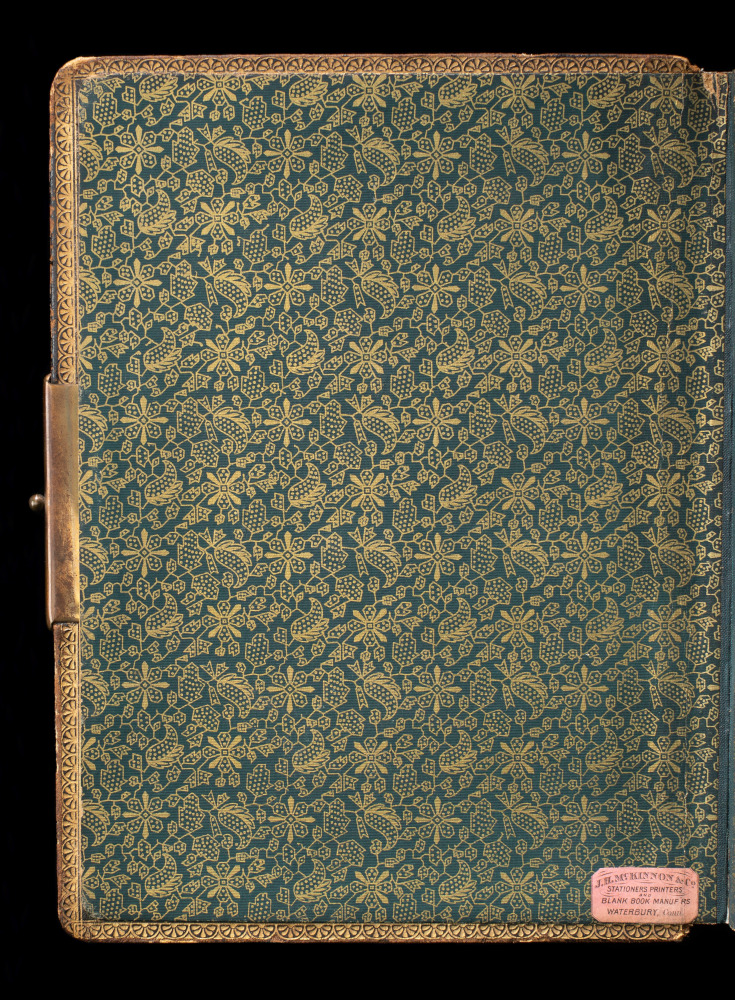
Object Name: Photograph album of Allston family and other portraits
Compiled by: Compiler once known
Manufactured by: Edward Posen & Co., active 1880s–90s
Distributed by: J. H. McKinnon & Co., American, active 1884–91
Located in: Waterbury, New Haven County, Connecticut
Date: 1880s–1910
Medium: Paper and linen with leather or leatherlike material, batting, and metal
Description: A photograph album containing thirty portraits and one memorial card, dating from the 1880s to the early 20th century. The album has a padded linen cover partially bound in a dark brown, textured, leather or leatherlike material. The album pages have gilt edges. The interiors of the covers and facing pages are lined with endpapers with a stylized emerald-green-and-gilt floral motif. A pink paper label adhered to the lower right corner of the interior of the front cover reads “J. H. McKINNON & Co. / STATIONERS PRINTERS / AND / BLANK BOOK MANUF’RS / WATERBURY, Conn.” The title page has a gilt floral design around an arched white window that contains gilt flowers. A banner with the word “ALBUM” in gilt letters runs across the upper portion of the window. Overlapping the bottom of the window is an emblem with a lion holding a shield containing text reading “E P & Co.” Following the title page are pages with windows for cabinet cards, which slide into place through a slit below the window. The album closes with a metal clasp on the right side.
Dimensions: 10 1/2 × 8 × 3 in. (26.7 × 20.3 × 7.6 cm)
Collection Title: Photograph album of Allston family and other portraits
Credit Line: Smithsonian National Museum of African American History and Culture, Gift of the Family of Keith M. Jones in honor of Lonnie Bunch
Accession number: 2009.31
Edward Posen & Co. (manufacturer) and J. H. McKinnon & Co. (distributor), Inside back cover, before 1892. From a photograph album of Allston family and other portraits, 1880s–1910. Paper and linen with leather or leatherlike material, batting, and metal. 2009.31.
Like the inside front cover and facing page, the inside back cover and facing page have endpapers in an abstract, gold floral design printed on a blue-green field (fig. 1). Endpapers are glued to the inside covers; here the endpapers are also attached to the thick, facing page. Adding elegance and interest to the beginning and end of the album, endpapers also serve utilitarian purposes, helping to protect the book block and attaching it to the cover. The edges of the inside front and back covers are reinforced with a decorative binding that overlaps the endpapers. The endpapers on the facing pages lack this reinforcement and have suffered some losses, but overall, the decorative endpapers are in relatively good condition, which speaks to their quality.
Object Name: Photograph album of Allston family and other portraits
Compiled by: Compiler once known
Manufactured by: Edward Posen & Co., active 1880s–90s
Distributed by: J. H. McKinnon & Co., American, active 1884–91
Located in: Waterbury, New Haven County, Connecticut
Date: 1880s–1910
Medium: Paper and linen with leather or leatherlike material, batting, and metal
Description: A photograph album containing thirty portraits and one memorial card, dating from the 1880s to the early 20th century. The album has a padded linen cover partially bound in a dark brown, textured, leather or leatherlike material. The album pages have gilt edges. The interiors of the covers and facing pages are lined with endpapers with a stylized emerald-green-and-gilt floral motif. A pink paper label adhered to the lower right corner of the interior of the front cover reads “J. H. McKINNON & Co. / STATIONERS PRINTERS / AND / BLANK BOOK MANUF’RS / WATERBURY, Conn.” The title page has a gilt floral design around an arched white window that contains gilt flowers. A banner with the word “ALBUM” in gilt letters runs across the upper portion of the window. Overlapping the bottom of the window is an emblem with a lion holding a shield containing text reading “E P & Co.” Following the title page are pages with windows for cabinet cards, which slide into place through a slit below the window. The album closes with a metal clasp on the right side.
Dimensions: 10 1/2 × 8 × 3 in. (26.7 × 20.3 × 7.6 cm)
Collection Title: Photograph album of Allston family and other portraits
Credit Line: Smithsonian National Museum of African American History and Culture, Gift of the Family of Keith M. Jones in honor of Lonnie Bunch
Accession number: 2009.31
Edward Posen & Co. (manufacturer) and J. H. McKinnon & Co. (distributor), Back cover, before 1892. From a photograph album of Allston family and other portraits,1880s–1910. Paper and linen with leather or leatherlike material, batting, and metal. 2009.31.
This photograph album is dated 1880s–1910 in order to include the dates of the album and its contents, but the album itself cannot be dated later than 1891: J. H. McKinnon & Co. in Waterbury, which sold the album, closed by 1892.[1] When the album arrived at the museum in 2009, its front and back covers were badly damaged, but some of the covering of leather or a leatherlike material survived on the back cover. Museum staff and the conservator who treated the album agreed to consolidate the loose pieces on the back cover but opted not to replace the missing areas of the covering. Replacing the missing areas of the covering or substituting a new covering overall would have made the album look more like it did when it was new, but this would have obscured historical evidence that the album had been heavily used. Photograph albums were displayed in people’s homes with the intention of making the contents accessible; the signs of wear in this album indicate that many people handled and paged through it. The covers were damaged but they protected what was more valued: the photographs and ephemera stored inside.
Notes
[1] For more information about conservation of the album, see Mirasol Estrada, “The Conservation of the Photograph Album of Allston Family and Other Portraits: Considerations, Collaboration, Treatment, and Impact,” in the Conservation component of this project.